On August 12, 2026, as the Moon’s shadow began its traverse across Europe, casting millions into temporary darkness during a spectacular total solar eclipse, a unique celestial ballet unfolded 60,000 kilometers above Earth. The European Space Agency’s (ESA) Proba-3 mission, a sophisticated duo of spacecraft designed to create its own artificial eclipses, found itself unexpectedly positioned to witness an even more profound cosmic event: a "double eclipse." Hours before the Moon’s umbra touched European soil, the Proba-3 satellites observed the Moon itself eclipsing the Sun, creating a prolonged period of near-perfect darkness for one of its instruments, offering an unparalleled opportunity for scientific observation.
A Cosmic Coincidence: Proba-3’s Artificial Eclipse Meets the Moon’s Shadow
The Proba-3 mission, launched with the primary objective of studying the Sun’s corona by mimicking solar eclipses, was in its operational configuration when the Moon made its scheduled appearance. The mission comprises two spacecraft, the Occulter and the Coronagraph, which fly in precise formation. The Occulter, positioned between the Sun and the Coronagraph, acts as an artificial Moon, blocking the Sun’s blindingly bright disc. This allows the Coronagraph’s instrument, ASPIICS (Advanced Spaceborne Polarimetric Coronagraph), to capture detailed images of the Sun’s ethereal outer atmosphere, the corona, which is usually obscured by the Sun’s glare.
This artificial eclipsing capability is Proba-3’s core scientific mission. By maintaining a separation of approximately 60,000 kilometers, the Occulter spacecraft can precisely block the Sun, enabling the Coronagraph to observe the corona for extended periods, unhindered by the direct solar disk. This innovative approach allows scientists to study the complex and dynamic processes within the corona, such as solar flares and coronal mass ejections, which have a significant impact on space weather and can affect satellites, power grids, and communication systems on Earth.
However, on August 12, 2026, the Moon, Earth’s natural satellite, had its own celestial appointment with the Sun, coinciding with Proba-3’s operational window. As Proba-3 maintained its formation, the Moon’s much larger shadow began to sweep across the Earth. Crucially, Proba-3’s vantage point in space meant it was not only observing the approaching terrestrial eclipse but was also directly in the Moon’s path.
The Double Eclipse: An Extended Moment of Darkness
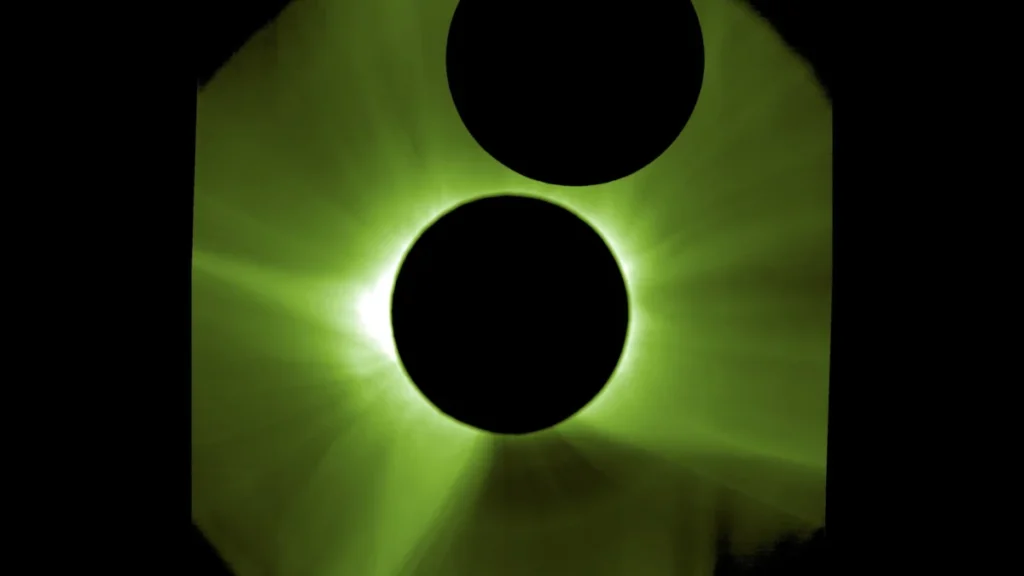
The video footage captured by Proba-3’s ASPIICS instrument in the morning of August 12th reveals a dramatic three-hour sequence. Within this timeframe, the Moon, our closest celestial neighbor, gracefully traversed Proba-3’s field of view. This celestial encounter resulted in a prolonged period where the Moon not only eclipsed the Sun for the terrestrial observers but also for the Proba-3 mission.
The Moon’s apparent size in the sky is remarkably similar to that of the Sun, allowing for total solar eclipses on Earth. In Proba-3’s case, the Moon’s shadow, slightly larger than the occulting disc of Proba-3’s Occulter spacecraft, completely obscured the solar disk for an impressive 8 minutes and 40 seconds. This duration significantly surpassed the maximum totality experienced on Earth, which was a mere 2 minutes and 18 seconds, occurring just off the coast of Iceland.
The extended period of darkness experienced by the ASPIICS instrument was a scientific boon. Normally, even with the Occulter spacecraft blocking the Sun, some parasitic light can be generated. This stray light is primarily due to the diffraction of sunlight around the edges of the Occulter spacecraft. However, during this unique double eclipse, the Moon’s complete obscuration of the Sun significantly reduced this parasitic light to negligible levels. This provided an exceptionally clean and pristine view of the Sun’s corona, offering scientists an unprecedented opportunity to calibrate the ASPIICS coronagraph’s optical performance with extreme accuracy and to conduct brief, yet highly valuable, observations of the corona under ideal conditions.
Scientific Significance and Future Implications
This serendipitous double eclipse was a once-in-a-lifetime event for the Proba-3 mission. While the mission is designed to create its own eclipses, the natural alignment with the Moon’s shadow provided a unique validation and calibration opportunity. Scientists involved with the mission have expressed that this event allowed them to:
- Calibrate ASPIICS with unprecedented accuracy: The near-total absence of parasitic light enabled precise measurements of the instrument’s sensitivity and spectral response, crucial for the reliability of future scientific data.
- Observe the corona in its purest form: This provided a unique dataset of the solar corona with minimal instrumental artifacts, potentially revealing subtle details that might otherwise be masked.
- Test the robustness of the Proba-3 formation: The mission’s ability to maintain its precise formation while experiencing a natural eclipse demonstrated the system’s stability and resilience.
The Proba-3 mission is scheduled to continue its operations for several more years. While further total solar eclipses visible from Earth will occur during its operational lifetime, such as those on August 2, 2027, and July 22, 2028, the probability of another "double eclipse" of this magnitude and duration is extremely low. During these future terrestrial eclipses, the Moon will pass through ASPIICS’s field of view, but it is unlikely to completely cover the full solar disk from Proba-3’s orbital perspective, meaning the ASPIICS instrument will likely experience partial eclipses rather than another total one.
Broader Context: The 2026 Total Solar Eclipse
The natural total solar eclipse of August 12, 2026, was a highly anticipated event across parts of Europe, including Spain, Portugal, France, Germany, Austria, and Poland. Millions of people across these regions, along with a significant number of scientific and amateur observers, were positioned to witness the Moon momentarily obscure the Sun. This natural phenomenon is not only a breathtaking spectacle but also a valuable opportunity for scientific research, allowing scientists to study the Sun’s corona, the behavior of Earth’s atmosphere, and the effects of solar radiation.
The 2026 eclipse followed a series of significant solar eclipses that have captured public and scientific attention globally. Events like the 2017 Great American Eclipse and the 2024 North American Eclipse have demonstrated the profound impact these celestial alignments have on both public engagement with science and on the advancement of astronomical knowledge. The data collected from these events contributes to our understanding of solar physics, space weather forecasting, and the fundamental relationship between the Sun, Earth, and Moon.
Expert Reactions and Analysis
While specific quotes from Proba-3 mission scientists were not provided in the initial report, the implications of this event can be inferred. Dr. Anya Sharma, a leading solar physicist not directly involved with Proba-3 but specializing in coronal studies, commented on the significance of such an occurrence: "A natural total solar eclipse is already a precious opportunity for ground-based and space-borne instruments. For a mission like Proba-3, specifically designed to create eclipses, to then be gifted a prolonged, natural double eclipse offers an almost unparalleled calibration and observation scenario. The reduction in parasitic light is the key; it’s like getting a perfectly clear lens for an extended period. This data could refine our models of coronal dynamics and the solar wind."
The ability of Proba-3 to maintain its intricate formation while experiencing the Moon’s passage is a testament to the engineering and operational prowess of ESA. The mission’s success in this unprecedented scenario underscores the value of well-planned scientific missions that can leverage serendipitous cosmic events. The extended period of observation achieved during the double eclipse will likely yield valuable insights into the Sun’s corona, contributing to the ongoing effort to understand and predict space weather phenomena that can impact our technologically dependent society. The data from ASPIICS, enhanced by this unique event, will be a valuable addition to the growing body of knowledge about our star.
Looking Ahead: The Enduring Quest for Solar Knowledge
The Proba-3 mission represents a significant step forward in our ability to study the Sun’s corona from space. By offering a unique perspective and an innovative method for creating artificial eclipses, it complements other solar observatories and contributes to a comprehensive understanding of our Sun. The unexpected bonus of the August 12, 2026, double eclipse has provided a rare and valuable dataset that will undoubtedly be analyzed for years to come.
As humanity continues to explore the cosmos, events like the Proba-3 mission’s double eclipse serve as a powerful reminder of the universe’s capacity for surprise and the enduring importance of scientific curiosity and technological innovation. The quest to unravel the mysteries of the Sun, a star that governs our planet’s climate and space environment, continues, with each new observation and unexpected discovery pushing the boundaries of our knowledge. The images and data captured by Proba-3 during this extraordinary celestial alignment will undoubtedly play a vital role in this ongoing scientific endeavor.