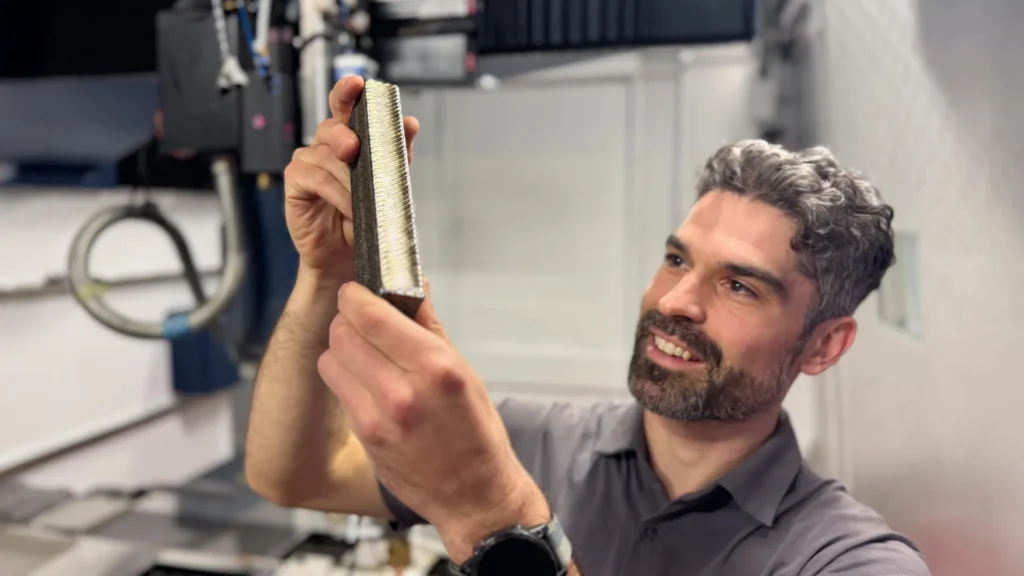
Engineers at RMIT University in Melbourne, Australia, have unveiled a groundbreaking new 3D-printable titanium alloy that promises to significantly disrupt the aerospace and medical device industries. This innovative material, developed by researchers at RMIT’s Centre for Additive Manufacturing (RCAM), is approximately one-third cheaper to produce than conventional titanium alloys, primarily by substituting the increasingly expensive element vanadium with more accessible alternatives. The breakthrough not only addresses a critical cost barrier in additive manufacturing but also boasts superior mechanical properties, offering a compelling leap forward for industries reliant on high-performance metallic components.
A Paradigm Shift in Titanium Alloy Development
The core of this innovation lies in a novel approach to alloy design and production. For decades, the aerospace and medical sectors have relied heavily on established titanium alloys, with Ti-6Al-4V (titanium, aluminum, vanadium) being a ubiquitous standard for 3D printing applications. However, the rising cost and supply chain volatility of vanadium have prompted a search for alternatives. The RMIT team’s success in developing a viable, cost-effective replacement marks a significant milestone.
"3D printing allows faster, less wasteful and more tailorable production yet we’re still relying on legacy alloys like Ti-6Al-4V that doesn’t allow full capitalisation of this potential," explained Ryan Brooke, a PhD candidate at RCAM and the lead author of the study. "It’s like we’ve created an aeroplane and are still just driving it around the streets." Brooke’s analogy vividly captures the untapped potential of additive manufacturing that has been constrained by the limitations of existing material formulations.
The researchers have meticulously detailed their innovative method in a study published in the prestigious journal Nature Communications. This publication not only validates their scientific findings but also provides a clear roadmap for the design and prediction of metallic alloy microstructures in additive manufacturing processes. RMIT has proactively filed a provisional patent to protect its intellectual property, signaling a strong intent to commercialize this transformative technology.
Unlocking the Potential of 3D Printing with Cost-Effective Materials
The economic advantage of the new alloy is substantial. While the exact composition remains proprietary for commercial reasons, the team has confirmed that their alloy is 29% cheaper to produce than standard titanium. This cost reduction is achieved by strategically replacing vanadium with more readily available and less expensive elements. This move is particularly timely given the global fluctuations in raw material prices, making the development a strategic imperative for industries seeking cost predictability and stability.
Beyond cost, the performance metrics of the new alloy are equally impressive. Testing has revealed that it exhibits improved strength and ductility compared to its conventional counterparts. This enhanced performance is crucial for applications where components are subjected to extreme stresses and demanding operational environments, such as in aircraft engines, structural components, and advanced prosthetics.
A key technical achievement of the RMIT team’s work is the elimination of the undesirable columnar microstructure that often plagues 3D-printed titanium. This specific microstructure, characterized by elongated, column-shaped grains, can lead to uneven mechanical properties, creating weak points and compromising the overall integrity of printed parts. The RMIT alloy, through its unique composition and the predictive framework developed by the researchers, prints more evenly, resulting in a uniform grain structure.
"By developing a more cost-effective formula that avoids this columnar microstructure, we have solved two key challenges preventing widespread adoption of 3D printing," stated Brooke. This addresses a critical hurdle that has limited the scalability and reliability of 3D-printed metal components for high-stakes applications.
A Rigorous Development and Validation Process
The journey to this breakthrough has been marked by diligent research and strategic validation. The RMIT team’s study outlines a time- and cost-saving method for selecting elements for alloying, specifically designed to leverage the capabilities of emerging 3D-printing technologies. This systematic approach ensures that the alloy composition is not only cost-effective but also optimized for the additive manufacturing process itself.
The research was conducted at RMIT’s state-of-the-art Advanced Manufacturing Precinct, a facility equipped with cutting-edge machinery and staffed by leading experts in additive manufacturing. The precinct provided the necessary infrastructure for producing and rigorously testing the newly developed alloy samples.
Brooke has recently taken a significant step toward commercialization by accepting a Research Translation Fellowship at RMIT. This fellowship will enable him to focus on the next stages of bringing the technology to market. His recent participation in CSIRO’s ON Prime program, a national innovation initiative, involved extensive market validation. During this program, Brooke engaged with representatives from the aerospace, automotive, and MedTech industries, gathering crucial insights into their specific needs and the requirements for adopting new materials.
"What I heard loud and clear from end users was that to bring new alloys to market, the benefits have to not just be minor incremental steps but a full leap forward, and that’s what we have achieved here," Brooke emphasized. This market-driven approach ensures that the innovation directly addresses industry demands and offers a compelling value proposition.
Future Prospects and Industry Collaboration
The implications of this development are far-reaching. For the aerospace industry, the prospect of significantly cheaper, lighter, and stronger 3D-printed titanium components could revolutionize aircraft design and manufacturing. It could enable the production of more complex geometries, reduce part counts, and lead to more fuel-efficient aircraft. Similarly, in the medical field, the improved biocompatibility and enhanced mechanical properties of the new alloy could pave the way for more sophisticated and personalized implants, prosthetics, and surgical instruments.
Professor Mark Easton, the corresponding author of the study and a key figure at RCAM, expressed considerable optimism about the future of this new alloy. "We are very excited about the prospects of this new alloy, but it requires a team from across the supply chain to make it successful," he stated. Professor Easton highlighted the university’s commitment to fostering collaborations to further develop and refine the technology.
RCAM is actively seeking partners from across the entire supply chain – from material suppliers and additive manufacturing equipment providers to end-users in the aerospace and medical sectors. This collaborative approach is essential for guiding the next stages of development, including scaling up production, rigorous certification processes, and market integration. The goal is to ensure that the new alloy can be seamlessly adopted into existing manufacturing workflows and meet the stringent regulatory requirements of these critical industries.
The framework for designing new alloys outlined in the Nature Communications paper is a significant contribution in itself. It provides a clear and predictable methodology for future material scientists and engineers to develop next-generation metallic alloys for additive manufacturing. This democratizes the innovation process, allowing for faster iteration and the creation of a wider range of advanced materials tailored to specific applications.
The RMIT team’s achievement represents a critical inflection point in the evolution of additive manufacturing. By tackling both the cost and performance limitations of existing titanium alloys, they have not only created a superior material but also provided a blueprint for future innovation in the field. The successful commercialization of this technology is expected to accelerate the adoption of 3D printing across key industrial sectors, driving advancements in efficiency, sustainability, and product performance. The journey from laboratory breakthrough to widespread industrial application is complex, but with the patent filed and a clear vision for collaboration, the future of this revolutionary titanium alloy appears exceptionally bright.