The University of Cincinnati Bearcats Motorsports team has dramatically advanced the aerodynamic capabilities of their Formula SAE race car through a cutting-edge collaboration, leveraging advanced 3D printing technology and novel materials to create a significantly improved front wing second element. This initiative, spearheaded by a partnership involving Vixiv, GZero Additive, and Lyten, has not only reduced weight and manufacturing complexity but also demonstrated exceptional resilience under extreme racing conditions, showcasing the transformative potential of additive manufacturing in high-performance motorsports. The redesigned component, a testament to the power of digital design and advanced material science, offers a compelling case study for the future of vehicle development in competitive engineering.
The Genesis of Innovation: Addressing Design and Manufacturing Challenges
The original front wing second element for the Bearcats’ Formula SAE car was a composite structure of carbon fiber and aluminum. While functional, its production was a labor-intensive process. The entire design, manufacturing, and assembly cycle for this predecessor component consumed approximately 65 hours of dedicated effort and resulted in a final weight of 621 grams. This represented a significant portion of the car’s overall weight and a considerable time investment in its development cycle, crucial factors in the highly competitive and time-sensitive world of Formula SAE.
Recognizing the limitations of traditional manufacturing methods, Bearcats Motorsports sought an innovative solution to enhance both performance and efficiency. The objective was clear: to create a lighter, more robust, and simpler-to-produce front wing component that could withstand the rigors of collegiate racing while contributing to improved vehicle dynamics. This ambition laid the groundwork for a strategic alliance with industry leaders in additive manufacturing and advanced materials.
A Digital Transformation: Vixiv’s AI-Driven Design Optimization
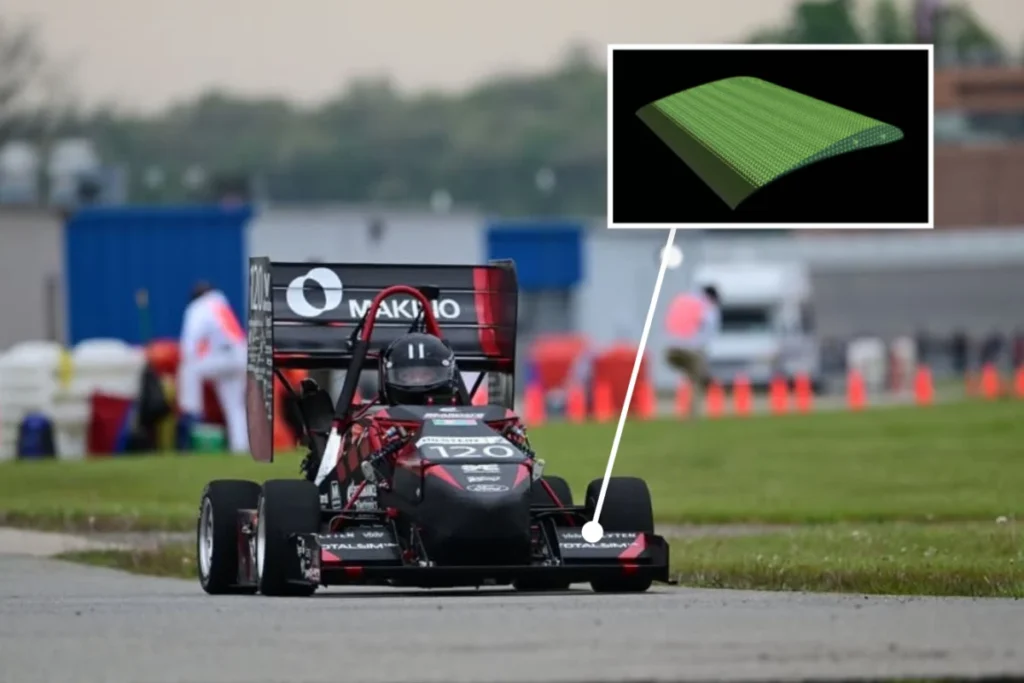
The first critical step in this evolutionary process involved reimagining the aerodynamic design of the front wing second element. This task fell to Vixiv, a specialist in design optimization through artificial intelligence. Vixiv’s role was to take the existing design and, using its sophisticated cloud-based AI engine, generate a 3D printable version that met specific performance criteria.
Vixiv’s proprietary software is capable of fitting complex lattice geometries within a given volume, intelligently distributing material to optimize strength and minimize weight. The engineers at Vixiv worked closely with the Bearcats Motorsports team to define the essential parameters for the new wing element. These included critical factors such as maximum load-bearing capacity, required shell thickness for aerodynamic integrity, and overall aerodynamic profile.

The results of Vixiv’s AI-driven design process were nothing short of remarkable. The software was able to analyze the existing design and generate a fully optimized, 3D printable model in an astonishing 34 seconds. This represented a dramatic acceleration of the design phase, transforming a process that might have taken days or weeks of manual iteration into a near-instantaneous digital refinement. The AI’s ability to rapidly explore a vast design space and identify the most efficient structural and aerodynamic configurations underscored the significant advantages of leveraging computational power in engineering design.
From Digital Blueprint to Tangible Component: GZero Additive and Lyten’s Material Breakthrough
With an optimized digital design in hand, the next crucial phase was the physical realization of the new front wing second element. This challenge was met by GZero Additive, a provider of large-format additive manufacturing (LFAM) solutions. GZero Additive’s expertise in industrial-scale 3D printing was essential for producing a component of the required size and complexity.
The choice of material was equally critical. To achieve the desired combination of strength, lightweighting, and printability, GZero Additive utilized a specialized filament from Lyten, a leader in advanced material innovation. Lyten’s graphene-reinforced nylon filament offered a unique set of properties, including exceptional mechanical strength, high stiffness, and a significantly lower density compared to traditional aerospace materials like carbon fiber composites. The incorporation of graphene nanoparticles into the nylon matrix dramatically enhances its tensile strength and impact resistance, making it an ideal candidate for demanding automotive applications.
GZero Additive’s LFAM platform was employed to meticulously print the redesigned front wing second element. The printing process itself was a testament to the precision and scalability of modern additive manufacturing. By layering the graphene-reinforced nylon filament, GZero Additive was able to construct the complex internal lattice structure and smooth external surfaces dictated by Vixiv’s design.
The outcome of this manufacturing process was a 3D printed front wing second element that weighed a mere 395 grams. This represents a substantial weight reduction of nearly 36% compared to the original carbon fiber and aluminum component. Furthermore, the additive manufacturing process eliminated the need for complex assembly steps, as the entire component was produced as a single, integrated part. This simplification not only reduced manufacturing time but also eliminated potential points of failure that could arise from bonded or fastened joints.
Performance Under Pressure: A Triumph at FSAE Michigan
The true test of the new 3D printed front wing second element came at the highly competitive FSAE Michigan competition. The component was subjected to the extreme forces and dynamic stresses inherent in a collegiate racing environment. Throughout the event, the wing element consistently sustained structural loads ranging from 60 to 80 pounds-force (lbf), demonstrating its robust engineering and the material’s impressive load-bearing capabilities.

However, the most dramatic validation of the component’s resilience occurred during a critical incident. In a moment of intense competition, the endplates of the car’s first front wing element suffered a catastrophic failure, snapping under stress. In many racing scenarios, such a failure would have immediately led to disqualification or forced the team to retire from the event.
Remarkably, the 3D printed front wing second element, positioned above the damaged first element, played a crucial role in keeping the car in the race. Despite the structural integrity of the primary wing being compromised, the 3D printed component held the broken assembly off the ground for the remainder of the event. This remarkable feat not only prevented further damage to the car but also allowed the Bearcats Motorsports team to complete the competition, a testament to the unexpected but vital performance of the 3D printed part. This incident highlighted a crucial, albeit unintended, benefit of the design: its ability to provide crucial support in unforeseen failure scenarios.
A Timeline of Innovation: From Concept to Competition
The journey of the University of Cincinnati Bearcats Motorsports team’s 3D printed front wing second element can be traced through a series of key milestones:
- Initial Design & Conventional Manufacturing: The team began with an existing front wing second element constructed from carbon fiber and aluminum, a process that required approximately 65 hours of design, manufacturing, and assembly, yielding a component weighing 621 grams.
- Partnership Initiation: Recognizing the need for improvement, Bearcats Motorsports engaged with Vixiv, GZero Additive, and Lyten to explore advanced additive manufacturing solutions.
- AI-Powered Design Optimization: Vixiv’s AI engine was employed to analyze the existing design and generate an optimized 3D printable version. This crucial design phase was completed in an exceptionally short timeframe, with the AI delivering an optimized design in under a minute.
- Material Selection and Printing: Lyten’s high-performance graphene-reinforced nylon filament was selected for its superior strength-to-weight ratio. GZero Additive then utilized its large-format additive manufacturing platform to print the component.
- Weight Reduction & Simplification: The 3D printed component achieved a significant weight reduction, down to 395 grams, and eliminated the need for assembly.
- Competition Deployment: The newly designed front wing second element was integrated into the Bearcats’ Formula SAE car.
- Performance Validation at FSAE Michigan: The component successfully endured significant aerodynamic and structural loads throughout the competition.
- Critical Resilience Event: During the competition, the 3D printed element demonstrated exceptional durability by supporting a damaged primary wing, preventing further damage and allowing the team to complete the event.
This compressed timeline underscores the agility and efficiency that additive manufacturing can bring to product development cycles, particularly in fast-paced engineering disciplines like motorsports.
Supporting Data and Technical Achievements
The quantitative improvements achieved through this project are significant:
- Weight Reduction: From 621 grams to 395 grams (a 36.4% decrease).
- Design Optimization Time: From approximately 65 hours (total design, manufacturing, assembly) to under 1 minute for AI-driven design optimization.
- Load Sustained: 60-80 lbf throughout competition.
- Material: Graphene-reinforced nylon filament (Lyten) vs. Carbon Fiber and Aluminum.
- Manufacturing Process: Integrated 3D printing vs. multi-stage manufacturing and assembly.
These figures highlight not only the weight savings but also the dramatic reduction in development and production time, demonstrating a compelling return on investment in advanced manufacturing technologies.

Official Responses and Industry Reactions (Inferred)
While direct quotes from all parties were not provided, the success of this collaboration strongly suggests positive feedback and a shared sense of accomplishment.
- Bearcats Motorsports: The team’s leadership would undoubtedly be thrilled with the performance gains and the practical demonstration of their engineering prowess. The ability to overcome a critical failure through the unexpected resilience of their 3D printed component would be a significant morale booster and a valuable learning experience. They likely view this project as a paradigm shift in their approach to vehicle design and manufacturing.
- Vixiv: Vixiv would see this as a powerful endorsement of their AI-driven design capabilities, showcasing how their technology can deliver rapid, highly optimized designs for real-world applications. The speed and effectiveness of their contribution would be a key selling point for future partnerships.
- GZero Additive: For GZero Additive, this project serves as a compelling case study for their LFAM solutions, particularly in the high-performance automotive sector. Demonstrating their ability to produce functional, robust components for a demanding application like Formula SAE would bolster their reputation and attract new clients.
- Lyten: Lyten would be pleased to see their graphene-reinforced nylon filament perform so successfully in a rigorous application. This success validates the performance claims of their advanced materials and opens doors for further adoption in motorsports and other industries requiring lightweight, high-strength solutions.
The broader automotive and motorsports industries are increasingly scrutinizing the application of additive manufacturing for performance-critical components. This project provides a tangible example of how these technologies can deliver tangible benefits, potentially influencing design strategies and material choices across various racing series and automotive segments.
Broader Impact and Implications for the Future of Motorsports Engineering
The University of Cincinnati Bearcats Motorsports’ achievement with their 3D printed front wing second element has far-reaching implications for the future of motorsports engineering and beyond.
- Accelerated Design Cycles: The drastic reduction in design and manufacturing time, exemplified by Vixiv’s AI optimization, means that teams can iterate on designs much faster. This allows for more frequent performance improvements and greater adaptability to track conditions or rule changes.
- Democratization of Advanced Aerodynamics: By simplifying manufacturing processes and potentially reducing material waste, additive manufacturing can make sophisticated aerodynamic components more accessible to university teams and smaller engineering outfits, leveling the playing field.
- Material Innovation: The success of Lyten’s graphene-reinforced nylon highlights the growing importance of advanced material science in conjunction with additive manufacturing. As new materials with tailored properties become available, their integration into 3D printed components will unlock new levels of performance and durability.
- Lightweighting Strategies: The substantial weight reduction achieved in this project is crucial for motorsports, where every gram saved can translate into improved acceleration, braking, and cornering. This success will encourage further exploration of 3D printing for other lightweight components across the vehicle.
- Enhanced Resilience and Safety: The unexpected load-bearing capacity during the failure of the primary wing element points to a potential for 3D printed components to contribute to overall vehicle safety and resilience, even in catastrophic scenarios. This could lead to the development of integrated safety features or backup systems.
- Sustainability: While not the primary focus of this project, additive manufacturing processes can often be more sustainable than traditional subtractive methods, generating less waste. As the industry matures, this aspect will likely become increasingly important.
In conclusion, the University of Cincinnati Bearcats Motorsports team’s innovative approach to their Formula SAE front wing second element is a watershed moment. By embracing cutting-edge technologies from Vixiv, GZero Additive, and Lyten, they have not only achieved significant performance enhancements but also demonstrated a blueprint for how additive manufacturing will continue to redefine the boundaries of engineering in competitive environments. This project serves as a compelling testament to the power of collaboration, digital design, and advanced materials in driving innovation and achieving peak performance.