In a landmark achievement for the field of high-energy physics, researchers at the University of Copenhagen, in collaboration with the international ALICE experiment at CERN, have successfully recreated the primordial state of matter that dominated the universe in the immediate aftermath of the Big Bang. By utilizing collisions between atomic nuclei significantly smaller than previously thought capable of such a feat, the team has opened a new window into the first millionth of a second of cosmic history. This breakthrough, recently published in the journal Physical Review Letters, suggests that the "Little Big Bangs" produced in particle accelerators do not require the massive weight of lead ions to manifest, but can instead be generated using lighter elements like oxygen and neon.
For decades, the prevailing scientific consensus held that the creation of quark-gluon plasma—a near-frictionless, ultra-hot liquid state of matter—required the immense energy density generated by colliding heavy nuclei. However, the new findings from the Niels Bohr Institute demonstrate that the fundamental conditions for this transition are more accessible than once believed. By smashing oxygen-16 and neon-20 nuclei at nearly the speed of light, physicists have proven that even these smaller systems can momentarily melt into the subatomic "soup" that eventually cooled to form the protons, neutrons, and atoms that constitute the modern universe.
The Nature of the Primordial Soup: Understanding Quark-Gluon Plasma
To appreciate the magnitude of this discovery, one must look back approximately 13.8 billion years. In the first microsecond following the Big Bang, the universe was far too energetic for matter as we know it to exist. Temperatures exceeded several trillion degrees Celsius, a state so extreme that protons and neutrons could not maintain their integrity. Instead, their constituent parts—quarks and the gluons that bind them—roamed freely in a substance known as quark-gluon plasma (QGP).
As the universe expanded and cooled, this plasma underwent a phase transition, with quarks becoming "confined" into the composite particles that form the building blocks of atomic nuclei. By recreating this plasma at the Large Hadron Collider (LHC) in Switzerland, scientists are effectively performing "cosmic archaeology," allowing them to study the fluid dynamics of the infant universe in a controlled laboratory setting. The researchers at the Niels Bohr Institute have been instrumental in analyzing how this plasma behaves as a "perfect liquid," a substance with nearly zero viscosity that flows with unprecedented efficiency.
Chronology of a Breakthrough: From Heavy Lead to Light Oxygen
The journey toward this discovery began with the inception of the ALICE (A Large Ion Collider Experiment) detector at CERN, which was specifically designed to study the physics of matter at extreme energy densities. For years, the standard procedure involved colliding lead ions (containing 208 protons and neutrons) because their large size ensured a high volume of interaction, making the creation of QGP a virtual certainty.
However, over the last decade, hints began to emerge that smaller systems might also exhibit "collective behavior," a hallmark of plasma formation. In 2017 and 2018, preliminary data from proton-proton and proton-lead collisions suggested that even these tiny interactions could produce signatures similar to those seen in heavy-ion collisions. This sparked a debate in the physics community: were these signals truly indicative of quark-gluon plasma, or were they a different phenomenon altogether?
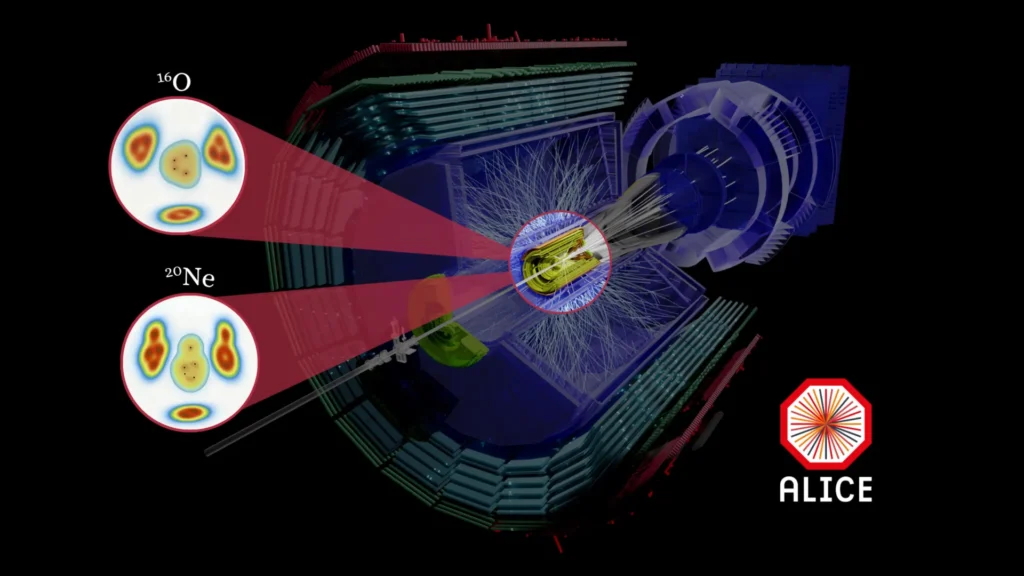
To resolve this, the University of Copenhagen team, led by Associate Professor You Zhou, turned to intermediate-sized nuclei. In the most recent experimental runs, the researchers utilized oxygen-16 (8 protons, 8 neutrons) and neon-20 (10 protons, 10 neutrons). The results were definitive. Even at these smaller scales, the characteristic flow patterns of QGP were observed, pushing the boundaries of nuclear physics and redefining the minimum requirements for the "Little Big Bang."
The Bowling Pin Signature: Geometry and Particle Flow
One of the most striking aspects of the new research is the discovery that the movement patterns of particles emerging from these collisions are a direct reflection of the initial shape of the colliding nuclei. This is what researchers have termed the "bowling pin" signature.
When two spherical oxygen nuclei collide, the resulting explosion of particles follows a relatively symmetrical, rounded distribution. However, neon-20 nuclei are not perfectly spherical; they possess an elongated, somewhat prolate shape, reminiscent of a bowling pin. When these elongated nuclei collide, the quark-gluon plasma droplet they form inherits this eccentric geometry.
Because the plasma is a fluid, it expands more rapidly in certain directions based on the pressure gradients created by its initial shape. As the droplet cools and transitions back into ordinary particles, those particles fly out in a pattern that preserves the "memory" of the collision’s geometry. Postdoctoral researcher Emil Gorm Dahlbæk Nielsen likened this process to a shadow: while the nuclei themselves are too small and the collision too fast to be seen directly, the resulting particle "shadow" reveals the precise structural details of the nuclei involved.
Probing the Strong Force and Nuclear Structure
The implications of this research extend far beyond cosmology. By using high-energy collisions to map the shapes of nuclei, the team is providing a new tool for nuclear physics—a field that has been a cornerstone of the Niels Bohr Institute for over half a century. Aage Bohr, the son of Niels Bohr, was awarded the Nobel Prize in Physics in 1975 for his work on the non-spherical geometry of atomic nuclei, and this new study represents a modern evolution of that legacy.
Traditionally, nuclear structure is studied using low-energy experiments, such as measuring how a nucleus vibrates or rotates when hit by a low-energy probe. While effective, these methods have limits. The "Little Big Bang" approach turns this strategy on its head. By smashing nuclei together at the highest possible energies, researchers can deduce the arrangement of protons and neutrons from the "imprint" left in the particle flow.
This is particularly relevant for understanding the strong force, one of the four fundamental forces of nature. The strong force is responsible for holding the nucleus together, overcoming the electromagnetic repulsion between positively charged protons. However, the exact way the strong force dictates the arrangement and shape of nucleons in heavier or oddly shaped elements remains a subject of intense study. The ability to "image" these shapes through high-energy plasma flow provides a new data set to refine the mathematical models of the Standard Model of particle physics.
Supporting Data and Technical Specifications
The data supporting these findings was collected using the ALICE detector’s sophisticated array of sensors, which can track thousands of particles simultaneously with sub-millimeter precision. The collisions occurred at a center-of-mass energy per nucleon pair in the range of several Tera-electron volts (TeV).
Key metrics from the study include:
- Particle Multiplicity: The researchers measured the number of charged particles produced in each collision, finding that even in oxygen-oxygen collisions, the density was sufficient to allow for the collective fluid-like behavior characteristic of QGP.
- Elliptic and Triangular Flow: Using mathematical coefficients known as $v_2$ and $v_3$, the team quantified the anisotropy of the particle distribution. The neon-20 collisions showed a significantly higher degree of elliptic flow compared to oxygen, directly correlating with the "bowling pin" deformation of the neon nucleus.
- Transition Temperature: The experiments confirmed that the energy density reached in these "small" collisions exceeded the critical threshold of approximately 150-160 MeV (mega-electron volts), the temperature at which ordinary matter "melts" into quarks and gluons.
Official Responses and the Future of the Paradigm Shift
Associate Professor You Zhou, who has recently transitioned from the Niels Bohr Institute to a new role, emphasized the importance of these findings for the future of the field. "We have pushed the boundary for how small the atomic nuclei can be while still recreating this primordial matter," Zhou stated. "We now know more about the fundamental conditions required for matter to transition into this extreme state."
The international community has reacted with significant interest, as the findings suggest that the LHC could be used as a high-precision microscope for nuclear geometry. The team is already planning the next phase of research, which involves testing even smaller systems, such as helium-4. Helium is a particularly interesting candidate because it is incredibly stable and "tightly packed," and discovering whether it can produce QGP would define the absolute lower limit of the "Little Big Bang."
"What is fascinating is that we can use the same experiment both to learn about the structure of atomic nuclei and to gain a better understanding of what happened during the birth of the Universe," Zhou added. "These two things turn out to be much more closely connected than one might initially think."
Broader Impact: Bridging the Microscopic and the Macroscopic
The research represents a significant step in bridging the gap between subatomic physics and the macro-scale evolution of the cosmos. By understanding how the quark-gluon plasma behaved in its infancy, scientists can better predict how the universe expanded and how the distribution of matter led to the formation of the first galaxies.
Furthermore, the technique developed by the ALICE collaboration offers a potential "paradigm shift" in how we study isotopes that are difficult to analyze through traditional means. If the shape of a nucleus can be reconstructed from a high-energy collision, then the LHC could potentially be used to study short-lived or rare isotopes that are crucial for understanding stellar nucleosynthesis—the process by which stars create heavier elements.
As the scientific community continues to digest the results published in Physical Review Letters, the focus shifts to the upcoming runs at CERN. With upgraded detectors and higher luminosities, the "Little Big Bangs" created in the heart of the LHC will continue to provide a flicker of light from the very beginning of time, illuminating the fundamental forces that built the world we inhabit today.