New astronomical observations have unveiled a startling reality: supermassive black holes, the colossal gravitational behemoths at the centers of galaxies, possess an influence far more expansive than previously comprehended. These insatiable cosmic entities are not merely consuming matter; they are also unleashing powerful winds that can propel energy across staggering distances, extending hundreds of thousands of light-years beyond the confines of their host galaxies. This groundbreaking discovery, powered by the cutting-edge X-ray astronomy satellite XRISM, suggests that these black holes play a far more active and dynamic role in shaping the intergalactic medium, the vast, diffuse gas that permeates the space between galaxies, than scientists had ever estimated.
The Unveiling of Monumental Cosmic Power
The research, spearheaded by Assistant Professor Satoshi Yamada of Tohoku University’s Frontier Institute for Interdisciplinary Sciences (FRIS), in collaboration with a multinational team including researchers from Kanazawa University and Tokyo Metropolitan University, focused on a distant quasar designated H1821+643. Located approximately 3.4 billion light-years away in the constellation Draco, this quasar serves as a beacon of intense cosmic activity, powered by a supermassive black hole voraciously devouring surrounding gas.
Quasars, by their very nature, are among the most luminous objects in the universe. Their brilliance stems from the immense energy released as matter spirals into the supermassive black hole at their core. This accretion process generates powerful jets and outflows, but the full extent of their reach has been a subject of ongoing scientific inquiry. Prior to this study, it was generally believed that such outflows, often referred to as galactic winds, were largely confined within the boundaries of their host galaxies.
However, the precision of XRISM’s instruments has provided an unprecedented glimpse into the dynamics around H1821+643. The satellite’s ability to capture detailed X-ray spectra allowed researchers to analyze the emission lines produced by iron ions within the intensely hot gas surrounding the black hole. This analysis revealed a far more turbulent and energetic environment than anticipated.
Turbulence and Energy: A Cosmic Shockwave
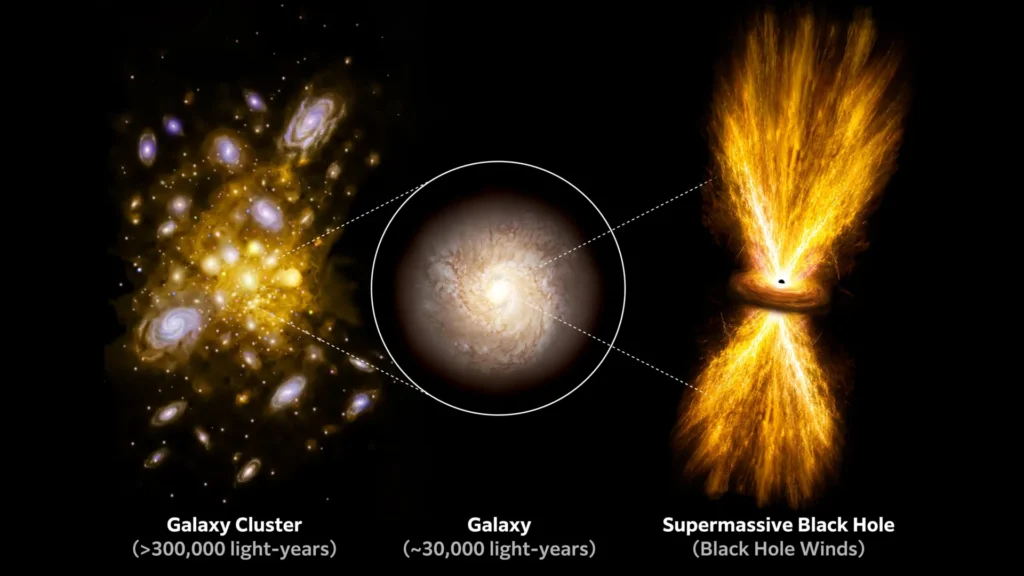
The key finding of the study is the confirmation that the hot gas surrounding the supermassive black hole at H1821+643 is not static. Instead, it is in a state of violent turbulence, driven by the black hole’s activity. This turbulence is not contained within the immediate vicinity of the black hole or even its host galaxy. XRISM’s data demonstrates that this energetic gas flow extends outward, reaching an astonishing distance of approximately 300,000 light-years. To put this into perspective, this distance is roughly equivalent to the diameter of the Milky Way galaxy, meaning the black hole’s influence extends far beyond its galactic home, effectively touching the intergalactic medium.
Even more significant is the quantification of the energy contained within these turbulent winds. The researchers discovered that this energy is approximately 100 times greater than earlier estimates for such outflows. This colossal energy output is comparable to the combined energy released by billions of supernova explosions – the cataclysmic blasts that mark the death of certain massive stars.
"Black holes are largely known for sucking matter in, but they also eject gas in the form of powerful winds," explained Professor Yamada in a statement. "These winds were thought to be contained within the galaxy, but our study revealed that the force is immensely more powerful than previously understood." He further emphasized the significance of this discovery, stating, "For the first time, we have shown that black holes influence the broader cosmic environment through a shock wave of astonishing power. Black holes are key drivers of gas flows and motion in space, transporting vast amounts of energy to different regions of the cosmos."
A Deeper Look at H1821+643: The Quasar’s Role
The choice of H1821+643 as the target for this investigation was strategic. As a quasar, it represents a period of intense activity in the universe’s history, where supermassive black holes were actively accreting matter at a significant rate. The black hole at the center of H1821+643 resides within a galaxy cluster, a dense collection of galaxies gravitationally bound together. This environment provides a rich reservoir of hot gas that fuels the black hole.
The X-rays emitted by this hot gas are crucial indicators of its properties, including its temperature, density, and motion. By meticulously analyzing the specific wavelengths of X-rays, known as emission lines, that are characteristic of iron ions, the research team could infer the speed and behavior of this gas. The high-resolution spectral data provided by XRISM was instrumental in distinguishing subtle Doppler shifts, which are direct measures of the gas’s velocity. These shifts indicated the violent outward motion characteristic of powerful winds.
The galaxy cluster setting also adds another layer of complexity. The supermassive black hole’s outflows are not only interacting with the gas within its own galaxy but also with the much larger reservoir of hot gas that permeates the entire cluster. This interaction is likely to have a profound impact on the evolution of the galaxy cluster itself, influencing star formation rates and the distribution of matter.
Timeline of Discovery and Observation
The journey to this revelation has been a gradual process, built upon decades of astronomical observation and theoretical modeling.
- Early Observations: Astronomers have long observed quasars and their associated energetic phenomena, recognizing the immense power of the central supermassive black holes. Early X-ray telescopes provided the first hints of hot gas surrounding these objects.
- Theoretical Models: Theoretical astrophysicists developed models suggesting that accretion disks around black holes could generate powerful outflows, but the scale and energy of these outflows remained largely speculative.
- Advancements in X-ray Astronomy: The development of increasingly sophisticated X-ray telescopes, such as Chandra and XMM-Newton, allowed for more detailed studies of the hot gas in galactic centers and clusters. These instruments provided evidence of galactic winds, but their extent was often difficult to precisely measure.
- The Advent of XRISM: The launch of XRISM (X-ray Imaging and Spectroscopy Mission) in September 2023 marked a significant leap forward. Designed with unparalleled spectral resolution in the X-ray band, XRISM was specifically engineered to detect subtle changes in the energy of X-ray photons, enabling precise measurements of gas motion and temperature.
- Targeting H1821+643: H1821+643 has been a known quasar for some time and has been observed by various telescopes. Its proximity and brightness made it an ideal candidate for detailed study with XRISM’s advanced capabilities.
- Data Analysis and Publication: Following XRISM’s operational phase and data acquisition, the research team meticulously analyzed the spectral data. The findings were then compiled and submitted for peer review, culminating in their recent publication in the prestigious journal Nature Astronomy. This publication marks the formal unveiling of these groundbreaking results to the scientific community and the public.
Broader Implications for Cosmic Evolution
The implications of this research extend far beyond our understanding of individual black holes. The realization that these objects can inject vast amounts of energy and matter into the intergalactic medium suggests a more dynamic and interconnected universe.
Regulation of Galaxy Formation: These powerful winds could act as a cosmic thermostat, regulating the rate at which gas cools and collapses to form stars within galaxies. By expelling gas, supermassive black holes might prevent excessive star formation, thus influencing the size and evolution of galaxies. This phenomenon is often referred to as "AGN feedback" (Active Galactic Nuclei feedback).
Chemical Enrichment of the Universe: The expelled gas carries heavy elements synthesized in stars and supernovae. The outward transport of this material into the intergalactic medium enriches it, providing the raw materials for future generations of stars and planets in other galaxies.
Structure Formation in the Universe: The distribution of matter in the universe is not uniform. Large-scale structures like galaxy clusters are formed through gravitational collapse. The energetic outflows from supermassive black holes can influence the dynamics of these structures, potentially shaping the cosmic web.
Revisiting Cosmological Models: Current cosmological models, which describe the evolution of the universe, often incorporate the effects of black hole feedback. This new evidence of the immense scale and power of these outflows will necessitate refinements and recalibrations of these models to more accurately reflect the universe’s complex processes.
Future Research and Unanswered Questions
While this study represents a monumental step forward, it also opens up new avenues for exploration. Future observations with XRISM and other advanced telescopes will aim to:
- Survey a Wider Range of Black Holes: The current findings are based on one specific quasar. Further observations of different types of supermassive black holes, including those in less active galaxies, will be crucial to determine if this phenomenon is universal.
- Map the Extent of Outflows: Precisely mapping the three-dimensional extent and structure of these winds will provide a more comprehensive understanding of their interaction with the intergalactic medium.
- Investigate the Mechanism of Energy Transfer: While the energy is clearly being transported, understanding the precise physical mechanisms by which it is accelerated and sustained over such vast distances remains a key area of inquiry.
- Quantify the Impact on Galaxy Evolution: Directly measuring the influence of these outflows on star formation rates and gas dynamics in a statistically significant sample of galaxies is the next critical step.
Professor Yamada’s team is already planning follow-up observations. "The capabilities of XRISM have truly revolutionized our ability to probe these extreme cosmic environments," he stated. "We are eager to apply these techniques to a broader range of objects to paint a more complete picture of how supermassive black holes shape the universe we see today."
This discovery underscores the dynamic and interconnected nature of the cosmos. Supermassive black holes, once viewed primarily as enigmatic cosmic vacuum cleaners, are now emerging as fundamental architects of galactic and intergalactic evolution, their powerful winds sculpting the very fabric of space over immense cosmic scales. The ongoing exploration of these celestial titans promises to continue reshaping our understanding of the universe’s grand narrative.