The bridge between abstract geometric theory and the tangible world of experimental physics has been significantly strengthened following a landmark study by researchers at the University of Tokyo. By utilizing a mathematical shape known as the "Smith hat"—the world’s first confirmed aperiodic monotile—scientists have successfully engineered optical structures that manipulate light in ways never before documented. This discovery, published in the journal Nature Communications, demonstrates that the unique geometric properties of the hat tile can induce unusual chiral diffraction patterns, offering a new paradigm for controlling light at the nanoscale.
For decades, mathematicians were haunted by the "Einstein problem," a quest to find a single shape that could tile a plane infinitely without ever repeating its pattern. The name is a play on the German words "ein stein," meaning "one stone." While aperiodic tilings were known to exist—most famously the Penrose tiling discovered in the 1970s—they always required at least two different shapes to function. In early 2023, David Smith, a retired printing technician and tiling enthusiast from the United Kingdom, alongside a team of academic collaborators, finally identified the "hat," a 13-sided polygon that satisfies the criteria of a monotile.
The transition from a mathematical curiosity to a physical breakthrough occurred when a research team led by Yuto Moritake and Masaya Notomi at the Institute of Industrial Science, The University of Tokyo, recognized the potential of the hat’s unique symmetry. By translating this geometric arrangement into a physical material, they have opened a new chapter in the study of quasicrystals and photonic crystals, materials designed to affect the motion of photons.
The Genesis of the Aperiodic Monotile
To understand the significance of the research, one must first look at the history of tiling theory. Standard tilings, such as those found on bathroom floors or honeycombs, are periodic. This means that if you shift the entire pattern by a certain distance in a specific direction, the pattern remains identical. In the 1960s, mathematicians began to wonder if a set of shapes could exist that would tile the plane only aperiodically—meaning the pattern would never repeat, no matter how far it extended.
The first such sets required thousands of different tiles. Over time, this number was whittled down. Roger Penrose famously reduced the number to two in 1974. However, the "holy grail" remained the elusive single tile. The 2023 discovery of the Smith hat was a seismic event in the mathematical community because it proved that a single shape could encode the complexity of aperiodicity.
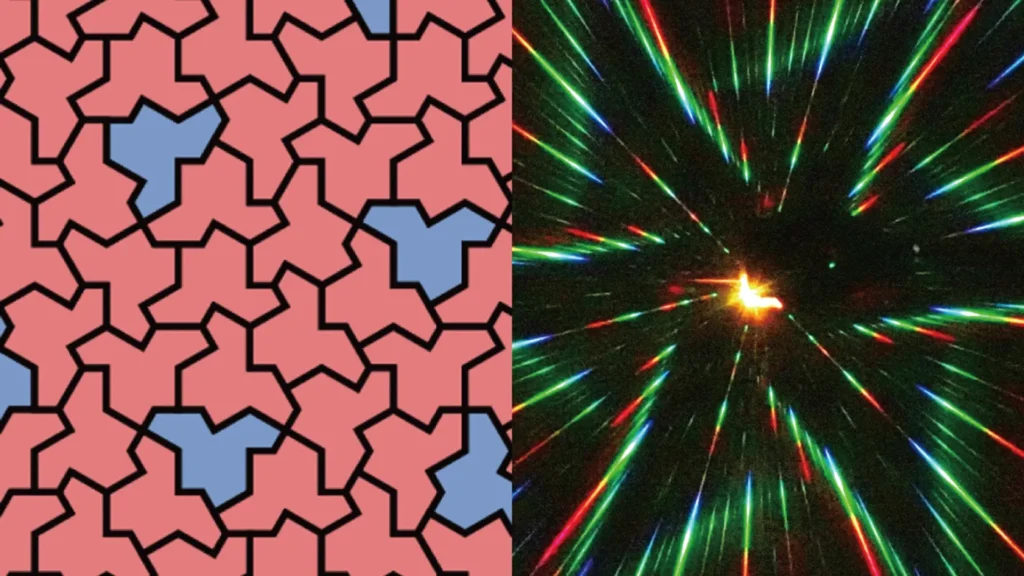
The hat is a "polykite," constructed from eight smaller kites arranged in a specific configuration. What makes it particularly interesting to physicists is its relationship to the hexagonal or honeycomb lattice. While the tiles themselves are arranged in a way that avoids translation symmetry, they still maintain a deep, underlying connection to structured geometry.
Engineering the Optical "Hat" Structure
The University of Tokyo researchers sought to determine if the mathematical "magic" of the hat tile would translate into unique physical properties. To do this, they moved from the drawing board to the laboratory, employing advanced nanofabrication techniques.
The team utilized electron beam lithography to etch the Smith hat pattern onto silicon nitride ($Si_3N_4$) thin films. Silicon nitride is a preferred material in photonics due to its high refractive index and transparency across a wide range of wavelengths, including the visible spectrum. The researchers created arrays where each "hat" acted as a scattering center for light.
By creating these nanoscale versions of the tiling, the researchers essentially built a "metasurface"—a synthetic material with properties not found in nature. Unlike conventional crystals, which have a predictable, repeating internal structure, or random materials, which have no order at all, the monotile array occupies a "middle ground." It possesses a high degree of order and mathematical rules but lacks the translational symmetry of a standard crystal.
Observations of Chiral Diffraction Patterns
The most striking result of the study occurred when the researchers directed laser light at the aperiodic monotile structures. In a standard crystal, light diffracts into a series of predictable, discrete spots. In the hat-tiled structure, the researchers observed something far more complex: pinwheel-like diffraction patterns.
These patterns are indicative of chirality. In physics and chemistry, chirality refers to an object that cannot be superimposed on its mirror image—much like a human’s left and right hands. While the individual Smith hat tile is chiral (it has a distinct "handedness"), the researchers discovered that the collective aperiodic arrangement of these tiles created a macroscopic chiral response in the light itself.
"The diffraction patterns themselves become chiral because the structure lacks mirror symmetry," explained senior author Masaya Notomi. This is a significant departure from traditional quasicrystals. While quasicrystals like the Penrose tiling have been studied for decades, the specific rotational and chiral properties emerging from a single-tile aperiodic system provide a level of control over light that was previously unattainable.
Symmetry-Controlled Optical Behavior
The research further revealed that the optical response of the monotile structures is highly sensitive to the properties of the incoming light. The researchers found that by changing the polarization (the direction in which the light waves vibrate) and the angle of the incident laser, they could manipulate the resulting diffraction pinwheels.
Furthermore, when the physical structures were fabricated as mirror images of the original pattern, the optical behavior reversed perfectly. This confirmed that the chiral light patterns were not an artifact of the experiment but were directly dictated by the mathematical symmetry of the Smith hat.
This "symmetry-controlled" behavior is of great interest to the field of photonics. In modern technology, the ability to selectively filter or rotate light based on its polarization is essential for everything from liquid crystal displays (LCDs) to fiber-optic communications. The aperiodic monotile offers a way to achieve these effects through geometry rather than through the use of rare or expensive chemical compositions.
Chronology of Tiling and Optical Discovery
The journey from the theoretical "Einstein problem" to the University of Tokyo’s optical experiment represents a rapid convergence of mathematics and physics:
- 1961: Mathematician Hao Wang conjectures that aperiodic sets of tiles cannot exist, a theory later disproven by his student Robert Berger.
- 1974: Roger Penrose discovers a two-tile set that tiles the plane only aperiodically, leading to the discovery of physical quasicrystals by Dan Shechtman in 1982.
- 2011: Dan Shechtman receives the Nobel Prize in Chemistry for the discovery of quasicrystals, proving that aperiodic order exists in nature.
- March 2023: David Smith, Joseph Samuel Myers, Craig S. Kaplan, and Chaim Goodman-Strauss publish their discovery of the "hat" monotile.
- May 2023: The same team discovers the "Spectre" tile, a version of the monotile that does not require its mirror image to tile the plane, solving the "strict" Einstein problem.
- 2024: The University of Tokyo team publishes their findings in Nature Communications, marking the first major application of the Smith hat in experimental optical physics.
Broader Implications for Science and Technology
The implications of this research extend far beyond the laboratory. The ability to create aperiodic structures that interact with light in a chiral manner could lead to several technological advancements:
1. Advanced Photonic Devices
Current optical components often rely on periodic structures (photonic crystals) to trap or guide light. However, periodic structures have limitations, particularly regarding "edge states" and sensitivity to defects. Aperiodic monotiles could provide a more robust platform for creating waveguides and resonators that are less sensitive to manufacturing imperfections.
2. Polarization Control and Sensing
Because the hat-tiled structures respond so strongly to the polarization of light, they could be used to develop ultra-thin polarization filters and sensors. Such devices are critical in medical imaging, where polarized light is used to detect changes in biological tissues, and in environmental monitoring.
3. Secure Communications
The unique diffraction patterns produced by aperiodic monotiles could serve as a "geometric key" in optical cryptography. Because the pattern is deterministic but non-repeating, it offers a high degree of complexity that could be used to encode information in laser signals.
4. Fundamental Physics Research
The study of aperiodicity is closely linked to the study of "topological insulators," materials that conduct electricity on their surface but act as insulators in their interior. Researchers believe that the geometry of the Smith hat may help them understand how topological properties emerge in systems that lack traditional crystal symmetry.
Academic and Industry Reactions
The scientific community has reacted with enthusiasm to the University of Tokyo’s findings. Experts in the field of condensed matter physics have noted that while the "hat" was initially celebrated as a win for pure mathematics, its rapid adoption by physicists shows the increasing overlap between geometry and material science.
"What is especially fascinating about the hat tile is that, although the resulting pattern appears irregular at first glance, it is actually constructed from the honeycomb lattice," noted lead author Yuto Moritake. This underlying order allows for a level of mathematical precision in fabrication that truly random or amorphous materials cannot match.
While the current experiment utilized silicon nitride and laser light, the principles discovered are universal. In theory, the same aperiodic patterns could be applied to acoustic waves (sound) or even used to design new types of metamaterials for stealth technology or seismic protection.
Conclusion: The Geometry of the Future
The discovery of the Smith hat solved a 60-year-old mathematical mystery, but the work of the University of Tokyo suggests that the story of the aperiodic monotile is only just beginning. By proving that a single geometric shape can dictate the behavior of light, researchers have provided a powerful new tool for the field of photonics.
As the team continues to explore the "fusion of quasiperiodic order and chirality," the focus will likely shift toward practical applications. The transition from abstract "Einstein" tiles to functional optical chips demonstrates that even the most theoretical mathematical puzzles can eventually yield solutions for the physical world. The "hat" is no longer just a shape; it is a blueprint for the future of light manipulation.