The search for extraterrestrial life has long been dictated by a "follow the water" mantra, a strategy rooted in the observation that life on Earth requires a liquid water solvent to facilitate the complex biochemical reactions necessary for survival. This Earth-centric approach has led planetary scientists to focus primarily on "Earth twins"—planets with moderate temperatures and liquid oceans. However, a groundbreaking study from the Massachusetts Institute of Technology (MIT) suggests that the biological "Goldilocks zone" may be far broader than previously imagined. Researchers have demonstrated that short peptides, the building blocks of proteins, not only survive in the extreme acidity of Venus’s cloud layers but also undergo structural folding that could enable biological functionality.
The findings, published in the Proceedings of the National Academy of Sciences, challenge the long-held assumption that the concentrated sulfuric acid environment of Venus is an absolute barrier to complex organic chemistry. By showing that these molecules can maintain stability and form distinct three-dimensional structures in 98 percent sulfuric acid, the research team has provided a new chemical framework for considering the habitability of environments once dismissed as too hostile for life.
The Corrosive Mystery of the Venusian Atmosphere
Venus is often described as Earth’s "evil twin." While similar in size and composition, its surface is a hellish landscape of crushing pressure and temperatures hot enough to melt lead. However, between 30 and 40 miles above the scorched surface lies a temperate cloud deck. In this region, temperatures and pressures are remarkably similar to those on Earth’s surface. Despite these physical similarities, the chemical composition of the clouds is terrifying: they are composed of droplets of highly concentrated sulfuric acid.
On Earth, sulfuric acid is a potent dehydrating agent and a corrosive substance that rapidly breaks down biological molecules through a process called hydrolysis. Scientists had assumed that any organic material entering these clouds would be instantly destroyed. Yet, the MIT team, led by senior authors Sara Seager and Mei Hong, sought to test this assumption. Their work builds on a series of studies initiated in 2020, following the controversial detection of phosphine—a potential biosignature—in the Venusian atmosphere.
A Chronology of Chemical Resilience
The path to this discovery has been a systematic exploration of how the building blocks of life behave when stripped of a water-based environment. The research began with the laboratory of Sara Seager, the Class of 1941 Professor of Planetary Sciences at MIT, who has dedicated much of her career to identifying signs of life on exoplanets.
In 2020, the team began testing the stability of various organic molecules in concentrated sulfuric acid. Their initial experiments utilized nuclear magnetic resonance (NMR) spectroscopy to observe the behavior of nucleic acids, the primary components of DNA and RNA. To the surprise of the scientific community, these molecules remained intact. Subsequent tests on lipids and individual amino acids yielded similar results, showing that the "corrosive" nature of the acid was not as universally destructive as previously believed.
The most recent phase of research moved from individual building blocks to more complex structures: peptides. Peptides are short chains of amino acids linked by peptide bonds. In water, these bonds are susceptible to acid-catalyzed hydrolysis, where water molecules break the chain apart. However, the MIT team hypothesized that in 98 percent sulfuric acid, the near-total absence of water might actually protect these bonds.
To test this, Seager collaborated with Mei Hong, an MIT professor of chemistry and an expert in high-resolution NMR spectroscopy. Using an 800-megahertz spectrometer, the team analyzed several peptides, including a synthetic seven-amino-acid peptide known as HHQ, its longer variant HHQ13, and a peptide called K7.
Structural Transformation: The Omega Loop and the Sulfuric Scaffold
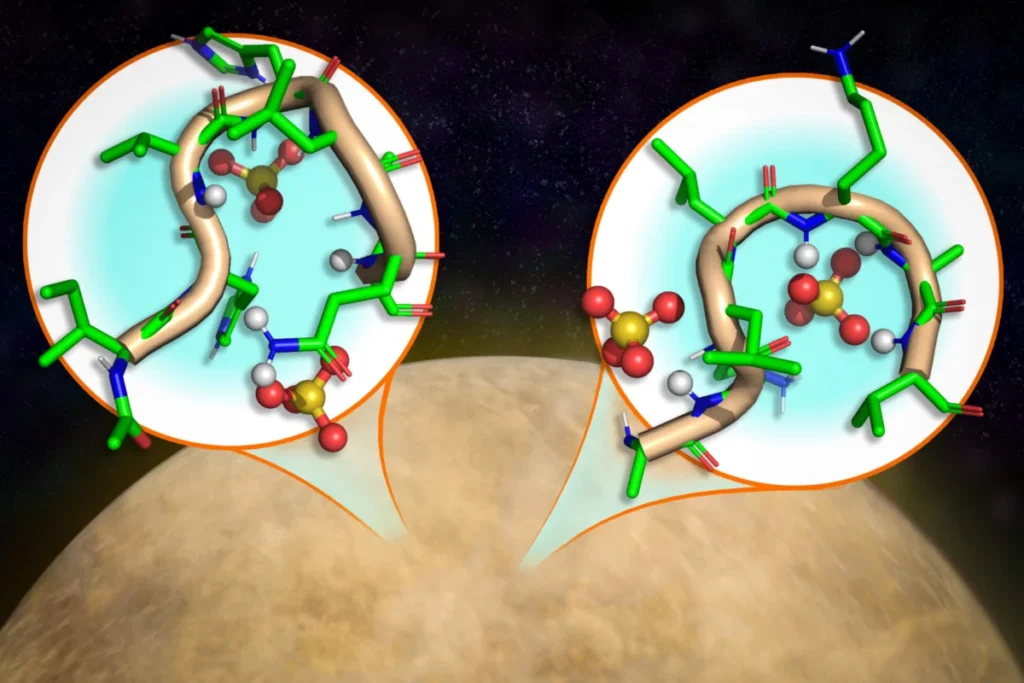
The results of the NMR analysis were unexpected. Not only did the peptides remain stable for several weeks, but they also abandoned their typical aqueous shapes to form entirely new structures. In water, the HHQ peptide typically forms flat beta-sheets, which eventually aggregate into long fibrils. In concentrated sulfuric acid, however, the researchers discovered that the peptides folded into "omega loops."
An omega loop is a non-repetitive secondary structure in proteins, characterized by its resemblance to the Greek letter Ω. In Earth-based biology, these loops often serve as flexible bridges between more rigid structures like alpha-helices and beta-sheets, playing critical roles in molecular recognition and protein folding.
"What hadn’t been known is that peptides can survive so well and have specific three-dimensional shapes in an acidic environment," says Mei Hong. "Once these macromolecules have a defined three-dimensional structure, they can potentially have a function."
The mechanism behind this stability appears to be the acid itself. The researchers believe that molecules of sulfuric acid act as a chemical scaffold, sliding into the center of the peptide loops and holding them in place. Furthermore, because the solution contains only 2 percent water, there are not enough water molecules to facilitate the hydrolysis reactions that would otherwise dissolve the peptide bonds. In this "water-limited" environment, the acid ceases to be a solvent of destruction and becomes a solvent of preservation.
Supporting Data and Technical Analysis
The implications of these findings are supported by the specific behavior of the peptides studied. The HHQ peptide (consisting of the sequence His-His-Gln) was specifically chosen because of its known role in forming catalytic amyloid fibrils in water. The transition from a fibril-forming sheet in water to a stable loop in acid demonstrates that the environment fundamentally dictates the "folding landscape" of biological molecules.
The study also highlighted the potential for "peptide nucleic acids" (PNA). PNA is an artificial molecule where the sugar-phosphate backbone of DNA is replaced by a peptide-like backbone. Seager’s previous work showed that single-stranded PNA is stable in sulfuric acid. The current finding that peptides can fold into complex shapes suggests that double-stranded PNAs or even more complex protein-like structures could theoretically exist and function within the Venusian cloud droplets.
This data provides a chemical basis for the "Venus Life Cycle" hypothesis. This theory suggests that microbial life could inhabit the cloud droplets, perhaps entering the atmosphere via meteorites that carry amino acids and peptides. If these building blocks can survive and fold in the clouds, the primary barrier to life in this environment shifts from "chemical stability" to "metabolic complexity."
Official Responses and Scientific Context
The broader scientific community has reacted to the study with a mixture of caution and excitement. Adriaan Bax, chief of the Section on Biophysical NMR at the National Institute of Diabetes and Digestive and Kidney Diseases, who was not involved in the research, characterized the findings as "important and unexpected."
"The observation that these peptides retain a substantial degree of conformational order in concentrated sulfuric acid raises the prospect that folded oligopeptide/protein structures can exist in such environments," Bax noted. This acknowledgment from the biophysical community underscores the shift in how scientists view "extreme" solvents.
The study’s senior authors emphasize that this research is not proof of life on Venus, but rather proof of the possibility of chemistry that could support life. Sara Seager, who is also leading the Morning Star Missions—a series of privately funded missions to Venus—views this as a call to broaden our horizons. "We’re seeking exoplanets that might be a true Earth twin, but what if they’re all Venuses?" Seager asks. "Our findings definitely open up a whole range of possibilities."
Implications for Astrobiology and Exoplanet Archetypes
The MIT study fundamentally alters the search for life in the universe by questioning the "Earth-centric" model of habitability. If complex, functional organic molecules can exist in concentrated sulfuric acid, then the definition of a "habitable zone" must be expanded to include planets with non-aqueous solvents.
This research introduces the concept of "alternative biochemistry" into the mainstream of planetary science. It suggests that when we look at the thousands of exoplanets discovered by telescopes like Kepler and James Webb, we should not rule out those with thick, acidic atmospheres. These planets may not be "failed Earths" but rather "successful Venuses," hosting a form of life that utilizes sulfuric acid as a scaffold for molecular complexity.
Furthermore, the study provides a roadmap for future missions. The Morning Star Missions, scheduled to begin launching in the coming years, will send a small probe to Venus to directly sample the cloud particles. Equipped with instruments informed by this lab research, the probe will look for organic fluorescence and other signs of complex chemistry within the droplets.
Conclusion and Future Directions
The discovery that peptides can survive and fold in concentrated sulfuric acid marks a significant milestone in astrobiology. It bridges the gap between simple organic chemistry and the complex structural biology required for life. The researchers now plan to analyze longer peptides and double-stranded PNA to see if even more complex "molecular machines" can persist in the Venusian environment.
As Sara Seager prepares to join the faculty at the University of Toronto this September, the legacy of this MIT-led research will continue to influence Venusian exploration. The project, funded by the Alfred P. Sloan Foundation, the NOMIS Foundation, and the National Institutes of Health, stands as a testament to the power of interdisciplinary collaboration—combining planetary science with high-end chemical instrumentation to solve the mysteries of the solar system.
The clouds of Venus, once thought to be a sterile, acidic wasteland, are now at the center of a new frontier in the search for life. By proving that the building blocks of biology are more resilient than ever imagined, scientists have moved one step closer to answering the ultimate question: are we alone in the universe, or is life simply more creative in its choice of environment than we are?