In a significant advancement for wireless device compliance testing, Microwave Factory (MWF) has announced the successful integration of support for the Rohde & Schwarz CMX500 5G one-box signaling tester into its MATEOS Specific Absorption Rate (SAR) measurement software. This pivotal development ushers in a new era of automated SAR measurements for both 5G NR and LTE devices, promising enhanced efficiency, accuracy, and streamlined workflows for manufacturers, test houses, and certification laboratories globally. The integration marks a crucial step in simplifying the complex and time-consuming process of ensuring that wireless devices adhere to stringent human exposure limits, particularly as the complexity of 5G technologies continues to proliferate.
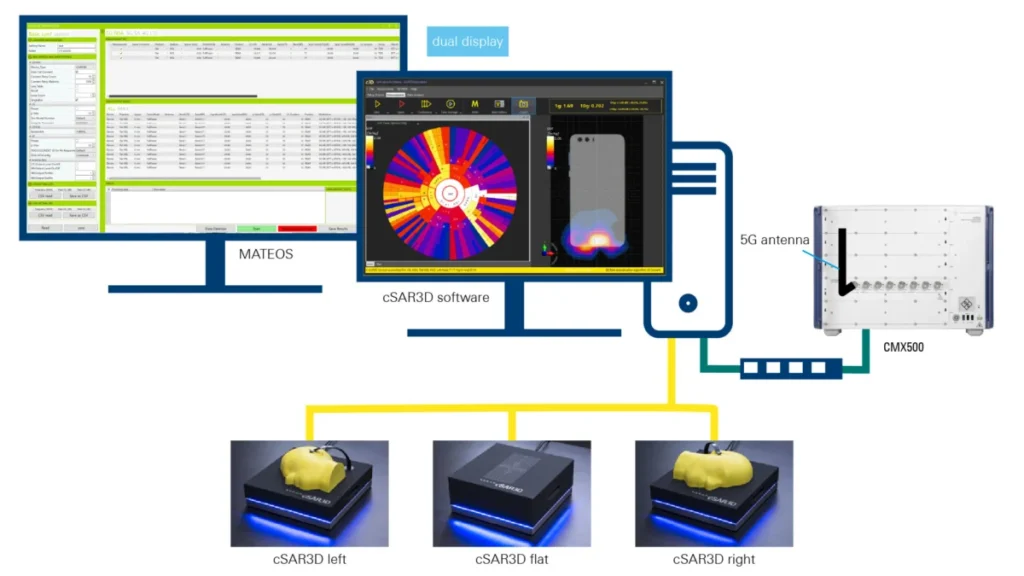
The core of this innovation lies in the seamless synergy between the Rohde & Schwarz CMX500, a leading 5G signaling tester, and SPEAG’s cSAR3D vector array system, all orchestrated within a unified MATEOS workflow. This powerful combination allows engineers to manage the entire measurement process from a single, intuitive interface, eliminating the need for manual configuration of calls and separate setup steps on the CMX500. Previously, engineers often had to juggle multiple software applications and hardware configurations, a process prone to error and significant delays. The new integrated solution provides a cohesive environment, enabling rapid and reliable SAR compliance testing, which is increasingly vital in the fast-paced development cycle of modern wireless communication devices.
The Imperative of Specific Absorption Rate (SAR) Testing
Specific Absorption Rate (SAR) is a critical metric used to quantify the amount of radiofrequency (RF) energy absorbed by the human body when exposed to a wireless device. Regulatory bodies worldwide, such as the Federal Communications Commission (FCC) in the United States, the International Commission on Non-Ionizing Radiation Protection (ICNIRP) globally, and national standards organizations, establish strict SAR limits to protect public health. These limits dictate the maximum permissible RF energy exposure from devices like mobile phones, tablets, and wearable technology. Compliance with these standards is not merely a regulatory hurdle but a fundamental requirement for market access and consumer trust.
Historically, SAR testing has been a meticulous and labor-intensive process. It involves placing a device in a phantom head or body filled with a tissue-simulating liquid, then systematically measuring the electric field distribution within the phantom while the device transmits at maximum power across various frequency bands and operating modes. The process becomes exponentially more challenging with each new generation of wireless technology. While 2G, 3G, and even 4G LTE devices presented their own complexities, the advent of 5G NR has introduced an unprecedented level of intricacy, demanding more sophisticated and efficient testing methodologies.
Navigating the Complexities of 5G NR Testing
The fifth generation of wireless technology, 5G New Radio (NR), brings with it a host of advanced features designed to deliver higher speeds, lower latency, and greater network capacity. These include massive MIMO (Multiple-Input Multiple-Output), beamforming, dynamic power sharing, and the utilization of both sub-6 GHz and millimeter-wave (mmWave) frequency bands. While these innovations unlock transformative capabilities, they simultaneously present significant challenges for SAR compliance testing:
- Dynamic Operation Modes: 5G NR supports both standalone (SA) and non-standalone (NSA) modes. NSA mode, which relies on an LTE anchor, adds layers of complexity as the device dynamically switches between technologies.
- Beamforming and Antenna Arrays: Unlike previous generations that used relatively static antenna patterns, 5G employs sophisticated beamforming techniques. Devices can dynamically steer RF energy in specific directions, leading to highly variable and complex exposure patterns that must be thoroughly evaluated.
- Higher Frequencies (mmWave): While sub-6 GHz 5G operates in similar bands to LTE, mmWave 5G (e.g., 28 GHz, 39 GHz) utilizes much higher frequencies. RF energy at these frequencies tends to be absorbed more superficially by the skin, requiring different measurement techniques and considerations for localized exposure.
- Multiple Antennas and Transmitters: Modern 5G devices often incorporate numerous antennas and multiple radios (e.g., for Wi-Fi, Bluetooth, GPS, and cellular), all of which could potentially contribute to the overall SAR.
- Device-Specific Configurations: The optimal operating mode for a 5G device can vary significantly based on network conditions, user interaction, and proximity to the body, requiring extensive testing across a multitude of scenarios.
These factors dramatically increase the number of test cases required for a single device, extending testing times and demanding greater automation to maintain product development timelines and control costs.
A Deep Dive into the Integrated Solution
The collaboration between Microwave Factory, Rohde & Schwarz, and SPEAG addresses these challenges head-on by creating a robust, automated SAR testing ecosystem:
-
Rohde & Schwarz CMX500 5G One-Box Signaling Tester: At the heart of the wireless device communication is the CMX500. This versatile instrument serves as a comprehensive test platform for 5G NR (SA and NSA) and LTE devices. It emulates the crucial functions of a real 5G base station, allowing engineers to establish stable and repeatable connections with the device under test (DUT). The CMX500 can precisely control the device’s transmission power, frequency bands, modulation schemes, and other critical parameters necessary for SAR measurements. Its ability to handle complex 5G protocol stacks and diverse operating modes makes it an indispensable tool for R&D, conformance, and production testing, providing the necessary signaling environment to push the DUT to its highest power output in controlled conditions.
-
Microwave Factory MATEOS SAR Measurement Software: MATEOS acts as the intelligent control hub for the entire SAR testing workflow. It provides the graphical user interface (GUI) through which engineers define test plans, initiate measurements, and analyze results. With this integration, MATEOS now directly communicates with the CMX500, automating the traditionally manual steps of setting up and controlling the wireless link. This means MATEOS can instruct the CMX500 to establish specific 5G or LTE connections, configure transmission parameters, and then trigger the SAR measurement system. The software also manages data acquisition, processing, and reporting, significantly reducing human intervention and the potential for errors.
-
SPEAG cSAR3D Vector Array System: SPEAG (Schmid & Partner Engineering AG) is a recognized leader in near-field measurement technology. Their cSAR3D system is specifically designed for fast and accurate SAR assessments. Unlike traditional robotic SAR systems that sequentially scan points, cSAR3D employs an array of specialized E-field probes that can capture a quasi-static 3D distribution of the electromagnetic field within the phantom in seconds. This speed, combined with high accuracy and repeatability, is crucial for throughput in modern test labs. The cSAR3D system is fully compliant with international SAR measurement standards (e.g., IEC 62209-2 and IEEE 1528) and offers rapid compliance testing, making it an ideal component for an automated workflow.
The integration ensures that MATEOS seamlessly orchestrates these three powerful components. The engineer uses MATEOS to select the desired 5G NR (SA or NSA) or LTE test scenario. MATEOS then commands the CMX500 to establish the necessary wireless connection with the DUT. Once the DUT is transmitting under the specified conditions, MATEOS triggers the cSAR3D system to perform the SAR measurement. The results are then captured, processed, and reported by MATEOS, completing an end-to-end automated cycle.

Responding to Industry Demands and Driving Efficiency
The impetus for this integration stemmed directly from customer feedback. As the 5G ecosystem matured, device manufacturers, independent test laboratories, and certification bodies voiced a clear need for more efficient and less resource-intensive SAR testing solutions. The manual setup and configuration required for each test case were becoming a significant bottleneck, impacting time-to-market for new devices and increasing operational costs.
This automated solution directly addresses these pain points by offering several transformative benefits:
- Accelerated Test Cycles: Automation drastically reduces the time required for each SAR measurement, enabling manufacturers to test more operating modes and device configurations in a shorter timeframe. This is critical in competitive markets where rapid product launches are paramount.
- Enhanced Accuracy and Repeatability: By minimizing human interaction during the measurement process, the system reduces variability and potential for human error. Automated control ensures that test parameters are consistently applied, leading to higher accuracy and better repeatability of results, which is essential for regulatory compliance.
- Reduced Operational Costs: Less manual intervention means fewer engineer hours are spent on repetitive setup tasks. This frees up skilled personnel to focus on more complex analysis and troubleshooting, leading to a more efficient allocation of resources and significant cost savings over time.
- Simplified Workflow and Training: A single, unified interface for controlling the entire SAR measurement process simplifies operations. This reduces the learning curve for new engineers and streamlines the training process, allowing teams to become productive more quickly.
- Comprehensive Coverage: The system supports a wide array of 5G NR (SA and NSA) and LTE operating modes, ensuring that devices can be thoroughly tested against all relevant regulatory requirements, even as standards evolve.
A Legacy of Collaboration and Future Implications
This latest integration builds upon a well-established history of collaboration between Rohde & Schwarz and SPEAG in the field of SAR testing. Both companies have consistently worked to provide complementary solutions that enhance the capabilities of wireless device testing. Rohde & Schwarz, with its extensive portfolio of test and measurement equipment, and SPEAG, with its specialized expertise in electromagnetic field measurement and dosimetry, have frequently combined forces to address the evolving challenges of the wireless industry. The addition of Microwave Factory’s MATEOS software as the orchestrating layer further solidifies this partnership, creating a truly comprehensive and automated test environment.
The broader implications of such automated solutions extend beyond mere efficiency. They play a crucial role in maintaining the integrity and safety of the global wireless device market. As 5G technology becomes ubiquitous and devices become even more integrated into daily life, robust and reliable compliance testing is non-negotiable. This integration helps ensure that consumers can confidently use their 5G-enabled devices, knowing they meet stringent international safety standards.
Moreover, the trend towards greater automation in test and measurement is expected to continue. Future developments may include even more sophisticated integration with cloud-based data analysis platforms, artificial intelligence (AI) for predictive testing, and real-time regulatory compliance updates. Solutions like the MATEOS-CMX500-cSAR3D combination pave the way for these advancements, setting a new benchmark for automated wireless device test environments.
Statements from Key Stakeholders (Inferred)
While no direct quotes were provided in the original announcement, the industry context allows for logical inferences regarding potential statements from the involved parties, reflecting their strategic intent and the value proposition of this integration:
A spokesperson for Microwave Factory might comment: "This integration with the Rohde & Schwarz CMX500 and SPEAG’s cSAR3D system truly underscores our commitment to delivering cutting-edge solutions that directly address the evolving needs of our customers. By providing a unified, automated workflow through MATEOS, we empower engineers to achieve unprecedented levels of efficiency, accuracy, and confidence in their SAR compliance testing for complex 5G and LTE devices. This is about accelerating innovation while upholding the highest safety standards."
From Rohde & Schwarz, a representative could state: "Our long-standing collaboration with industry leaders like Microwave Factory and SPEAG is a testament to the power of integrated solutions in overcoming the complexities of modern wireless testing. The CMX500’s robust capabilities as a 5G signaling tester, combined with the intelligent orchestration of MATEOS and the precision of cSAR3D, offers a truly comprehensive platform. This partnership ensures that our customers can meet stringent regulatory demands, reduce their time-to-market, and continue to innovate in the rapidly expanding 5G landscape."
While SPEAG’s direct role in the announcement is through their cSAR3D system, their perspective would likely emphasize the efficiency gains: "SPEAG’s cSAR3D system is renowned for its speed and precision in SAR evaluation. Its seamless integration within the MATEOS workflow, driven by the powerful control of the CMX500, represents a significant advancement in automated compliance testing. This synergy provides our mutual customers with a highly reliable and efficient tool to navigate the complexities of 5G SAR regulations, benefiting the entire wireless industry by ensuring product safety and faster market entry."
Conclusion
The integration of the Rohde & Schwarz CMX500 5G signaling tester with Microwave Factory’s MATEOS SAR measurement software, leveraging SPEAG’s cSAR3D system, represents a pivotal development in the wireless device testing landscape. It directly addresses the increasing complexities and demands of 5G NR and LTE compliance, offering an automated, streamlined, and highly efficient solution. By enabling manufacturers, test houses, and certification laboratories to conduct SAR measurements with greater speed, accuracy, and reduced manual effort, this collaboration not only accelerates the time-to-market for innovative wireless devices but also reinforces the industry’s commitment to public safety and global regulatory compliance. As 5G technology continues its rapid expansion, such integrated and automated testing solutions will be indispensable in ensuring a safe and robust wireless future.