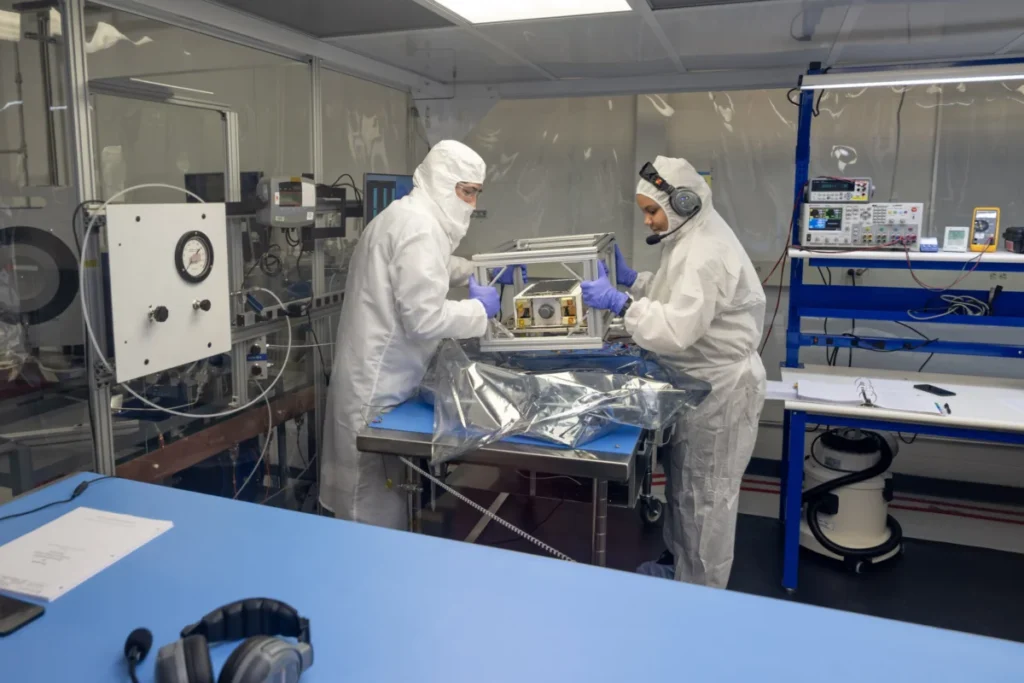
NASA Marshall Space Flight Center, Huntsville, Ala. – A shoebox-sized spacecraft, designed to demonstrate a novel low-toxicity propellant, is slated for launch on an upcoming SpaceX rideshare mission. This pioneering mission, featuring the Green Propulsion Dual Mode (GPDM) spacecraft, aims to validate a revolutionary dual-mode propulsion system utilizing ASCENT propellant over a nine-month period in low-Earth orbit. The development represents a significant stride in NASA’s decade-long pursuit of safer and more efficient spacecraft propulsion.
The ASCENT propellant, an ionic liquid developed by the Air Force Research Laboratory, stands as a promising alternative to hydrazine, the long-dominant liquid propellant in satellite technology. Hydrazine, while effective, is a hypergolic compound notorious for its hazardous nature, requiring stringent handling protocols due to its high flammability and corrosive properties. ASCENT, conversely, is engineered to be significantly less toxic, promising enhanced safety for astronauts and ground crews, as well as simplified launch and mission operations.
Beyond its safety advantages, ASCENT boasts a higher energy density compared to hydrazine. This means that spacecraft utilizing ASCENT can achieve greater distances or sustain longer operational periods with the same amount of fuel. Nehemiah Williams, project manager for green propulsion technology development at NASA Marshall, described the propellant as a "pinkish" hue, underscoring its distinct visual identity alongside its performance benefits.
This upcoming GPDM mission marks NASA’s third flight demonstration of ASCENT, but it is particularly significant as it represents "the first time that we’ve looked at dual-mode technology on a small spacecraft," according to Williams. The GPDM is a six-unit CubeSat, a standardized small satellite format, equipped with a sophisticated propulsion system that integrates both chemical and electric thrusters. This innovative design allows these disparate thruster types to draw from a single propellant tank, offering unprecedented flexibility in mission planning and execution.
The Dual-Mode Advantage: Combining Thrust and Efficiency
The core innovation of the GPDM lies in its dual-mode propulsion capability. Chemical propulsion, characterized by high thrust, is ideal for rapid maneuvers and significant orbital changes. However, it typically suffers from lower fuel efficiency, requiring larger propellant loads for extended operations. Electric propulsion, on the other hand, offers very low thrust but exhibits exceptionally high fuel efficiency, enabling long-duration missions with minimal propellant mass.
By integrating both systems, the GPDM aims to harness the complementary strengths of each propulsion type. "If you have both on a spacecraft, you’re expanding the possible types of missions you can fly," Williams explained. This synergistic approach could revolutionize the capabilities of small satellites, enabling them to perform a wider array of complex maneuvers and undertake longer, more ambitious missions that were previously out of reach.
The ASCENT propellant’s unique chemical composition is key to enabling this dual-mode functionality. For chemical propulsion, the propellant is passed through a catalyst bed, inducing a controlled exothermic reaction that generates thrust. In contrast, for electric propulsion, the ASCENT is ionized using an electromagnetic grid, a process that accelerates charged particles to generate a continuous, albeit low, thrust. This adaptability of ASCENT to different propulsion mechanisms is a critical enabler of the GPDM’s dual-mode design.
Mission Timeline and Operational Objectives
The GPDM spacecraft is scheduled to launch aboard a SpaceX Falcon 9 rocket, with a target liftoff date "no earlier than Oct. 1," as announced by Jason Adam, director of NASA Marshall’s Science and Technology Office, during a panel discussion last month at the Space and Missile Defense Symposium.
Upon reaching its low-Earth orbit (LEO), the GPDM will undergo an initial week of system checkouts. This period will involve verifying the functionality of its battery systems, solar arrays, and communication links. Following these essential checks, the mission will proceed to the propulsion system testing phase.
In the second and third weeks of the mission, the GPDM will first engage its chemical thruster. This initial burn will serve to confirm the integrity and performance of the chemical subsystem. Subsequently, the spacecraft will transition to testing its electric thrusters, the electrosprays. This phased approach ensures a thorough validation of each propulsion mode before the commencement of the nominal mission phase.
The nominal mission, if all systems perform as expected, will involve extended operations of the electrospray thrusters. During this phase, operators will explore varying burn durations and experiment with utilizing the dual propulsion system to precisely control the satellite’s altitude and orientation. This will provide invaluable data on the long-term performance and control capabilities of the ASCENT-powered dual-mode system.
Learning from Past Experiences: Lunar Flashlight’s Legacy
The GPDM mission builds upon lessons learned from NASA’s previous ASCENT flight demonstration, the Lunar Flashlight. Launched in late 2022 with the ambitious goal of reaching lunar orbit, Lunar Flashlight unfortunately encountered performance issues that prevented it from achieving its intended trajectory. A subsequent investigation by the NASA Engineering and Safety Council identified blockages caused by powder from a 3D-printed component as the primary culprit, impeding the thrusters’ ability to generate sufficient thrust.
Acknowledging this setback, the GPDM team has implemented "extra precautions" to mitigate similar issues. Williams emphasized that meticulous attention has been paid to "really make sure that the feed system ducts were clear of debris." This proactive approach, informed by prior flight experience, underscores NASA’s commitment to rigorous testing and continuous improvement in its technology development programs.
Williams expressed his deep personal investment in the GPDM project, having been involved for over four years. He described the journey from "PowerPoint charts and sketches to a flight system that you get to show off to the world" as one of the most exhilarating experiences an individual can have. This sentiment highlights the dedication and passion of the NASA teams working to advance space exploration technologies.
Future Implications: Expanding Lunar and Interplanetary Capabilities
The success of the GPDM mission could pave the way for a new generation of advanced small satellite systems. Williams envisions the development of "larger dual-mode small sat systems that’s going to the moon or beyond." This future trajectory, while requiring significant technological scaling, is a key objective for NASA’s exploration roadmap.
Jason Adam further indicated that NASA is actively planning a follow-on ASCENT demonstration featuring "larger and more capable thrusters," signaling a clear commitment to scaling up this promising propulsion technology.
The strategic deployment of small satellites equipped with these enhanced propulsion systems holds immense potential for supporting NASA’s broader lunar exploration goals. Williams suggested that such satellites could form "constellations for communication, for instance, around lunar surface assets." This could provide vital communication links for astronauts and robotic explorers operating on the Moon. Moreover, these advanced small satellites could undertake their own lunar missions or even venture into interplanetary space, performing reconnaissance, scientific measurements, or serving as precursors for larger exploration endeavors.
The development and successful demonstration of the GPDM spacecraft and its ASCENT-powered dual-mode propulsion system represent a significant leap forward in the quest for safer, more efficient, and more versatile spacecraft propulsion. This innovation not only promises to enhance current space missions but also holds the key to unlocking new frontiers in lunar and interplanetary exploration. The meticulous planning, lessons learned from past missions, and the inherent advantages of the ASCENT propellant position this initiative as a cornerstone of future space endeavors.