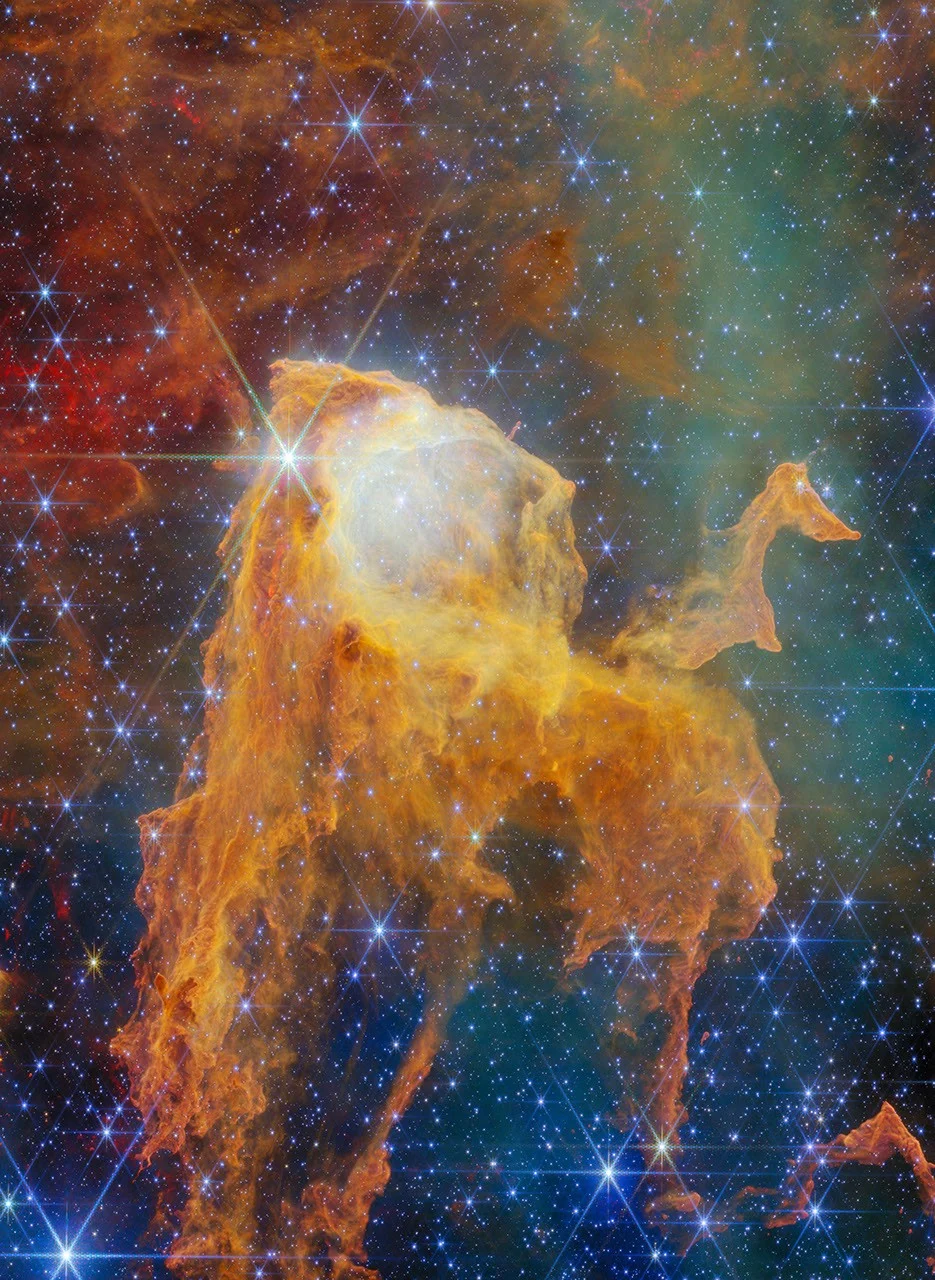
The universe, in its infinite grandeur, frequently presents celestial spectacles that ignite the human imagination. Today, through the unparalleled vision of NASA’s James Webb Space Telescope (JWST), we are treated to a breathtaking panorama that has been poetically likened to an open treasure chest, brimming with the nascent glow of stars. This awe-inspiring image, captured within the turbulent confines of the Carina Nebula, approximately 7,500 light-years from Earth, offers a profound glimpse into the fundamental processes of stellar birth and evolution. The featured photograph, a testament to the JWST’s groundbreaking capabilities, showcases a colossal pillar of interstellar gas and dust, sculpted by the relentless forces of stellar winds and radiation emanating from its luminous neighbors.
A Stellar Nursery Revealed
The Carina Nebula, a vast and dynamic region of star formation in our own Milky Way Galaxy, has long been a focal point for astronomical study. This particular image highlights a dense structure, a colossal cloud of cosmic material that, through the combined action of intense radiation and powerful stellar winds from nearby massive stars, has been eroded and sculpted into a form strikingly reminiscent of an open chest. The "lid" of this celestial vault is the result of the star formation process within the pillar itself, which is actively excavating its head, pushing away the surrounding gas and dust to reveal the burgeoning stellar population within.
The Jewels Within the Chest
Astronomers estimate that this pillar harbors a remarkably dense cluster of approximately 70 young stars. This cluster, a veritable cradle of stellar creation, is estimated to be a mere 1.3 million years old, a blink of an eye in cosmic timescales. Among these infant stars is a particularly massive one, weighing in at roughly 19 times the mass of our Sun. The sheer brilliance and rapid evolution of such massive stars make them the "shiniest jewels" within this cosmic treasure chest, illuminating the surrounding nebula with their intense light and energy.
The formation of stars is a complex and multifaceted process. It begins with the gravitational collapse of vast interstellar clouds of gas and dust. As these clouds condense, they fragment into smaller, denser clumps. Within these clumps, gravity continues to pull material inward, increasing temperature and pressure at the core. Eventually, the core becomes hot and dense enough for nuclear fusion to ignite, marking the birth of a star. The energetic processes associated with these nascent stars, including powerful stellar winds and ultraviolet radiation, can then dramatically influence their immediate surroundings, shaping nebulae and triggering further star formation in nearby clouds.
The Carina Nebula, being a region of prolific star formation, is home to some of the most massive and luminous stars known, including the Eta Carinae stellar system. This system, a binary star system comprising two extremely massive stars, is more luminous than 5 million Suns. The immense energy output from Eta Carinae and other massive stars in the vicinity plays a crucial role in shaping the delicate structures observed in the nebula, such as the pillar revealed by the JWST.
The James Webb Space Telescope: A New Era in Astronomy
The James Webb Space Telescope, launched on December 25, 2021, represents a paradigm shift in our ability to observe and understand the universe. As the successor to the Hubble Space Telescope, JWST is equipped with a much larger primary mirror and operates primarily in the infrared spectrum. This allows it to peer through dust clouds that obscure visible light, revealing celestial objects and phenomena that were previously hidden from view. Its advanced instrumentation enables astronomers to study the formation of the first stars and galaxies, the evolution of planetary systems, and the chemical composition of exoplanet atmospheres, providing unprecedented insights into the origins and evolution of the cosmos.
The development of JWST was a monumental undertaking, involving international collaboration between NASA, the European Space Agency (ESA), and the Canadian Space Agency (CSA). The telescope’s journey to its operational orbit at the Sun-Earth L2 Lagrange point, approximately 1.5 million kilometers (nearly 1 million miles) from Earth, was meticulously planned and executed. Since its deployment and commissioning, JWST has consistently delivered stunning images and groundbreaking scientific data, exceeding the expectations of the astronomical community.
The ability of JWST to capture such detailed infrared images of nebulae like the one in Carina is particularly significant. Infrared light can penetrate the dense clouds of gas and dust that often enshroud young stars. This allows JWST to observe stars in their earliest stages of formation, providing crucial data for understanding the processes that lead to the birth of stars and planetary systems. The resolution and sensitivity of JWST’s instruments enable astronomers to resolve individual stars within dense clusters and to analyze the chemical composition of the interstellar medium, offering clues about the raw materials from which stars and planets are made.
Context and Chronology
The discovery of the Carina Nebula dates back to the 1750s, observed by Nicolas Louis de Lacaille. However, its complex structures and the intense star formation within have been a subject of continuous study with successive generations of telescopes. Early observations with optical telescopes provided a broad overview, but the intricate details of dust and gas dynamics, and the processes of star birth, remained somewhat elusive.
The Hubble Space Telescope, with its superior resolution and sensitivity in visible and ultraviolet light, provided iconic images of the Carina Nebula, including the famous "Cosmic Cliffs" within the nebula, which also showcased pillar-like structures. These images, while spectacular, were limited by the obscuring effects of dust at visible wavelengths.
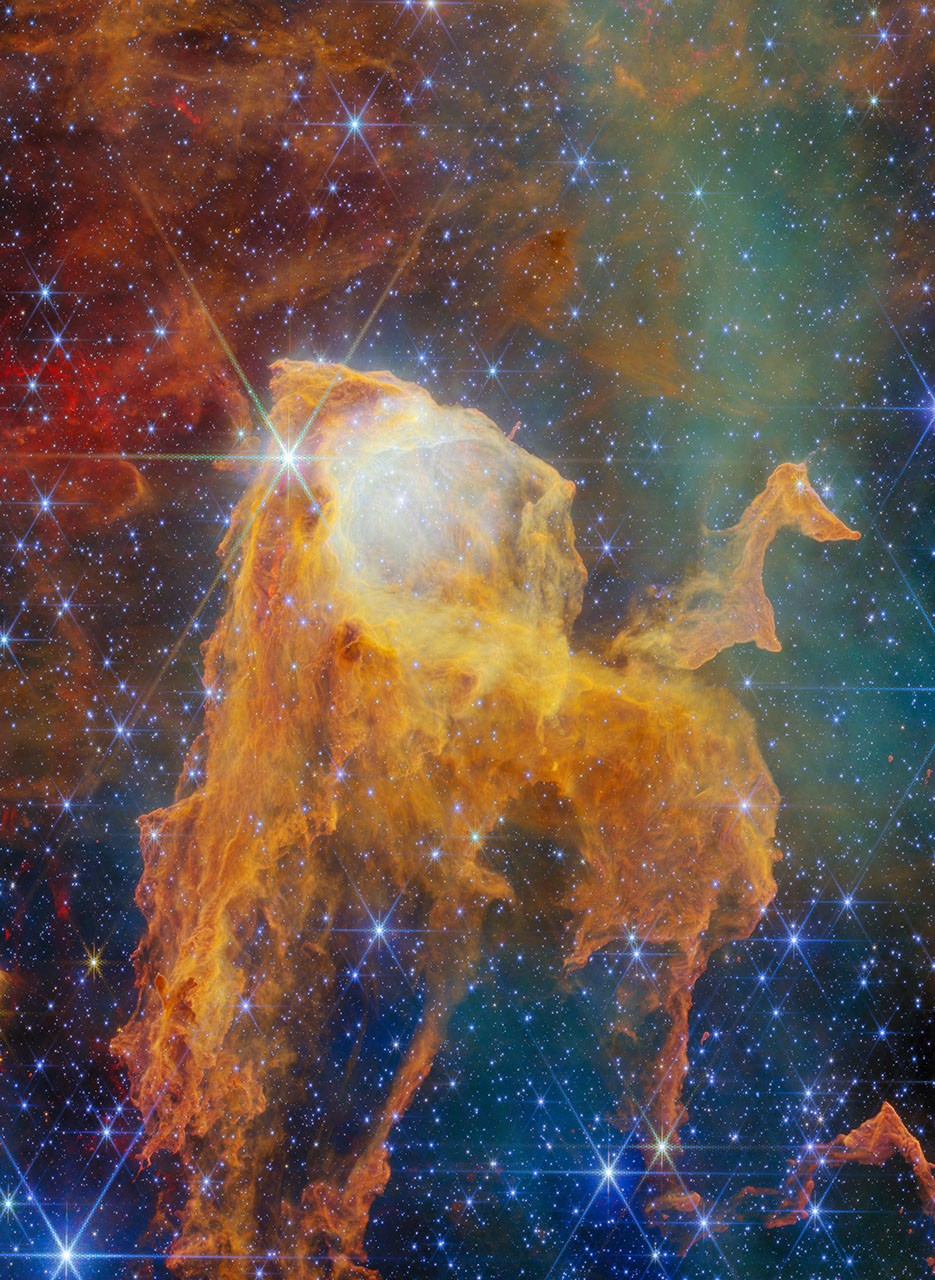
The advent of the James Webb Space Telescope marked a significant leap forward. Its infrared capabilities allow it to penetrate these dusty veils. The image featured here, taken by JWST, represents a new perspective on the Carina Nebula, revealing details that were previously inaccessible. The specific image of the "treasure chest" pillar was likely obtained as part of a broader survey or dedicated observation program focused on regions of active star formation. The selection of this particular image as the Astronomy Picture of the Day (APOD) highlights its exceptional scientific significance and aesthetic appeal.
The date associated with this image, September 17, 2026, indicates that this is a forward-looking release, suggesting a planned publication schedule for APOD. This implies that the scientific analysis and interpretation of the data have been ongoing for some time, culminating in this public presentation. The credit for the image is attributed to a consortium of space agencies – ESA, Webb (referring to the telescope itself), NASA, and CSA – along with individual researchers like M. Reiter and acknowledgments to M. H. Őzsaraș, underscoring the collaborative nature of modern space science.
Supporting Data and Analysis
The estimated distance to the Carina Nebula, around 7,500 light-years, places it within our galactic neighborhood, making it an accessible laboratory for studying stellar evolution. The presence of a massive star estimated to be 19 times the mass of the Sun within a cluster of 70 stars is statistically significant. Such massive stars are relatively rare but play a disproportionately large role in galactic evolution due to their intense radiation, strong stellar winds, and eventual explosive deaths as supernovae. These events can trigger or quench star formation in their vicinity, contributing to the complex interplay of galactic processes.
The age of the star cluster, approximately 1.3 million years, is remarkably young. This allows astronomers to study stars in their very early evolutionary stages, providing crucial data for testing and refining models of stellar birth and evolution. The density of stars within this cluster suggests a highly efficient star-forming environment, where gravitational forces are strong enough to compact a significant number of stars within a relatively small volume.
The composition of the interstellar gas and dust is also a key area of study. These materials are the building blocks of stars and planets. By analyzing the spectral signature of the light emitted and absorbed by these materials, astronomers can determine their chemical composition, which in turn provides clues about the conditions under which stars and planets form and the potential for habitability in other planetary systems.
Official Responses and Acknowledgment
The Astronomy Picture of the Day (APOD) program, a long-standing initiative by NASA, serves to disseminate captivating astronomical imagery and scientific insights to a global audience. The decision to feature this JWST image of the Carina Nebula underscores its importance and visual appeal. The collaborative nature of the JWST mission, involving NASA, ESA, and CSA, is reflected in the credit given to these agencies. The inclusion of individual researchers and acknowledgments highlights the dedication of the scientific community in pushing the boundaries of our understanding.
NASA’s commitment to public outreach through programs like APOD is crucial for fostering interest in science and inspiring future generations of researchers. The move of the APOD main NASA site to science.nasa.gov/apod signifies an ongoing effort to consolidate and enhance access to NASA’s vast scientific resources.
Broader Impact and Implications
The unveiling of cosmic treasures like this "treasure chest" nebula has profound implications beyond pure scientific inquiry. It ignites a sense of wonder and curiosity about our place in the universe. Images captured by telescopes like JWST serve as powerful educational tools, making complex scientific concepts accessible and engaging for people of all ages. They can inspire students to pursue careers in science, technology, engineering, and mathematics (STEM), contributing to future advancements in our understanding of the cosmos and our own planet.
Furthermore, these discoveries contribute to our broader philosophical understanding of the universe. The realization that the raw materials for stars and planets are abundant throughout the cosmos, and that star formation is a continuous and dynamic process, has implications for our search for life beyond Earth. By studying the conditions under which stars and planetary systems form, we gain insights into the likelihood of similar processes occurring elsewhere in the universe.
The ongoing exploration of nebulae like Carina also helps us to better understand our own solar system’s origins. By studying the formation of other planetary systems, astronomers can glean insights into the early history of our own, potentially uncovering clues about how Earth formed and evolved, and what factors contribute to the emergence of life. The "treasure chest" of stars within the Carina Nebula serves as a potent reminder of the ongoing cosmic dance of creation and evolution, a spectacle that continues to unfold, revealing new wonders with every passing observation. The implications of such discoveries are far-reaching, shaping our perception of the universe and our place within it, and fueling our insatiable desire to explore and understand the mysteries that lie beyond our terrestrial home.