Electron microscopes have long been indispensable tools for visualizing structures far beyond the reach of conventional light microscopy, enabling groundbreaking discoveries in fields ranging from materials science to biology. However, despite their extraordinary capabilities, a team of researchers in Austria posits that traditional electron microscopy may be leaving a wealth of valuable information untapped. Their innovative approach seeks to harness the quantum properties of electrons, traditionally overlooked, by integrating an electron microscope with a quantum computer, promising a new era of high-resolution imaging with reduced sample damage.
The Limitations of Conventional Electron Microscopy
For decades, electron microscopy has operated on the principle of counting electrons that interact with a sample. In a standard system, a beam of electrons illuminates a specimen, and detectors measure how many electrons pass through, are scattered, or are emitted from the sample, building an image based on these quantitative measurements. This method has pushed the boundaries of visualization to the atomic scale, revealing intricate details of molecules, cells, and materials. Scanning Electron Microscopes (SEM) and Transmission Electron Microscopes (TEM), for instance, can resolve features down to fractions of a nanometer, far surpassing the diffraction limit of light.
However, this unparalleled resolution comes with a significant trade-off, particularly when dealing with delicate biological samples or radiation-sensitive materials. To achieve high-contrast, clear images, conventional electron microscopes often require a substantial flux of electrons. This intense electron exposure can inflict considerable damage on the specimen, altering its structure, causing denaturation, or even completely destroying it. For biological samples such as proteins, viruses, or cellular organelles, which are inherently fragile and hydrated, the electron dose needed for detailed imaging can render the results unreliable or impossible to obtain without artifacts. This fundamental challenge has driven researchers to seek methods that can extract more information from fewer electrons, thereby mitigating sample damage.
A Quantum Leap: Unlocking Hidden Information
The collaborative effort, spearheaded by researchers at TU Wien and involving teams from the University of Vienna, JKU Linz, and the University of Innsbruck, introduces a paradigm shift. Their central hypothesis is that each electron carries not only its quantifiable presence (which is counted in traditional microscopy) but also inherent quantum information that typically goes unutilized. This quantum information, if harnessed, could provide a deeper, more nuanced understanding of the electron’s interaction with the sample, allowing for the construction of clearer images from a significantly reduced electron dose.
"Today, we can image tiny details on the atomic scale," explains Philipp Haslinger from the Institute of Atomic and Subatomic Physics at TU Wien. "However, this requires a large number of electrons. And not every sample can be exposed to so many electrons without being damaged. This is often a problem, particularly when imaging biological samples such as individual proteins." The core challenge, therefore, lies in maximizing the information yield from each individual electron, making every electron count in a qualitatively richer way.
The Mechanism: Electron-Ion Entanglement
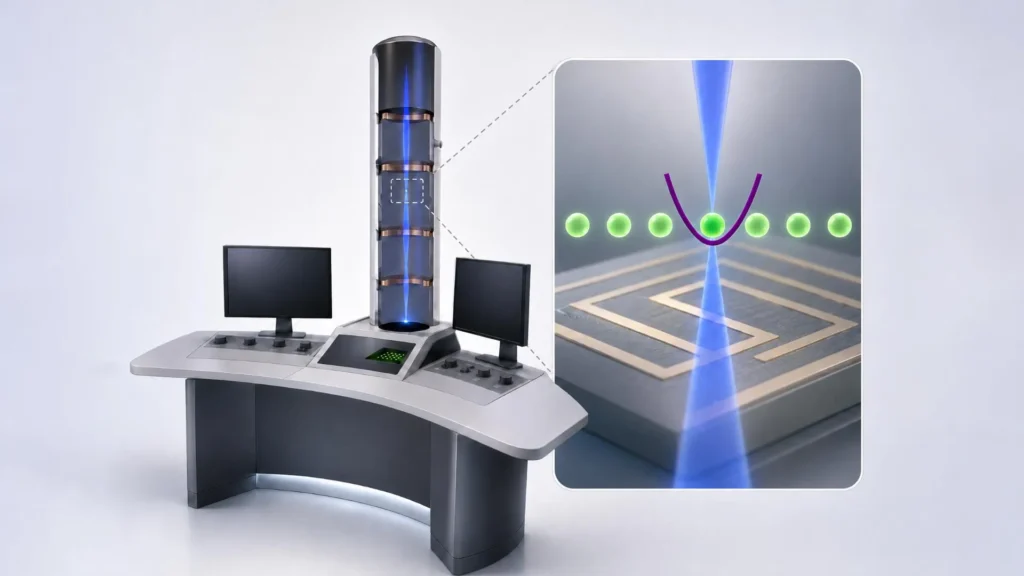
The innovative concept proposes connecting a specialized electron microscope to a quantum computer built around trapped ions. This integration is designed to capture and process the previously discarded quantum information. The groundbreaking idea involves creating quantum entanglement between the electrons passing through the microscope and the ions held within the quantum computer’s trap.
"Our idea is to combine the electrons with a quantum computer. We let them interact with ions that are held in place along the path of the electron beam," elaborates Elias Pescoller, first author of the publication and a doctoral student at the Institute for Theoretical Physics and the Institute of Atomic and Subatomic Physics at TU Wien. "This can, for example, create quantum entanglement between the electron and the quantum computer. The electron and the ion then share a joint quantum state."
Quantum entanglement is a phenomenon unique to quantum mechanics, where two or more particles become intrinsically linked, sharing a common fate regardless of the distance separating them. A measurement performed on one entangled particle instantaneously influences the state of the others. In this novel setup, as an electron interacts with the sample and then passes through the quantum computer, it becomes entangled with a trapped ion. This entanglement allows information about the electron’s interaction with the sample – information that would otherwise be lost or indistinguishable from noise – to be encoded and stored within the quantum state of the ion.
Quantum Algorithms for Signal Enhancement
The process doesn’t stop with a single electron. After one electron interacts and entangles with a trapped ion, another electron follows suit, also becoming entangled with the quantum computer. The power of this system lies in its ability to combine and process information from multiple electrons through a series of carefully orchestrated quantum operations.
"If we perform very specific quantum-computing operations each time, we can optimally combine the information from several electrons so that we obtain a signal of maximum strength even though we use only a relatively small number of electrons," states Dennis Rätzel from the Institute of Atomic and Subatomic Physics at TU Wien. These sophisticated quantum algorithms, crucial for translating weak quantum signals into robust, useful data, were developed in close collaboration with Johannes Kofler’s team at JKU Linz.
The fundamental imaging process remains rooted in the interaction of electrons with the specimen, similar to any conventional electron microscope. The transformative difference, however, lies in the quantum computer’s capacity to process and synthesize the quantum information carried by these electrons. This allows the system to extract details that would be utterly invisible or lost in the statistical noise of traditional electron counting methods.
"The electrons themselves are used to image small objects, just as in any other electron microscope. But by processing the quantum information carried by these electrons in a quantum computer, we can extract significantly more information from the process," explains Iva Bezinová from the Institute for Theoretical Physics at TU Wien. "What would previously have been indistinguishable from random noise can thus become a clear signal." This ability to differentiate subtle quantum states means scientists can recover crucial information that would otherwise be dismissed as irrelevant background. Elias Pescoller underscores this by stating, "Quantum physics allows us to overcome the statistical limits that constrain conventional electron microscopes."
From Theoretical Proof to Experimental Reality
The journey from a groundbreaking theoretical concept to a functional instrument is often long and arduous. In this case, the researchers have meticulously laid the mathematical groundwork, demonstrating the significant advantages their new method should offer. The next critical phase involves the experimental realization and validation of these theoretical predictions.
A quantum computer electron microscope based on this innovative concept is currently under construction at TU Wien. This ambitious undertaking involves the integration of a specialized ion-based quantum computer, which was developed by Philipp Schindler’s team at the University of Innsbruck, into an electron microscope system at TU Wien’s University Service Center for Transmission Electron Microscopy (USTEM). This collaboration exemplifies the interdisciplinary nature of modern scientific breakthroughs, bringing together expertise in quantum information, quantum computing, and advanced microscopy.
The project’s timeline has progressed from initial conceptualization and mathematical modeling to the current phase of hardware integration and system construction. The expectation is that, once operational, the system will undergo rigorous testing to experimentally demonstrate its ability to produce clearer images with fewer electrons than conventional methods. Success in this experimental phase would not only validate the theoretical framework but also pave the way for a new generation of electron microscopes.
Broader Impact and Implications
The successful implementation of this quantum-enhanced electron microscope holds profound implications across various scientific and technological domains:
-
Revolutionizing Biological Imaging: The most immediate and significant impact is anticipated in the life sciences. Imaging delicate biological structures – such as individual proteins, DNA strands, viruses, and cellular machinery – without causing damage has been a holy grail for decades. This technology could enable unprecedented insights into the structure and function of these molecules in their native states, accelerating drug discovery, vaccine development, and our fundamental understanding of diseases like cancer and neurodegenerative disorders. Researchers could observe dynamic biological processes with minimal perturbation, revealing mechanisms previously hidden.
-
Advancing Materials Science: In materials science, the ability to characterize novel materials at the atomic scale with greater detail and less beam damage would be transformative. This could accelerate the development of new superconductors, catalysts, semiconductors, and advanced composites. Understanding defects, grain boundaries, and atomic arrangements with enhanced precision is critical for optimizing material properties for applications in electronics, energy storage, and manufacturing. The quantum microscope could provide crucial data for designing next-generation materials with tailored functionalities.
-
Pioneering Quantum Technology Applications: Beyond microscopy, this project represents a significant step forward in demonstrating the practical utility of quantum computing in real-world scientific instruments. It showcases how quantum information science can be leveraged to overcome classical limits in measurement and sensing. This success could inspire further interdisciplinary research at the intersection of quantum physics, materials science, and engineering, fostering the development of other quantum-enhanced scientific tools.
-
Technological Leadership and Economic Impact: For Austria, this project solidifies its position as a leader in quantum technology and advanced scientific instrumentation. The Cluster of Excellence quantA, which coordinates the consortium, aims to foster world-class research and innovation. Such pioneering technologies can lead to the creation of new industries, attract investment, and develop a highly skilled workforce, contributing to economic growth and technological sovereignty.
The collaborative spirit underpinning this endeavor is a key factor in its potential success. Thomas Juffmann from the University of Vienna emphasizes this: "It is really exciting that, within the quantA Cluster of Excellence, we can combine the expertise in quantum information, quantum computing and electron microscopy available at the different universities in Austria. This allows us to launch a unique project."
The consortium receives major funding from the Austrian Science Fund (FWF) through the Cluster of Excellence quantA, and from the Gordon and Betty Moore Foundation. This substantial support underscores the high potential recognized by leading scientific funding bodies. If the system performs as expected, this quantum-enhanced electron microscope could fundamentally alter how scientists observe the microscopic world, revealing details previously obscured and opening new avenues for discovery across diverse scientific disciplines. The future of imaging at the atomic scale appears to be increasingly quantum.