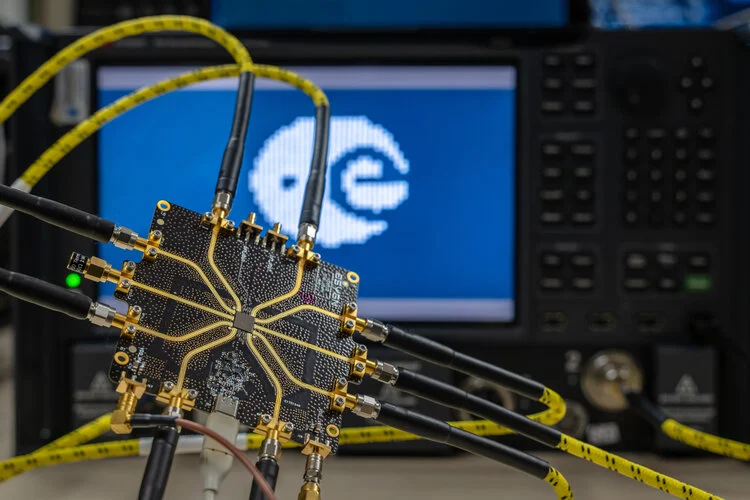
The silent revolution in satellite communication and beyond is being orchestrated by a minuscule component: the beamforming integrated circuit. These tiny, yet powerful, microchips, nestled at the heart of electronic circuit boards, are fundamentally reshaping how we interact with the radio spectrum. They are the unsung heroes enabling the development and widespread adoption of phased array antennas, a technology poised to redefine connectivity across numerous sectors, from global navigation to deep space exploration. The European Space Agency (ESA), a long-standing pioneer in this domain, recently showcased a significant leap forward in this field through a compelling technology demonstration featuring the latest generation of beamforming integrated circuits developed by the French company Asygn. This advancement not only highlights cutting-edge performance but also underscores Europe’s growing strategic advantage in securing a robust and independent supply chain for these critical components.
The Evolution of Antenna Technology: From Mechanical Tilt to Electronic Precision
For decades, the established method for maintaining a consistent link with a target in satellite communication and other radio-frequency applications involved mechanical antennas. These systems relied on physical movement, often through the precise tilting and rotation of an antenna dish, to track and connect with their intended recipient. While effective, this approach inherently presented limitations. Mechanical systems are susceptible to wear and tear, requiring regular maintenance and increasing the potential for failure, particularly in harsh environments such as space. Furthermore, the physical constraints of moving parts can limit the speed and agility with which an antenna can reorient itself, impacting the responsiveness of communication systems.
The advent of phased array antennas has dramatically altered this paradigm. These sophisticated systems eliminate the need for any moving parts, achieving a level of agility and reliability previously unimaginable. At their core, phased array antennas employ an array of individual antenna elements, each of which can be independently controlled. This control is exerted through specialized microchips known as beamforming integrated circuits. These chips are responsible for precisely manipulating the phase and amplitude of the radio signals transmitted or received by each element. By orchestrating these subtle adjustments across the entire array, the antenna can electronically steer its radio beams in any direction with remarkable speed and accuracy. This process, known as beamforming, allows for the creation of highly directional beams that can be rapidly redirected without any physical movement.
The Microchip’s Ascent: Enabling Compact, Reliable, and Affordable Phased Array Antennas
The miniaturization of these beamforming integrated circuits, propelled by advancements in modern silicon semiconductor technologies, has been a pivotal factor in the widespread adoption of phased array antennas. As these chips have become smaller and more powerful, they have enabled the design of phased array antennas that are not only more compact but also significantly more reliable and cost-effective. This technological evolution has opened the door for their integration into an ever-expanding range of applications.
In satellite communications, phased array antennas are revolutionizing broadband internet access, enabling higher data rates and more resilient connections. For global navigation systems, they enhance precision and signal integrity. In Earth observation, they facilitate the collection of more detailed and timely data about our planet. And in space missions, their compact size and reliability are invaluable for spacecraft with limited payload capacity and demanding operational requirements.
ESA’s Enduring Commitment to Beamforming Innovation
The European Space Agency has long recognized the transformative potential of beamforming technology. For decades, ESA has been at the forefront of research and development in this critical area, consistently exploring innovative ways to electronically steer radio beams for both space-based and terrestrial applications. "For decades, ESA has been at the forefront of beamforming technology, exploring innovative ways to electronically steer radio beams for space and terrestrial applications," states Václav Valenta, ESA’s engineer and a leading expert in phased array technology. His assertion underscores the agency’s sustained investment and strategic vision in fostering advancements that drive technological progress.
The agency’s current strategic focus is particularly keen on the development of highly integrated analogue and digital beamforming chips. The emphasis is on solutions that are not only designed and manufactured within Europe but also offer cutting-edge performance. "Today, the focus is increasingly shifting towards highly integrated analogue and digital beamforming chips both designed and manufactured in Europe," Valenta elaborates. "These developments combine cutting-edge performance with the strategic advantage of a secure European supply chain." This dual objective – pushing the boundaries of technological capability while simultaneously fortifying European industrial autonomy – is a hallmark of ESA’s forward-looking approach.
Asygn’s Next-Generation Beamforming Integrated Circuits: A Tangible Demonstration
A recent technology demonstration at ESA’s RF Active Technology Laboratory at the European Space Research and Technology Centre (ESTEC) provided a compelling illustration of these advancements. The French company Asygn, a specialist in radio frequency integrated circuits, presented its new generation of beamforming integrated circuits, showcasing the tangible results of this European collaborative effort.
To vividly demonstrate the sophisticated level of control that Asygn’s microchip offers over beamforming, the company’s engineers presented a visually striking addition to their showcase. This consisted of the blue-and-white ESA logo, ingeniously rendered not as a static image, but as a dynamic composition of hundreds of individual dots. Each of these dots was precisely positioned by a specific amplitude and phase setting of the beamformer, a testament to the chip’s fine-grained control over the radio beam. This creative display effectively translated complex technical capabilities into an easily understandable and memorable visual representation, highlighting the precision and versatility of the technology.
Precision Engineering for Mission-Critical Applications
The performance metrics and design philosophy behind Asygn’s new beamforming integrated circuits are tailored to meet the stringent demands of modern space missions. Clement Jany, Radio Frequency business unit co-director at Asygn, elaborated on the company’s approach. "By designing single-chip solutions dedicated to specific frequency bands – notably X and Ka – we achieve the very high levels of performance required for mission-critical satellite communication applications," he stated. The X-band (8 to 12 GHz) and Ka-band (26.5 to 40 GHz) are crucial frequency bands for satellite communication, offering significant bandwidth and enabling high data rates. The ability to create integrated circuits optimized for these specific bands allows for maximum efficiency and performance.
Jany further emphasized the practical benefits for system integrators: "Our objective is to simplify system integration for phased array antenna manufacturers by delivering high-precision phase and amplitude control and an ultra-low noise figure on a single chip." The integration of these critical functions onto a single chip significantly reduces the complexity, size, and power consumption of phased array antenna systems. An ultra-low noise figure is paramount for ensuring the integrity of received signals, especially in scenarios where signals are weak or subject to interference. This focus on providing a comprehensive, high-performance solution on a single chip directly addresses the needs of antenna manufacturers seeking to streamline their development processes and enhance the overall capabilities of their products.
Broader Implications and the Future of European Space Technology
The successful demonstration by Asygn, supported by ESA’s strategic vision and laboratories, signifies more than just a technological achievement. It represents a critical step in bolstering Europe’s self-sufficiency in a strategically vital technological domain. As global reliance on satellite services continues to surge, the ability to independently design, manufacture, and deploy advanced components like beamforming integrated circuits becomes increasingly important for national security, economic competitiveness, and technological sovereignty.
The trend towards highly integrated analogue and digital beamforming chips aligns with the broader trajectory of the semiconductor industry towards System-on-Chip (SoC) and System-in-Package (SiP) solutions. These integrated approaches offer significant advantages in terms of performance, power efficiency, and miniaturization. For phased array antennas, this translates into lighter, more energy-efficient, and more cost-effective systems that can be deployed in a wider array of platforms and applications.
Supporting Data and Context:
- Market Growth: The global phased array antenna market is projected to grow significantly in the coming years. Reports indicate a compound annual growth rate (CAGR) of over 10% from 2023 to 2028, driven by the expansion of 5G networks, satellite internet services, and advanced radar systems.
- Frequency Bands: X-band is commonly used for satellite communications, weather radar, and military applications. Ka-band offers higher bandwidth, making it ideal for broadband satellite internet, high-resolution Earth observation, and advanced radar systems. The development of integrated circuits optimized for these bands is therefore crucial for future growth.
- ESA’s Role in Technology Development: ESA’s Directorate of Technology, Engineering and Quality (DTEQ) plays a vital role in funding and supporting the development of critical space technologies through its General Support Technology Programme (GSTP) and other initiatives. These programs aim to mature technologies from laboratory concepts to flight-ready systems, fostering European industrial capabilities.
- Timeline of Advancement: The development of beamforming technology has been an evolutionary process. Early phased arrays, often bulky and complex, emerged in the mid-20th century for military radar applications. The integration of semiconductor technology in the late 20th and early 21st centuries enabled significant miniaturization and performance enhancements, leading to the sophisticated integrated circuits demonstrated today.
Analysis of Implications:
The successful development and demonstration of these advanced beamforming integrated circuits by Asygn, in collaboration with ESA, have several key implications:
- Enhanced European Competitiveness: By fostering a strong domestic supply chain for critical semiconductor components, Europe reduces its reliance on external suppliers, enhancing its resilience against geopolitical disruptions and technological embargoes. This also positions European companies to compete more effectively in the global market for advanced antenna systems.
- Accelerated Innovation in Space and Beyond: The availability of high-performance, integrated beamforming chips will accelerate the development and deployment of next-generation satellite constellations, advanced Earth observation missions, and new space-based services. The benefits will extend beyond space, impacting terrestrial applications such as advanced wireless communication, automotive radar, and medical imaging.
- Strategic Importance of Integrated Circuits: The demonstration underscores the critical importance of integrated circuits as enabling technologies. Investments in semiconductor design and manufacturing capabilities within Europe are therefore paramount for maintaining technological leadership and economic prosperity.
- Future-Proofing Communication Systems: As data demands continue to escalate and new spectrum allocations are explored, the ability to precisely and dynamically steer radio beams will be indispensable. The innovations showcased by Asygn and ESA are laying the groundwork for the communication systems of the future.
The ongoing collaboration between European space agencies and industry partners, exemplified by the work of Asygn and ESA, is vital for securing Europe’s position at the forefront of technological innovation. The miniature black chip, once a hidden component, is now a symbol of sophisticated engineering and strategic foresight, paving the way for a more connected and data-rich future. The ability to precisely control radio waves with such elegance and efficiency is not just an engineering feat; it is a cornerstone of future global connectivity and scientific discovery.