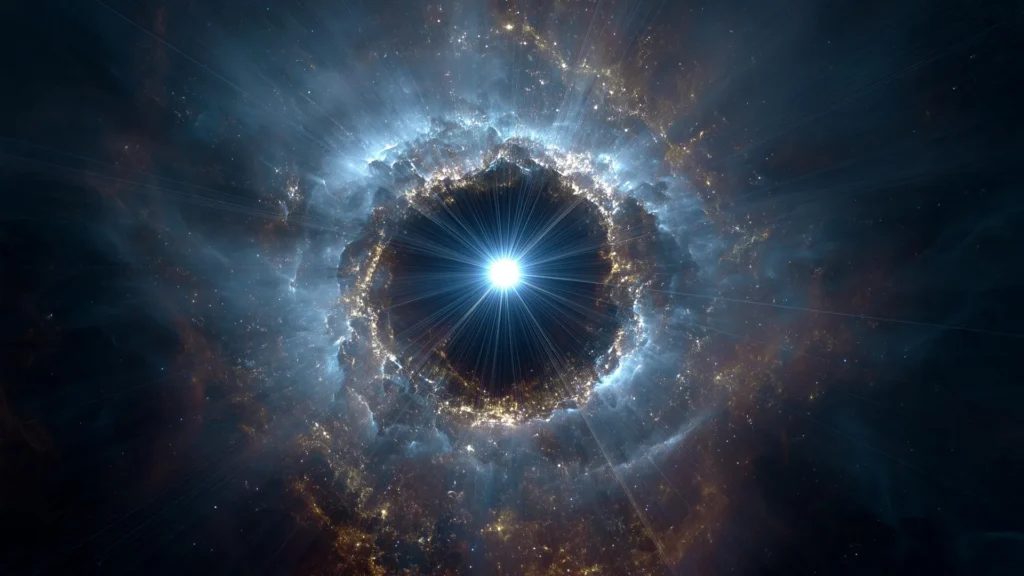
This groundbreaking research, published as a Letter in Physical Review D by Colgate University scientists Sohan Ghodla and Cosmin Ilie, proposes a compelling link between the universe’s infancy and its current gravitational wave symphony. Their work explores whether supermassive black holes that originated during the "cosmic dawn" — a pivotal epoch when the first stars and galaxies ignited — could be responsible for a significant portion of the gravitational wave background currently being measured by Pulsar Timing Arrays (PTAs). The study bridges two seemingly disparate fields of astronomy: the observations of unexpectedly massive black holes in the early universe and the gravitational waves produced billions of years later by spiraling binary supermassive black holes.
The Enigma of the Gravitational Wave Background
Gravitational waves, ripples in spacetime predicted by Albert Einstein over a century ago, were first directly detected in 2015 by the LIGO experiment, originating from merging stellar-mass black holes. However, the universe also resonates with a much lower-frequency hum – a stochastic gravitational wave background (SGWB). This cosmic background noise is thought to be generated by a myriad of merging supermassive black hole binaries, each weighing millions to billions of times the mass of our Sun, as they slowly spiral towards each other in the hearts of colliding galaxies.
Detecting these incredibly long-wavelength gravitational waves, with periods ranging from months to years (nanohertz frequencies), requires an entirely different approach than the high-frequency waves detected by ground-based interferometers like LIGO, Virgo, and Kagra. This is where Pulsar Timing Arrays come into play. PTAs leverage networks of rapidly spinning neutron stars, known as pulsars, which act as exceptionally precise cosmic clocks. These celestial objects emit radio pulses at incredibly regular intervals, often with millisecond precision. As a gravitational wave passes between Earth and a pulsar, it subtly stretches and compresses spacetime, causing tiny, measurable deviations in the arrival times of these radio pulses. By meticulously monitoring dozens of pulsars across the galaxy over many years, international consortia—including the North American Nanohertz Observatory for Gravitational Waves (NANOGrav), the European Pulsar Timing Array (EPTA), the Parkes Pulsar Timing Array (PPTA) in Australia, and the Indian Pulsar Timing Array (InPTA)—have amassed evidence for this faint, pervasive gravitational wave background.
In June 2023, these global collaborations independently announced strong evidence for a common signal across their respective pulsar networks, widely interpreted as the first detection of the nanohertz gravitational wave background. This momentous discovery has opened an entirely new window into the universe, allowing scientists to probe phenomena on scales and timescales previously unimaginable. The most widely accepted astrophysical explanation for this background is indeed a population of supermassive black hole binaries, whose combined masses often exceed a billion solar masses, making significant contributions at the nanohertz frequencies detected by PTAs.
The "Seed Problem" at Cosmic Dawn
While the existence of supermassive black hole binaries is well-established, their origins present a profound cosmological puzzle, often referred to as the "seed problem." Observations from advanced telescopes like the James Webb Space Telescope (JWST) and the Chandra X-ray Observatory have repeatedly uncovered surprisingly massive black holes (some weighing millions to billions of solar masses) existing at incredibly early stages of cosmic history, mere hundreds of millions of years after the Big Bang. For instance, JWST has identified active galactic nuclei (AGNs) powered by supermassive black holes at redshifts exceeding z=10, indicating their presence when the universe was less than 500 million years old. One such object, JADES-GS-z11-0, harbors a black hole estimated to be tens of millions of solar masses at z=11.5, posing a significant challenge to conventional black hole formation models.
The rapid growth required for these colossal objects to form so early in the universe’s history has intensified interest in formation mechanisms capable of producing large "seed" black holes very quickly. Traditional models, involving the collapse of the first massive stars (Population III stars) to form seeds of tens to hundreds of solar masses, struggle to explain how these seeds could accrete enough material to reach billion-solar-mass scales in such a short cosmological timeframe. This has led researchers to consider alternative, more exotic scenarios for generating massive initial seeds.
Connecting Ancient Seeds to Modern Waves
Ghodla and Ilie’s study directly tackles this challenge by investigating whether the descendants of such ancient, massive black hole seeds could persist through cosmic time, grow alongside their host galaxies, eventually pair up during galaxy mergers, and generate the gravitational wave background detected billions of years later. Their research posits a direct causal link, suggesting that the ripples we detect today could carry information from the earliest moments of black hole formation.
"Pulsar timing arrays are usually thought of as probes of supermassive black-hole binaries in the relatively recent Universe," explained Cosmin Ilie. "What our work shows is that the signal may also contain information about how the ancestors of those black holes formed at cosmic dawn. In that sense, gravitational waves observed today could provide a new window onto the birth of the first supermassive black holes."
Two Pathways to Primordial Black Hole Seeds
The researchers explored two primary hypothetical routes for producing massive black hole seeds in the early universe:
-
Direct Collapse Black Holes (DCBHs): This scenario involves the direct collapse of massive primordial gas clouds, typically forming black holes with masses ranging from 10,000 to 100,000 solar masses. For DCBHs to form, specific, extreme conditions must be met: the gas must be pristine (composed only of hydrogen and helium), molecular hydrogen cooling must be suppressed (often by a strong ultraviolet background radiation from nearby star-forming galaxies), and the gas cloud must collapse isothermally. These conditions are thought to be rare, limiting the number density of DCBHs.
-
Black Holes Formed Through the Collapse of Supermassive Dark Stars: This more exotic, yet increasingly compelling, hypothesis centers on "Dark Stars." These are hypothetical primordial stars that would derive much of their energy from the annihilation of dark matter particles (specifically Weakly Interacting Massive Particles, or WIMPs) within their cores, rather than relying primarily on conventional nuclear fusion. In the WIMP dark matter scenario considered by Ghodla and Ilie, these Dark Stars could remain relatively cool and extended, allowing them to continuously accrete vast amounts of gas from their surroundings. Under the right conditions, they might grow to truly colossal sizes, reaching a million times the mass of the Sun or even more, before eventually collapsing to form massive black hole seeds. The self-annihilation of dark matter within their cores provides a powerful internal heat source, counteracting gravitational collapse and enabling them to grow to immense proportions.
Modeling Cosmic Evolution and Gravitational Wave Production
To test their hypotheses, Ghodla and Ilie developed sophisticated cosmological models. They tracked the evolution of dark matter halos—the invisible scaffolding of the universe—that would host these early black hole seeds. They then estimated how frequently these objects would merge as their host galaxies collided over billions of years. Crucially, they calculated the cumulative gravitational wave background that these mergers would produce, comparing it against the signal currently detected by PTAs.
Their results revealed a striking difference between the two proposed seed populations. If remnants of supermassive Dark Stars existed at a number density of approximately 10^-3 per cubic megaparsec (Mpc^-3), their descendants could potentially provide a large, and possibly dominant, share of the gravitational wave signal measured by PTAs. This density is high enough to generate the observed background, suggesting that Dark Stars could be the primary progenitors of the supermassive black holes responsible for the nanohertz gravitational waves.
In contrast, the direct collapse black hole population, under the parameters considered in the study, appears to have been much less common. With characteristic densities near 10^-6 Mpc^-3, these objects would contribute substantially less to the observed signal. This finding suggests that while DCBHs might exist, they are unlikely to be the primary drivers of the stochastic gravitational wave background detected by PTAs.
PTAs as Probes of Cosmic Dawn
One of the study’s most profound conclusions is that current PTA measurements can place concrete limits on how common the earliest seeds of supermassive black holes could have been. The detected gravitational wave background provides a cosmic odometer, effectively telling us how many large black hole mergers have occurred throughout the universe’s history.
"Produce too many of these massive seeds and you end up over-producing the PTA-detected signal. Produce too few, and you need other sources to efficiently assemble these supermassive black holes later in the life of the universe to match PTA observations," said Sohan Ghodla.
Within the models examined by the researchers, seed densities around the 10^-2 to 10^-1 Mpc^-3 range would begin generating more gravitational wave background than current observations allow. The precise upper limit depends strongly on the masses of the dark matter halos where those seeds originally formed. This exquisite sensitivity gives PTA observations an unexpected and powerful ability to probe extremely ancient populations of objects—those that existed at redshifts greater than 10 (corresponding to less than 500 million years after the Big Bang)—even though the mergers of their descendants that create the gravitational waves happen much later in cosmic history.
The calculations also reinforced an earlier finding in the field: binary systems with a total black hole mass roughly above 10^9 solar masses overwhelmingly dominate the predicted PTA signal. Binary systems containing less massive black holes, while perhaps more numerous, contribute far less to the overall gravitational wave background in the nanohertz frequency range due to their lower energy output at these specific wavelengths. This implies that PTAs are particularly sensitive to the most massive black hole binaries, which in turn points back to the need for massive initial seeds.
Connecting Dark Matter, Dark Stars, and Black Holes
The findings of Ghodla and Ilie create a crucial new observational link between several major, unresolved questions in modern cosmology and astrophysics. These include:
- The Nature of Dark Matter: If Dark Stars are indeed the progenitors of a significant fraction of supermassive black holes, then the properties of dark matter, particularly its ability to self-annihilate, become directly testable through gravitational wave astronomy. This provides a novel, indirect probe of dark matter candidates like WIMPs.
- The Formation of the First Luminous Objects: Dark Stars represent a unique class of primordial objects that could have formed before or alongside the first conventional stars, influencing the early chemical enrichment and ionization of the universe.
- The Origins of Supermassive Black Holes: The study offers a concrete, testable mechanism for forming the massive seeds required to explain the early appearance of supermassive black holes observed by JWST and Chandra.
- The Gravitational Waves that Travel Through the Universe: The research highlights the immense power of gravitational wave astronomy not just to detect events, but to infer the conditions and processes of the very early universe.
"Dark Stars were originally proposed as objects that might be seen directly at cosmic dawn," Ilie noted. "This work points to a completely different way of testing their possible role in cosmic history. Their descendants could leave a gravitational-wave imprint that persists all the way to the present-day Universe."
The implications are profound. This research provides a robust theoretical framework for interpreting the nascent field of nanohertz gravitational wave astronomy. It suggests that as Pulsar Timing Array measurements become more precise, and as astronomers improve their understanding of distant black holes and the galaxies that hosted them, researchers may soon be able to distinguish more clearly among competing explanations for how the universe’s first supermassive black holes formed. Future observations could potentially confirm or refute the Dark Star hypothesis, providing a transformative insight into the genesis of cosmic structures and the enigmatic nature of dark matter itself. The universe’s hum, it turns out, might just be an echo of its earliest song.