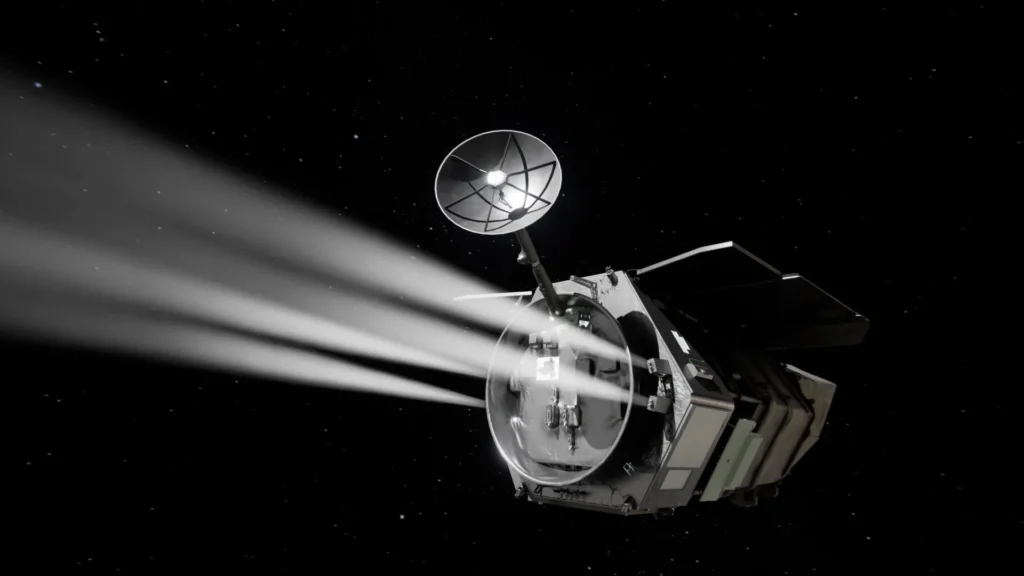
The Nancy Grace Roman Space Telescope, NASA’s ambitious next-generation observatory, is poised for a significantly longer operational life than initially anticipated, potentially more than doubling its planned mission duration. This remarkable extension is largely attributed to an exceptionally precise first mid-course correction maneuver, coupled with other strategic fuel conservation measures enacted during its journey to its operational orbit. These advancements suggest that Roman could be exploring the cosmos and delivering groundbreaking scientific data for at least 22 years, a testament to meticulous planning and engineering prowess.
"As a result of exquisite planning by our orbital dynamics team, brilliant execution by the operations team, and a precise launch from SpaceX, Roman has fuel for at least 22 years of potential science operations," stated Jamie Dunn, center director at NASA’s Goddard Space Flight Center in Greenbelt, Maryland. This optimistic outlook represents a dramatic shift from the observatory’s original design parameters, which envisioned a decade of scientific exploration.
Fuel Savings: A Trifecta of Efficiency
The projected longevity of the Roman Space Telescope is the product of a confluence of factors, each contributing to a substantial reduction in fuel consumption. Firstly, the observatory utilized far less propellant than projected during its inaugural course correction maneuver. Secondly, it carried a greater reserve of propellant at launch than initially deemed necessary. Finally, current projections indicate that Roman is expected to conserve even more fuel during its upcoming second mid-course correction and subsequent orbital insertion.
Original Design and the Critical Role of Propellant
The Nancy Grace Roman Space Telescope was originally conceived and engineered with a five-year primary mission, followed by a five-year extended mission. This ten-year operational lifespan was predicated on a carefully calculated fuel budget, recognizing propellant as the spacecraft’s most critical consumable resource. In the vacuum of space, where refueling is not an option, every kilogram of propellant saved during transit and throughout its mission translates directly into additional years of valuable scientific observations. This principle underscores the profound impact of even minor efficiencies on the long-term utility of a space observatory.
The First Burn: A Remarkable Achievement
The observatory executed its inaugural trajectory adjustment burn on August 31st, a critical maneuver designed to guide Roman toward its ultimate orbital destination. Since this initial burn, the mission control team has been meticulously analyzing its impact on the spacecraft’s long-term fuel outlook. The results of this analysis have far exceeded expectations.
The first mid-course correction was executed with an astonishing accuracy exceeding 99%. This precision meant that the maneuver consumed less than 10% of the fuel specifically allocated for it. Roman utilized approximately 40 pounds (18 kilograms) of propellant, a stark contrast to the planned allocation of 441 pounds (200 kilograms). This single maneuver, therefore, has the potential to add roughly four additional years to the observatory’s operational life, a significant bonus that was not factored into the original mission planning.
Supporting Data: Precision in Numbers
To fully appreciate the magnitude of this achievement, consider the context of orbital mechanics. Spacecraft maneuvers, especially those involving significant trajectory changes, require precise calculations and execution to avoid overshooting or undershooting the target trajectory. Even small deviations can necessitate larger, more fuel-intensive corrections later on. The exceptional accuracy of Roman’s first burn indicates a high degree of confidence in the orbital dynamics models and the spacecraft’s thruster control systems.
Extra Propellant at Launch: A Conservative Approach Pays Off
Beyond the fuel saved during its first maneuver, Roman also benefited from a strategic decision made during its design and launch phases: it began its journey with a larger propellant reserve than originally calculated as strictly necessary.
Engineers responsible for Roman’s fuel requirements adopted a conservative approach, basing their calculations on a maximum projected weight of 21,605 pounds (9,800 kilograms). However, the actual launch weight of the spacecraft was considerably less, weighing in at just 17,760 pounds (8,056 kilograms). This substantial difference in mass had a direct impact on fuel needs. A lighter spacecraft requires less propellant for propulsion, including the crucial mid-course corrections.
Moreover, this lower launch mass allowed the mission team to fill Roman’s propellant tanks to their full capacity. Instead of carrying only enough fuel to support the original 10-year mission, they were able to maximize the propellant load. This additional fuel, carried from the outset, is now estimated to support approximately four more years of operational time.
"A spacecraft’s mass changes throughout the design and build process, so we base the propellant budget on a set maximum value so we won’t come up short," explained Alison Rao, the Roman propulsion lead at NASA Goddard. "We track the propellant needed based on actual mass throughout integration and testing as well, to make sure we have wiggle room. Since Roman’s was lower than we budgeted for, we were able to fill the propellant tanks to their capacity rather than only filling them as much as we needed to for the 10-year requirement." This proactive approach highlights the foresight of the engineering teams in anticipating potential weight variations and ensuring ample resources for the mission.
Anticipating Further Fuel Savings: The Second Correction
The success of Roman’s initial mid-course correction is also expected to streamline and reduce the fuel requirements for its second and final trajectory adjustment. This subsequent maneuver, now scheduled for later this month, will provide the precise amount of energy needed for Roman to achieve its final operational orbit at the Sun-Earth L2 Lagrange point.
Because the first burn was so remarkably accurate, mission controllers have the luxury of waiting longer before initiating the follow-up adjustment. This extended waiting period allows for a more refined calculation of the exact orbital adjustments needed, further minimizing the fuel expenditure for the second correction.
Current estimations suggest that both the second correction and the subsequent orbital insertion maneuvers will consume less fuel than originally budgeted. When combined, these anticipated savings could contribute an additional four years to the mission’s potential lifespan, leaving even more propellant available for future scientific endeavors.
Chronology of Roman’s Journey to L2
- Launch: The Nancy Grace Roman Space Telescope was launched by SpaceX.
- August 31st: First mid-course correction burn performed with exceptional accuracy.
- Post-August 31st: Mission team analyzes fuel outlook based on the first burn’s performance.
- Late October/Early November (current month): Second mid-course correction and orbital insertion maneuvers are scheduled.
- Early December: Roman is expected to arrive at its permanent orbit around the Sun-Earth L2 Lagrange point, approximately 100 days after launch.
Maintaining Orbit: Routine Station-Keeping
Once Roman has successfully settled into its stable orbit around the L2 point, the ongoing task of maintaining its precise position will require only periodic "station-keeping" burns. These are typically small, infrequent adjustments made to counteract minor gravitational perturbations and solar radiation pressure. It is estimated that these burns will be needed about once every 28 days, a relatively low consumption rate that further conserves propellant over the long term.
Implications for Future Scientific Discoveries
The extended operational life of the Nancy Grace Roman Space Telescope holds profound implications for the scientific community and our understanding of the universe. Roman is equipped with a 2.4-meter primary mirror, the same size as Hubble’s, but with a field of view 100 times larger. This powerful combination allows it to survey vast areas of the sky with unprecedented speed and detail.
Initially, Roman’s primary scientific goals include:
- The Dark Energy Survey: Mapping the distribution of dark energy by observing the positions and shapes of billions of distant galaxies. This could shed light on the mysterious force accelerating the expansion of the universe.
- The Exoplanet Microlensing Survey: Detecting thousands of exoplanets, including those that are Earth-sized and in the habitable zones of their stars, using a technique called gravitational microlensing. This method is particularly adept at finding planets far from their stars, which are often missed by other detection methods.
- The Infrared Sub-millimeter Lens Mode Survey: Observing the dusty stellar nurseries where stars and planets are born, providing insights into the early stages of star formation and planetary system development.
An extended mission duration means that Roman can delve deeper into these groundbreaking investigations, potentially collecting more data, refining its observations, and even pursuing new scientific questions that may emerge as the mission progresses. It also provides a greater opportunity for international collaboration and for a wider range of scientific proposals to be accommodated.
Background Context: A Legacy of Observational Power
The Nancy Grace Roman Space Telescope is named in honor of Nancy Grace Roman, a pioneering astronomer who was instrumental in the development of NASA’s space telescope programs. Often referred to as the "Mother of Hubble," Roman played a key role in the planning and funding of the Hubble Space Telescope, which has revolutionized our understanding of the cosmos over the past three decades. The Roman Space Telescope is seen as a spiritual successor to Hubble, designed to tackle some of the most fundamental questions in astrophysics and cosmology. Its development has been a collaborative effort involving numerous NASA centers, including Goddard Space Flight Center, and industry partners.
The Sun-Earth L2 Lagrange point, where Roman will be stationed, offers a stable vantage point for astronomical observations. Located approximately 1.5 million kilometers (930,000 miles) from Earth, away from the Sun, it provides a thermally stable environment and minimizes interference from Earth’s light and heat. This location is ideal for infrared observations, as it allows the telescope to remain cold and detect faint infrared signals from distant celestial objects.
Conclusion: A Brighter Future for Astronomical Exploration
The exceptional fuel efficiency demonstrated by the Nancy Grace Roman Space Telescope’s initial maneuvers, coupled with strategic planning and a lighter-than-expected launch mass, has dramatically enhanced its prospects for long-term scientific productivity. The potential to operate for at least 22 years, nearly doubling its originally envisioned lifespan, signifies a significant victory for NASA’s engineering and mission planning teams. This extended tenure promises a wealth of new data and discoveries that will continue to push the boundaries of our knowledge about the universe, from the nature of dark energy and exoplanets to the very origins of stars and galaxies. The Roman Space Telescope is now poised to become an even more powerful engine of cosmic exploration for decades to come.