A groundbreaking innovation emerging from the Massachusetts Institute of Technology (MIT) promises to revolutionize the creation of interactive objects by eliminating the need for delicate electronic components. Researchers at MIT have developed a novel system, dubbed "ShiftLens," that enables the fabrication of a wide array of dynamic, physically responsive items capable of displaying different visual states through purely mechanical means. This advancement holds significant implications for fields ranging from consumer products and industrial applications to art and architecture, offering a robust and intuitive approach to object interactivity.
The core of the ShiftLens system lies in its ability to transform user-designed concepts into 3D printable models featuring mechanically switchable surface appearances. Unlike conventional interactive products that rely on fragile electronic screens and sensors, which are susceptible to damage from environmental factors like water, harsh chemicals, or physical stress, ShiftLens offers a resilient alternative. The system cleverly combines two optical layers on an object’s surface: a layer of precisely engineered lenticular lenses positioned above an underlying, patterned backplane.
"With our system, an object can tell you whether you are using it properly, without the need for sensors or any complicated electronics," explained Yunyi Zhu, a graduate student in MIT’s Department of Electrical Engineering and Computer Science (EECS) and the lead author of the research paper detailing this platform. "The interactive display is mechanical, so you can create a self-contained, multistate, interactive device that a user can control very intuitively." This mechanical interaction, Zhu elaborated, allows for a more robust and user-friendly experience, particularly in environments where electronic components might fail.
The research, which will be presented at the prestigious ACM Symposium on User Interface Software and Technology, is the result of a collaborative effort. Co-authors include Dingning Cao, an MIT undergraduate student; Jeremy Mrzyglocki, a graduate student at the Technical University of Munich; Stefanie Mueller, an associate professor in both EECS and Mechanical Engineering at MIT and a member of the Computer Science and Artificial Intelligence Laboratory (CSAIL); and Narjes Pourjafarian, a postdoc at Northeastern University. This multidisciplinary team has laid the foundation for a new era of physically interactive design.
The Mechanics of Mechanical Interactivity
The development of ShiftLens directly addresses a significant limitation in current interactive object design: the inherent fragility of electronic components. Many everyday objects, from smart packaging to public signage, depend on electronic displays to convey information or indicate status. However, exposure to adverse weather conditions, accidental impacts, or exposure to liquids can easily render these devices inoperable. This vulnerability limits their deployment in demanding environments where durability is paramount.
Conversely, existing non-electronic methods for altering an object’s visual appearance often rely on static optical principles, such as the use of stickers or curved lenses that create parallax effects. While these methods can change how an object looks depending on the viewer’s position, their interactivity is typically limited to passive observation, lacking the dynamic feedback that users have come to expect from modern interfaces.
ShiftLens bridges this gap by creating dynamic, interactive surfaces through a purely mechanical mechanism. The system’s design hinges on the precise alignment and interaction between its two primary layers. The upper layer consists of an array of micro-scale lenticular lenses. These curved lenses are designed to refract light in specific ways, altering the perceived image based on the viewing angle. Beneath this lens layer lies the patterned backplane, which contains strips of different images. These images represent the various visual states the object can display.
The magic happens when the user manipulates the object, causing a relative shift between the lens layer and the patterned backplane. This movement brings different sections of the backplane’s images into view. The lenticular lenses then magnify and selectively reveal these underlying patterns, effectively changing the object’s surface appearance in real-time. This allows for a sophisticated visual transformation without a single electronic circuit.
"The biggest challenge in this project was to make sure all moving parts align," stated Zhu. "We need to ensure that the optical effect, mechanical linkages, and computational graphics align with one another." Achieving this level of precision in fabrication and design is crucial for the system’s success, ensuring that the intended visual transitions are smooth and predictable.
A Streamlined Design and Fabrication Process
Recognizing that not all designers possess expertise in optics or intricate mechanical engineering, the MIT team has developed a user-friendly tool that automates much of the complex design process. This intuitive interface takes the burden of generating intricate ShiftLens structures off the user. Instead, it requires only a few key inputs: the desired visual states (provided as images), and information about the object’s intended shape and curvature. The software then automatically generates a 3D printable model optimized for the ShiftLens mechanism.
"Another challenge is to communicate to users who are not familiar with optics or mechanical structures and let them specify and achieve what they have in mind," Zhu added. The researchers have invested significant effort in making the design tool accessible, providing clear guidance on its capabilities and limitations.
The ShiftLens system is not universally applicable to all object designs. It fundamentally relies on a mechanism that allows for relative motion between the lens and pattern layers to enable interaction. Therefore, users must either design objects with inherent shifting motions – such as the twisting mechanism of a lipstick tube or a sliding component – or integrate an external actuation mechanism. This could take the form of a simple switch, a rotary knob, or a roller, providing a tangible point of control for the user to trigger the visual changes.
"With ShiftLens, users can control what an object looks like while they are using it," Zhu emphasized, highlighting the active and engaging nature of the interaction.
Demonstrating Versatility Across Applications
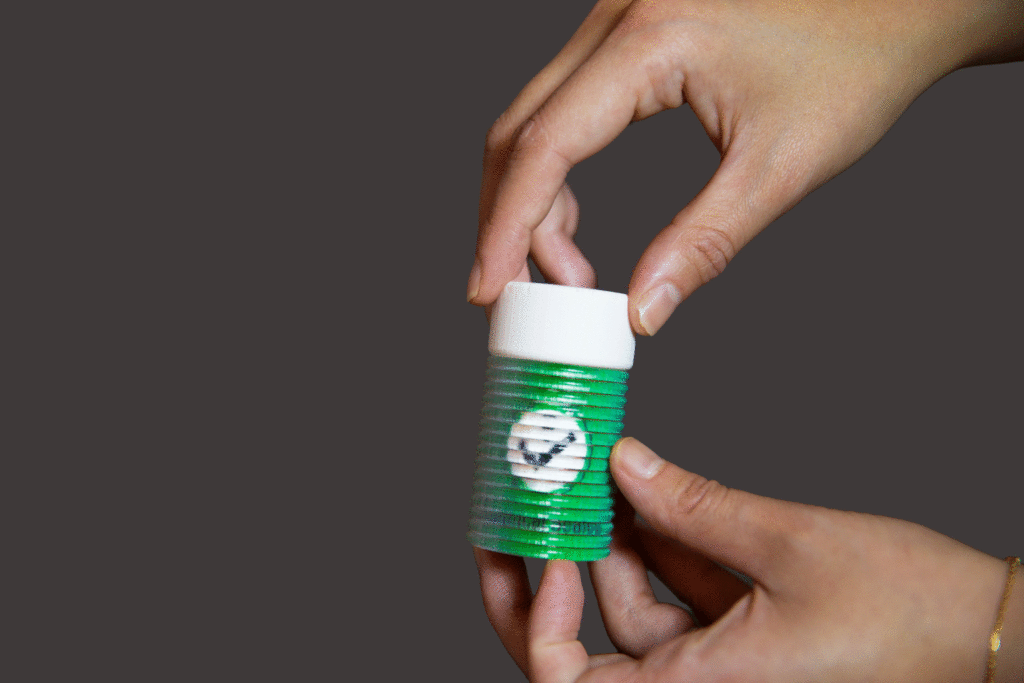
To illustrate the potential of ShiftLens, the researchers fabricated a diverse range of interactive prototypes. One compelling demonstration involved a chemical bottle designed to provide clear safety indicators. When the cap was securely tightened, the bottle’s surface would change to display a green color and a checkmark symbol. Conversely, if the cap was loose, indicating a potential leak or contamination risk, the bottle would turn red and show an exclamation mark. This application showcases the system’s ability to provide immediate, unambiguous feedback for safety-critical functions.
Another engaging prototype was a tic-tac-toe game. Each square on the game board could be manipulated to display either a red "X," a blue "O," or remain blank. The visual state of each square was controlled by turning a small knob, offering a playful yet functional example of interactive design.
Beyond consumer products and games, the implications for industrial and architectural applications are substantial. For instance, the ShiftLens technology could be used to create adaptable warning signs for construction sites or hazardous environments, ensuring they remain visible and informative even under harsh weather conditions. In manufacturing, it could be applied to piping systems, where a change in surface appearance could instantly signal a damaged connection or a leak.
"The leaking sink in my apartment would be a lot easier to fix if it could tell me where the leak was coming from," Zhu remarked, illustrating a practical, everyday problem that ShiftLens could help solve. The ability for infrastructure to self-diagnose and communicate its status visually without relying on complex sensor networks represents a significant advancement in smart infrastructure.
Future Directions and Broader Impact
The research team plans to explore a wider spectrum of applications for ShiftLens in their future work. A key area of development is the enhancement of the design algorithm. The goal is to create a system that can automatically generate ShiftLens structures with even fewer user inputs, further simplifying the design process and making it accessible to an even broader audience. Additionally, they aim to expand the design tool’s capabilities to support a greater variety of actuation mechanisms, offering users more flexibility in how they integrate interactive elements into their objects.
The potential societal impact of ShiftLens is considerable. By democratizing the creation of durable, interactive objects, it empowers makers, designers, and engineers to innovate without the constraints of fragile electronics. This could lead to more sustainable product designs, as objects become more resilient to wear and tear. Furthermore, the intuitive nature of mechanically controlled interactions could improve user experience and accessibility, particularly for individuals who may find complex electronic interfaces challenging.
The research team’s work, culminating in the presentation at the ACM Symposium on User Interface Software and Technology, marks a pivotal moment in the evolution of interactive design. ShiftLens represents a paradigm shift, moving away from a reliance on delicate electronics towards robust, mechanically driven interactivity. As this technology matures, it is poised to reshape how we interact with the physical world, making everyday objects smarter, more informative, and significantly more durable. The ability to imbue objects with a tangible, visual language that communicates status and function through purely mechanical means opens up a vast landscape of possibilities for innovation across countless disciplines.