The landscape of microcontrollers (MCUs) has undergone a profound transformation over the last two decades, evolving not only in raw processing power and memory capacity but fundamentally reshaping the development paradigms for engineers. This significant shift, and the direction MCU technology is poised to take, was the central theme of a recent Electropages Podcast featuring Robin Mitchell and Kevin Jones, Business Development Manager at GigaDevice, a prominent player in the semiconductor industry. Their discussion illuminated critical trends, from the burgeoning influence of open-source architectures like RISC-V to the integration of advanced intelligence in robotics and the accelerating movement of artificial intelligence (AI) towards the network edge.
Evolution of Microcontrollers: A Foundation for Innovation
The journey of microcontrollers from simple embedded controllers to sophisticated system-on-chip (SoC) devices has been remarkable. Early MCUs, often 8-bit or 16-bit, were characterized by limited processing capabilities, small memory footprints, and specialized instruction sets designed for specific control tasks. Development was often intricate, requiring deep hardware knowledge and assembly-level programming. Fast forward to today, and modern MCUs, exemplified by architectures such as ARM Cortex-M series or advanced RISC-V cores, boast multi-core processing, gigabytes of flash memory, integrated peripherals for high-speed communication (like USB, Ethernet, CAN), and even dedicated hardware accelerators for cryptographic functions or digital signal processing (DSP).
This exponential growth in capabilities has democratized embedded development. High-level programming languages like C and C++, coupled with sophisticated integrated development environments (IDEs) and extensive software libraries, have made it easier for engineers to design complex systems without needing to delve into the minutiae of every hardware register. The shift has enabled MCUs to tackle more demanding applications, from complex industrial control systems and sophisticated consumer electronics to highly integrated medical devices and the burgeoning Internet of Things (IoT). The discussion between Mitchell and Jones underscored that this evolution is far from complete, with the next wave of innovation driven by architectural flexibility and distributed intelligence.
RISC-V: The Open-Source Revolution in MCU Architecture
One of the most disruptive forces shaping the future of microcontrollers is the rise of RISC-V. This open-source instruction set architecture (ISA) has emerged as a compelling alternative to proprietary architectures, offering unprecedented flexibility and fostering a collaborative development ecosystem. Unlike proprietary ISAs, which typically involve licensing fees and vendor-specific restrictions, RISC-V is freely available for anyone to use, modify, and extend. This open nature has catalyzed innovation, allowing semiconductor manufacturers and designers to create highly customized processors tailored precisely to their application requirements without the burden of costly intellectual property (IP) licensing.
GigaDevice stands out as a pioneering mainstream adopter of RISC-V technology. In 2019, the company introduced the GD32VF103, marking a significant milestone as one of the first widely available MCUs based on the RISC-V architecture. This move demonstrated a clear vision for the future, recognizing the strategic advantages of an open standard. By embracing RISC-V, GigaDevice not only diversified its product portfolio but also positioned itself at the forefront of a movement that promises to redefine the competitive landscape of embedded processing. Kevin Jones highlighted that this flexibility is paramount, allowing manufacturers to develop processors optimized for specific applications and workloads, from low-power IoT devices to high-performance industrial controllers.
The impact of RISC-V extends beyond mere cost savings. It fosters greater transparency, encourages community-driven development, and reduces vendor lock-in, providing developers with more control over their hardware designs. This architectural freedom is particularly beneficial for emerging applications where highly specialized processing units are required, such as in advanced sensor fusion, custom accelerators for machine learning, or ultra-low-power edge computing. The RISC-V International organization, which stewards the ISA, reported over 10 billion RISC-V cores shipped by 2022, underscoring its rapid adoption and projected market growth across various sectors, from data centers to automotive and embedded systems. This trajectory suggests that RISC-V will continue to play an increasingly central role in the evolution of MCU technology, empowering a new generation of customized and optimized embedded solutions.
Elevating Intelligence in Robotics: The Demand for Determinism
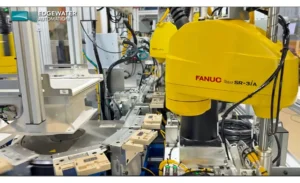
Industrial robotics represents a segment with uniquely stringent demands on embedded hardware. As robots become more sophisticated, incorporating an increasing number of motors, intricate sensors, and complex movement patterns, the necessity for highly deterministic communication and control between various components becomes paramount. Determinism, in this context, refers to the guarantee that data will be delivered and processed within a predictable and specified timeframe, a critical requirement for safety, precision, and synchronized motion in robotic systems. Any latency or jitter in communication can lead to errors, inefficiencies, or even dangerous malfunctions.

Kevin Jones elaborated on how GigaDevice’s GD32H7 devices, equipped with advanced features like EtherCAT, are addressing these challenges. EtherCAT (Ethernet for Control Automation Technology) is a high-performance, real-time Ethernet fieldbus system specifically designed for industrial automation applications. Unlike standard Ethernet, which can suffer from unpredictable delays due to collision detection and retransmissions, EtherCAT operates on a principle of "processing on the fly." Data frames are passed through each node, where relevant data is extracted and new data is inserted, all without stopping the frame. This ensures extremely low latency, high synchronization accuracy, and a deterministic data exchange, making it ideal for multi-axis motion control and distributed I/O in complex robotic setups.
The traditional approach to robotics often involves a central processor making every decision and sending commands to individual motor controllers. However, as robots grow in complexity and autonomy, this centralized model can become a bottleneck, introducing latency and limiting scalability. Jones discussed a paradigm shift towards distributed microcontrollers, where individual motors and sections of a robotic system can be controlled locally by their own dedicated MCUs. This architectural change allows robots to make time-critical decisions at the point of action, rather than relying on constant feedback from a central unit. For instance, a robot arm with multiple joints could have a GD32H7 MCU managing each joint’s motor, sensor feedback, and local trajectory planning, communicating seamlessly and deterministically via EtherCAT.
This distributed intelligence offers several profound advantages:
- Reduced Latency: Local decision-making eliminates the round-trip delay to a central processor, leading to faster response times and more precise control.
- Improved Scalability: Adding more motors or modules to a robot becomes simpler, as each can have its own dedicated controller, without overwhelming a single central unit.
- Enhanced Reliability and Redundancy: If one local controller experiences an issue, other parts of the system may continue to function, improving overall system resilience.
- Simplified Wiring: Fieldbus systems like EtherCAT can significantly reduce the complexity of cabling compared to point-to-point connections.
By enabling more intelligent and autonomous subsystems, GigaDevice’s solutions are paving the way for robots that are not only more precise and efficient but also more adaptable and robust in dynamic industrial environments. The future of robotics increasingly hinges on this kind of decentralized, deterministic control architecture.
Edge AI: Bringing Intelligence Closer to the Source
The conversation also delved into the rapidly expanding domain of edge AI, where artificial intelligence computations are performed directly on local devices rather than in distant cloud data centers. This paradigm shift is being driven by the need for lower latency, enhanced privacy, reduced bandwidth consumption, and greater operational reliability, especially in environments with intermittent connectivity. Applications such as motor anomaly detection, human presence sensing, predictive maintenance, gesture recognition, and other local inference tasks are prime examples where edge AI offers significant advantages and doesn’t necessarily demand the immense processing power of high-end AI accelerators like GPUs or specialized neural processing units (NPUs).
Kevin Jones explained how modern microcontrollers, specifically those based on ARM Cortex-M7 and Cortex-M33 architectures, are increasingly capable of handling these demanding AI workloads. These MCUs, while not designed for training large-scale AI models, are proving highly effective for inference – the process of running a trained model to make predictions or classifications. Key features that enable this include:
- DSP Instructions: Many Cortex-M cores include digital signal processing extensions, which are crucial for accelerating common operations in neural networks, such as convolutions and matrix multiplications.
- Floating-Point Units (FPU): Integrated FPUs improve the precision and speed of mathematical computations required for AI models.
- Larger Caches and Memory: Increased on-chip memory and efficient cache architectures allow for storing larger models and faster data access.
- Enhanced Clock Speeds: Modern MCUs operate at significantly higher frequencies, boosting overall computational throughput.
A critical aspect of deploying AI on resource-constrained MCUs involves model optimization techniques. Jones highlighted that models can be "reduced" to match available processing resources. This often involves:
- Quantization: Reducing the precision of model weights and activations from floating-point (e.g., 32-bit) to lower-bit integers (e.g., 8-bit or even 4-bit). This drastically cuts down memory footprint and computational requirements with minimal impact on accuracy for many applications.
- Pruning: Removing redundant connections or neurons from a neural network, thereby simplifying its structure.
- Model Compression: Employing techniques like knowledge distillation, where a smaller "student" model learns from a larger "teacher" model.
- Efficient Architectures: Designing AI models specifically for edge deployment, using lightweight architectures like MobileNet or TinyML models.
These optimizations make local AI practical in more cost-sensitive embedded applications, from smart home devices and industrial sensors to wearable technology and automotive subsystems. The implications are far-reaching:
- Reduced Dependence on Cloud Processing: By performing AI inference locally, devices become less reliant on continuous internet connectivity and remote servers, enhancing privacy and operational autonomy.
- Lower Latency: Decisions are made instantly at the source, which is critical for real-time applications like collision avoidance in vehicles or immediate anomaly detection in machinery.
- Enhanced Privacy and Security: Sensitive data, such as facial recognition or voice commands, can be processed locally without being sent to the cloud, significantly improving data privacy and reducing security risks.
- Lower Power Consumption: Optimized edge AI algorithms on efficient MCUs can consume significantly less power than continuously streaming data to the cloud for processing, extending battery life in portable devices.
The trend of moving AI further towards the edge is not merely a technical advancement but a strategic shift that promises to unlock new applications and redefine the interaction between devices and their environment. As MCUs continue to integrate more AI-specific capabilities and developers refine optimization techniques, the ubiquity of intelligent, autonomous edge devices will only accelerate.
In conclusion, the insights shared by Kevin Jones of GigaDevice on the Electropages Podcast underscore a pivotal moment in microcontroller technology. The convergence of open-source architectures like RISC-V, the demand for deterministic control in advanced robotics, and the imperative to bring AI processing to the edge is driving a new era of innovation. These trends collectively point towards a future where embedded systems are not just more powerful and efficient but also more intelligent, adaptable, and autonomous, fundamentally reshaping industries and daily life.