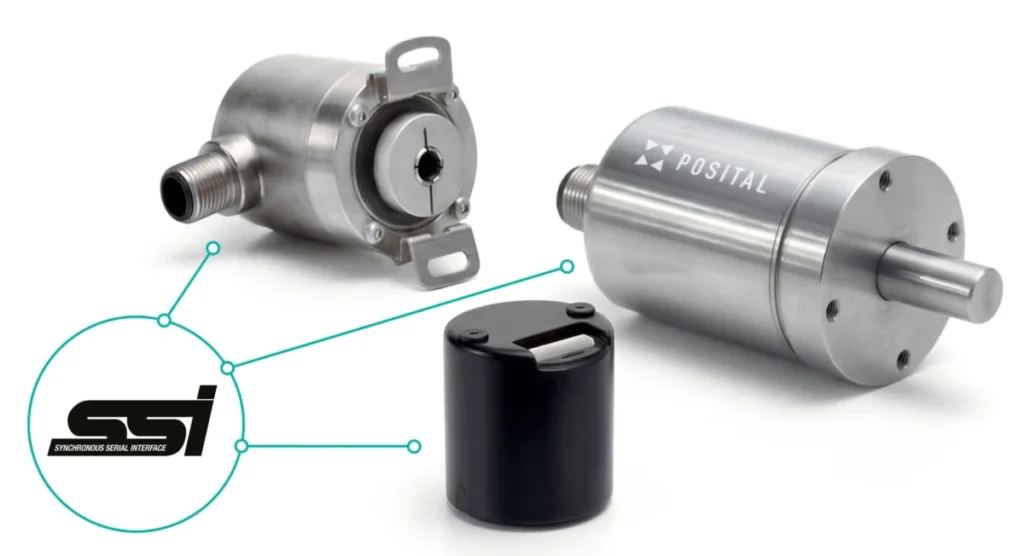
POSITAL, a leading manufacturer of high-precision position and motion sensors, has significantly expanded the range of its IXARC absolute rotary encoders to include comprehensive support for the Synchronous Serial Interface (SSI) communication protocol. This strategic enhancement spans across a wide array of their product offerings, encompassing both modular kit encoders and robust industrial encoders. Notably, this expansion also extends to POSITAL’s recently introduced 20mm miniature form factor, addressing the growing demand for compact yet powerful sensing solutions in modern automation.
The integration of SSI interfaces is not limited to smaller form factors. For larger encoders, POSITAL is now offering SSI options across several established mechanical configurations, including 36mm compact models designed for space-constrained applications, 58mm rugged versions built for harsh industrial environments, and 78mm explosion-proof models that boast ATEX certification, making them suitable for hazardous locations. In these larger dimensions, customers retain the critical flexibility to choose between two fundamental measurement technologies: magnetic and optical. This dual offering allows engineers to select the most appropriate technology based on the specific precision, resilience, and environmental requirements of their applications.
The Enduring Relevance of Synchronous Serial Interface (SSI)
Synchronous Serial Interface (SSI) stands as a testament to robust and reliable data communication within industrial automation. Developed in the 1980s by Siemens and subsequently adopted widely, SSI is a point-to-point, synchronous serial communication protocol that has become a cornerstone for many types of sensors, particularly absolute encoders. Its enduring popularity stems from its inherent simplicity, reliability, and cost-effectiveness, making it an ideal choice for systems where complex networking protocols might introduce unnecessary overhead or cost.
Technically, SSI operates on the RS-422 standard, ensuring high noise immunity, crucial in electrically noisy industrial settings. It connects sensors directly to digital Programmable Logic Controllers (PLCs) or microcontrollers via dedicated clock and data lines. The synchronous nature of the communication, where the master (PLC) provides the clock signal and the slave (encoder) responds with data, ensures precise timing and data integrity. This design is straightforward to implement, reducing commissioning time and engineering complexity. SSI supports impressive transmission rates, allowing for rapid data updates, and can maintain reliable connections over substantial distances, often up to 1,200 meters, depending on the baud rate and cable quality. The protocol’s widespread adoption is further solidified by its support across most major PLC manufacturers, ensuring broad compatibility and ease of integration into existing and new automation architectures globally.
While the industrial landscape has seen the rise of more sophisticated fieldbus networks and Industrial Ethernet protocols like PROFINET, EtherCAT, and Modbus TCP, SSI continues to hold a vital niche. It is particularly well-suited for smaller, dedicated systems, or applications where direct, high-integrity data transfer from a single sensor to a controller is paramount without the need for multi-drop capabilities or complex network management inherent in bus systems. Its resilience, proven track record, and low implementation cost make it a preferred choice for many engineers prioritizing simplicity and reliability.
Technological Prowess Behind IXARC Encoders
POSITAL’s IXARC encoders are engineered with advanced technologies that underscore their performance and reliability. The distinction between absolute and incremental encoders is fundamental to understanding their utility. Incremental encoders provide pulses for each increment of rotation, requiring a reference point at power-up and being susceptible to errors from power interruptions. Absolute encoders, conversely, provide a unique digital code for each shaft position within its full range, maintaining position information even after power loss without needing re-homing. This absolute positioning capability is critical for applications requiring continuous, precise position knowledge.
A significant number of POSITAL IXARC magnetic encoders leverage Tunneling Magnetoresistance (TMR) sensors for angular position measurement. TMR technology represents a substantial leap forward from earlier Hall-effect sensors. TMR sensors offer enhanced stability across varying conditions, significantly lower temperature sensitivity, and a superior response to minute changes in magnetic fields, leading to higher accuracy and repeatability. Furthermore, their improved energy efficiency contributes to the overall longevity and reduced power consumption of the encoder system. This technological choice reflects POSITAL’s commitment to pushing the boundaries of magnetic sensing for robust industrial applications.
For multiturn versions of their encoders, POSITAL employs a sophisticated Wiegand energy-harvesting sensor system for rotation counting. The Wiegand effect is a phenomenon where a specially treated ferromagnetic wire, when subjected to an alternating magnetic field, generates a strong voltage pulse. In IXARC encoders, this effect is harnessed to generate energy with each shaft rotation, which is then used to power the multiturn counting circuitry. This innovative approach allows the encoder to record every shaft rotation in non-volatile memory, critically including rotations that occur when the main system power is unavailable. The profound advantage of this system is the complete elimination of the need for a backup battery, which typically requires periodic replacement and introduces a point of failure. This not only enhances the encoder’s reliability and operational lifespan but also significantly reduces maintenance requirements and total cost of ownership for end-users.
Optical encoders, offered in larger SSI-enabled IXARC models, provide an alternative for applications demanding extremely high precision and resolution. These encoders typically use a light source and photodetector array to read patterns on a rotating disc, translating them into angular position data. While often more sensitive to shock and vibration than their magnetic counterparts, optical encoders excel in environments where the utmost accuracy is paramount, such as high-precision machine tools, medical imaging equipment, and scientific instruments.
Versatility in Form Factors and Configuration
The expansion of SSI options across POSITAL’s diverse product range emphasizes versatility. The introduction of the new 20mm miniature form factor for both kit and industrial encoders with SSI is particularly noteworthy. As industrial machinery and robotics become increasingly compact and intricate, there is a growing demand for sensing components that can fit into tight spaces without compromising performance. This miniature encoder opens up new possibilities for integration into smaller motors, robotic joints, and embedded systems, facilitating the design of more compact and efficient automated solutions.
Kit (modular) encoders are designed for seamless integration directly into the customer’s mechanical structure, such as motor housings or specialized machinery. These unhoused units offer maximum flexibility for original equipment manufacturers (OEMs) and system integrators, allowing them to create highly customized and space-optimized designs. By providing SSI communication in this modular format, POSITAL empowers designers to leverage the protocol’s advantages within their unique machine architectures.

Industrial encoders, on the other hand, are self-contained, rugged units built for standalone installation in a wide range of applications. Available in various robust mechanical configurations, including different shaft types (solid, hollow), flange sizes, and housing materials, these encoders are engineered for durability and ease of installation in challenging industrial environments. The availability of SSI across 36mm compact, 58mm rugged, and 78mm ATEX-certified explosion-proof models ensures that demanding applications, from general factory automation to hazardous chemical processing plants, can benefit from the reliable SSI interface.
Hybrid Communication: A Bridge to Enhanced Flexibility
POSITAL further augments its offering with IXARC encoders featuring a hybrid communication interface that simultaneously supports both absolute (SSI) and incremental measurements. This innovative capability provides control system designers with unprecedented flexibility. Absolute measurement, delivered via SSI, is ideally suited for precise positioning tasks, ensuring that the machine always knows its exact location even after power cycles. Concurrently, the incremental output provides a dynamic response, making it excellent for monitoring rotational speed and direction in real-time.
The ability to combine both functions within a single device is a significant advantage. It allows engineers to design systems that can leverage the strengths of both measurement types. For instance, a robotic arm might use the absolute SSI data for precise homing and position control, while simultaneously using the incremental data for continuous velocity feedback during movement. This hybrid approach is particularly valuable when a future transition from purely incremental monitoring to absolute position measurement is being considered, or when an application requires both functionalities but space or cost constraints prevent the use of two separate encoders. This future-proofing aspect simplifies system upgrades and reduces hardware complexity.
Programmability and Future-Proofing with UBIFAST
Adding another layer of versatility, POSITAL encoders with SSI interfaces are fully programmable. This programmability is facilitated through software updates using POSITAL’s proprietary UBIFAST programming tool. UBIFAST allows users to configure a wide array of operating parameters, including resolution, direction of rotation, measurement range, and error bits. This capability offers substantial benefits: it simplifies inventory management for distributors and users by allowing a single encoder model to be adapted to various applications; it enables on-site customization, reducing downtime and the need for specialized stock; and it provides an avenue for future-proofing, as parameters can be adjusted to meet evolving application requirements without replacing the hardware. This level of flexibility translates directly into cost savings and greater operational efficiency for system integrators and end-users alike.
Market Context and Industry Implications
The expansion of SSI options by POSITAL comes at a time of significant growth and transformation within the industrial automation sector. The global industrial encoder market, valued at approximately $2.7 billion in 2022, is projected to grow at a compound annual growth rate (CAGR) of around 6-7% over the next decade, driven by factors such as the increasing adoption of automation and robotics, the rise of Industry 4.0 initiatives, and the growing demand for intelligent, connected sensors.
The move by POSITAL aligns perfectly with these broader industry trends. As manufacturing processes become more automated and interconnected, the demand for reliable, precise, and easily integrable position sensors escalates. SSI, with its proven track record and widespread support, continues to be a crucial communication standard in this evolving landscape. The introduction of SSI in miniature form factors and robust configurations, coupled with advanced technologies like TMR and Wiegand, positions POSITAL to meet the diverse and challenging requirements of modern industrial applications.
Industry experts view this expansion as a strategic move that reinforces POSITAL’s commitment to providing flexible and high-performance solutions. "The enduring relevance of SSI in industrial automation, particularly for its simplicity and robustness, cannot be overstated," remarks an unnamed analyst specializing in automation components. "By expanding SSI support across their innovative IXARC line, including new compact form factors and advanced sensor technologies, POSITAL is directly addressing the practical needs of engineers seeking reliable and cost-effective solutions for a wide array of applications, from precision robotics to heavy industrial machinery."
While not directly quoted in this specific release, spokespeople for POSITAL have consistently emphasized the company’s dedication to innovation and customer-centric product development. This latest expansion underscores a strategy focused on offering a comprehensive portfolio that caters to varying technical requirements and budgetary considerations, ensuring that customers can find an optimal solution for their specific automation challenges.
Broader Impact and Future Outlook
The implications of POSITAL’s expanded SSI offerings are far-reaching. For system integrators and OEMs, it translates into greater choice, easier integration, and potentially streamlined design processes. The availability of SSI across such a broad range of form factors and measurement technologies means that engineers have more tools at their disposal to build efficient, reliable, and cost-effective automation systems. This flexibility is critical for accelerating product development cycles and bringing innovative machinery to market more quickly.
The enhancements contribute significantly to the ongoing realization of Industry 4.0 and smart manufacturing initiatives. By providing precise, reliable absolute position data via a widely supported interface, IXARC encoders facilitate better control, diagnostics, and predictive maintenance capabilities within automated systems. From robotics and machine tools to material handling, renewable energy, and mobile machinery, the enhanced IXARC line promises to deliver improved performance and reliability.
POSITAL’s continuous investment in advancing encoder technology, from TMR sensors to Wiegand energy harvesting and versatile communication options, solidifies its position as a key innovator in the field. This latest expansion of SSI support for its IXARC absolute rotary encoders is a clear indication of the company’s responsiveness to market demands and its commitment to empowering the next generation of industrial automation with robust, intelligent, and adaptable sensing solutions. The market can anticipate further innovations from POSITAL as the demands for precision, efficiency, and connectivity continue to evolve within the global industrial landscape.