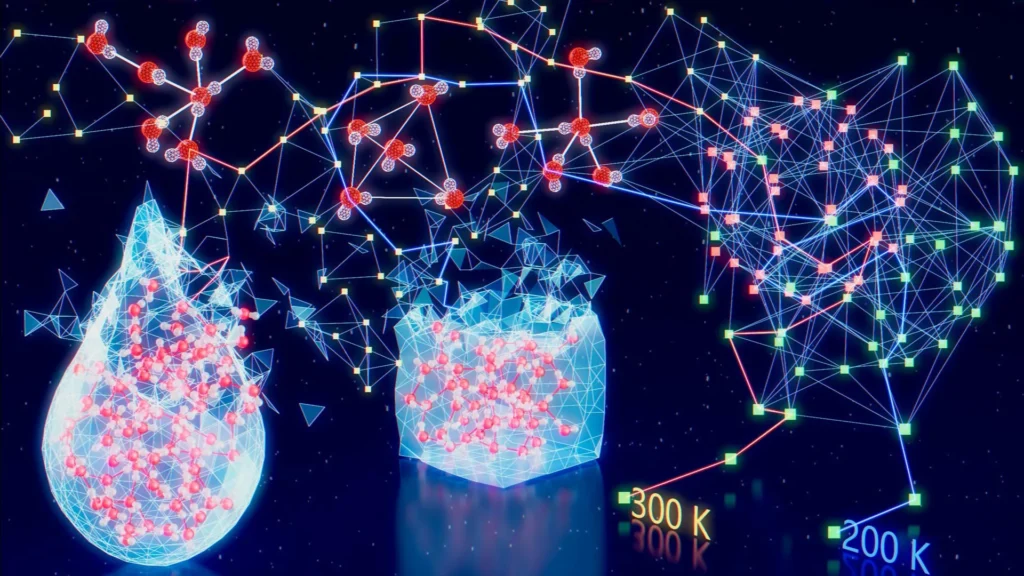
Water covers most of Earth’s surface, yet it behaves in ways that set it apart from nearly every other liquid. One of its most unusual traits is that it expands instead of contracts when it freezes, a phenomenon critical for the existence of life as we know it, preventing lakes and oceans from freezing solid from the bottom up. Beyond this well-known anomaly, water exhibits a suite of other peculiar characteristics, including an exceptionally high specific heat capacity, high surface tension, and a maximum density at approximately 4 degrees Celsius, rather than at its freezing point. Scientists have long linked these odd behaviors to changes in water’s microscopic structure as temperature and pressure vary, hypothesizing the existence of competing molecular arrangements within the liquid state. However, they have historically lacked a consistent, unified framework to accurately describe, compare, and quantify these elusive structural changes. This long-standing challenge has significantly hampered a complete understanding of the most ubiquitous and vital substance on our planet.
Now, in a significant scientific advancement, researchers at the University of Osaka have turned to artificial intelligence (AI) to tackle this formidable challenge. Their innovative AI system provides a unified, objective way to compare different methods of describing the intricate molecular structure of supercooled water, a state where liquid water persists below its normal freezing point without solidifying. By systematically evaluating various structural descriptors, the AI helps identify which ones most effectively capture the crucial features defining water’s unique properties. This groundbreaking research, which promises to shed new light on one of nature’s most enduring puzzles, was recently published in the esteemed journal Communications Chemistry.
The Puzzling Nature of Water’s Anomalies
Water’s exceptional properties are not mere curiosities; they are fundamental to planetary climate, geological processes, and biological systems. For instance, its high specific heat capacity helps moderate Earth’s temperatures, while its solvent capabilities are unparalleled, making it the "universal solvent" essential for biochemistry. These anomalies stem from the unique network of hydrogen bonds formed between water molecules. Each water molecule can form up to four hydrogen bonds with neighboring molecules, leading to a dynamic, ever-changing tetrahedral arrangement. Unlike most liquids, which become denser as they cool, water’s density peaks at 4°C, and then decreases as it approaches freezing, causing ice to float. This expansion upon freezing is a direct consequence of the more open, ordered structure of ice compared to liquid water.
The theoretical understanding of these anomalies has been a subject of intense scientific debate for decades. Various models have been proposed, often relying on the idea that water is not a homogeneous liquid but rather a mixture of different structural motifs or even two distinct liquid phases. The concept of a "two-liquid model" posits the existence of a high-density liquid (HDL) and a low-density liquid (LDL), each with different molecular arrangements and densities, whose relative proportions shift with temperature and pressure. The challenge, however, has always been to precisely characterize these fleeting structures and to establish a consistent language for their description.
The Enigma of Supercooled Water
For liquid water to transition into ice, its molecules must arrange themselves into an orderly crystal lattice. This process typically begins at a nucleation site – a microscopic surface where ice crystals can start forming. These sites can be tiny impurities suspended in the water, dust particles, or even minute scratches on the interior surface of a container. However, if these nucleation sites are meticulously absent, water can remain in a liquid state even when cooled significantly below its normal freezing point of 0°C. This metastable, non-equilibrium state is known as supercooled water.
Under supercooled conditions, water’s already unusual properties become even more pronounced and amplified. For instance, its compressibility, specific heat, and thermal expansion coefficient all exhibit dramatic increases as the temperature drops further into the supercooled regime. Scientists believe these exaggerated behaviors are inextricably linked to a delicate balance between the two competing forms of liquid water: the more compact, disordered high-density liquid (HDL) and the more open, ordered low-density liquid (LDL). At the molecular level, water molecules are in a constant state of flux, forming and breaking networks of hydrogen bonds. As the temperature rises, the more compact HDL structures become increasingly dominant over the more open, ice-like LDL arrangements. Conversely, as temperature drops, particularly into the supercooled region, the LDL structures are hypothesized to become more prevalent, leading to the observed anomalies. Studying supercooled water is crucial because it provides a window into the "critical point" of water, a hypothetical point where the two liquid phases are thought to diverge, offering a deeper understanding of water’s phase diagram and its fundamental nature.
Historical Context and the Rise of Computational Chemistry
The scientific quest to understand water dates back centuries, with early observations noting its unique freezing behavior. The 20th century saw significant advancements with the development of quantum mechanics and statistical mechanics, enabling scientists to propose molecular-level explanations. The advent of powerful computers in the latter half of the 20th century revolutionized the field, allowing researchers to simulate the behavior of water molecules using techniques like molecular dynamics (MD) and Monte Carlo (MC) simulations. These computational methods provide atomic-level trajectories and configurations, generating vast amounts of data on how molecules interact and arrange themselves.
Despite these powerful simulation tools, a persistent challenge remained: how to extract meaningful structural information from the deluge of data. Over the years, researchers have proposed many different ways to describe the local arrangement of water molecules. These "structural descriptors" include measurements such as tetrahedral bond order (quantifying the degree of tetrahedral arrangement around a molecule), local density (number of molecules within a certain radius), and various angular and radial distribution functions. Because these structural descriptors were developed independently by different research groups, often focusing on specific aspects of water’s behavior, they frequently utilize different scales, dimensions, and types of information. This lack of standardization has made it exceptionally difficult to directly compare them, assess their relative merits, and definitively determine which descriptors are the most useful or accurate in capturing the essential structural changes responsible for water’s anomalies. This is precisely where the University of Osaka team identified a critical gap that AI could fill.
AI as a New Frontier in Molecular Science
The application of artificial intelligence and machine learning (ML) has rapidly expanded across various scientific disciplines in recent years, proving particularly adept at identifying complex patterns within large datasets that might elude human observation. In materials science and chemistry, AI is increasingly being used for tasks such such as predicting molecular properties, accelerating drug discovery, designing new catalysts, and analyzing complex experimental or simulation data. The Osaka team recognized the potential of AI to bring order to the disparate world of water structural descriptors.
"Past studies have already demonstrated that using machine learning to classify and understand complex structural data is an incredibly effective approach," explains corresponding author Kang Kim, reflecting on the broader context of their work. "We specifically wanted to incorporate a neural network model into this study to objectively evaluate how accurate and efficient these various descriptors were at capturing key structural information. Our aim was to do this in a way that, in essence, mimics or even surpasses the pattern recognition capabilities often associated with human cognition, but with the added rigor and consistency of an algorithmic approach." The team’s strategy was to train an AI to "learn" the differences between the proposed HDL and LDL structures from raw simulation data, and then assess how well existing descriptors performed in mirroring the AI’s learned distinctions.
Osaka University’s Novel AI-Driven Approach
To train their artificial intelligence system, the Osaka researchers fed a sophisticated neural network structural data generated from extensive molecular dynamics simulations of supercooled water. These simulations meticulously track the movement and interactions of thousands of water molecules over picoseconds or nanoseconds, providing a detailed, atomistic view of their collective behavior at different temperatures and pressures within the supercooled regime. The neural network, through repeated cycles of trial and error and optimization, learned to recognize and differentiate meaningful patterns in the molecular structures associated with the hypothesized HDL and LDL states. This unsupervised learning phase allowed the AI to develop its own internal representation of water’s structural landscape, free from pre-conceived human biases regarding what constitutes a "good" descriptor.
Once the neural network had established its internal understanding of the structural differences between HDL and LDL, the researchers then used it as a benchmark. They tested how well 16 different, previously proposed structural descriptors — ranging from simple local density measurements to more complex tetrahedral order parameters — performed in distinguishing between these two liquid forms at various supercooled temperatures. The AI effectively became an impartial judge, evaluating the efficacy of each descriptor.
"The network used what it had learned from the raw simulation data to compare how 16 different descriptors differentiated between LDL and HDL structures across a range of supercooled temperatures," reports Nobuyuki Matubayasi, senior author of the study, highlighting the core methodology. "Through this rigorous comparison, we were able to systematically determine the most efficient and robust descriptors – those that most accurately and uniquely captured the essential structural information relevant to water’s anomalous behavior." This method provides a quantitative and objective ranking of descriptors, moving beyond qualitative arguments or reliance on specific theoretical models.
Unveiling Water’s Hidden Structures and Broader Implications
The findings from the Osaka University study offer new, compelling clues to water’s hidden structure and provide a clearer path forward for future research. By identifying the most effective structural descriptors, the research provides scientists with better tools to analyze simulation data and interpret experimental results. This refined understanding of how microscopic structural changes are connected to the macroscopic thermodynamic behavior of water is crucial. It means researchers can now focus on descriptors that truly matter, streamlining future computational efforts and enhancing the precision of their analyses.
The implications of this work extend far beyond a mere refinement of descriptors. Firstly, it strengthens the theoretical basis for the "two-liquid model" of water, providing a more robust framework for understanding the interplay between HDL and LDL. This could lead to a more complete theory explaining the origin of all of water’s unusual properties, not just those observed in the supercooled state. Secondly, the methodology itself — using AI to evaluate and unify disparate scientific descriptors — represents a significant advance in computational science. This framework is highly adaptable and could be applied to other complex molecular systems where structural characterization is challenging, such as polymers, biological macromolecules, or exotic materials.
Expert Perspectives and Future Directions
The scientific community is keenly watching developments in this area, recognizing the foundational importance of water research. Dr. Kim’s emphasis on AI’s ability to approach problems "like human cognition" suggests a future where AI systems can not only process data but also infer scientific principles in a more intuitive, yet rigorous, manner. Dr. Matubayasi’s focus on identifying "efficient descriptors" underscores the practical utility of this research for computational chemists and physicists. The ability to distil complex structural information into a minimal, yet comprehensive, set of parameters will accelerate research and facilitate the development of predictive models.
Looking ahead, this research paves the way for several exciting avenues. The identified descriptors can be incorporated into new experimental techniques, such as advanced spectroscopic methods, to provide more precise measurements of water’s structure in real-time. Furthermore, a deeper understanding of supercooled water is critical for applications in cryopreservation, where preventing ice crystal formation is paramount for storing biological materials like organs and cells. In atmospheric science, insights into supercooled water droplets are vital for accurate climate models, as they play a crucial role in cloud formation and precipitation. The framework developed by the Osaka team could also guide the development of even better, more sophisticated AI tools for studying the complex molecular structures of various liquids, amorphous solids, and soft matter, ultimately pushing the boundaries of materials design and fundamental scientific discovery. This innovative blend of molecular simulation and artificial intelligence marks a significant stride in humanity’s ongoing quest to comprehend the most fundamental aspects of the natural world.