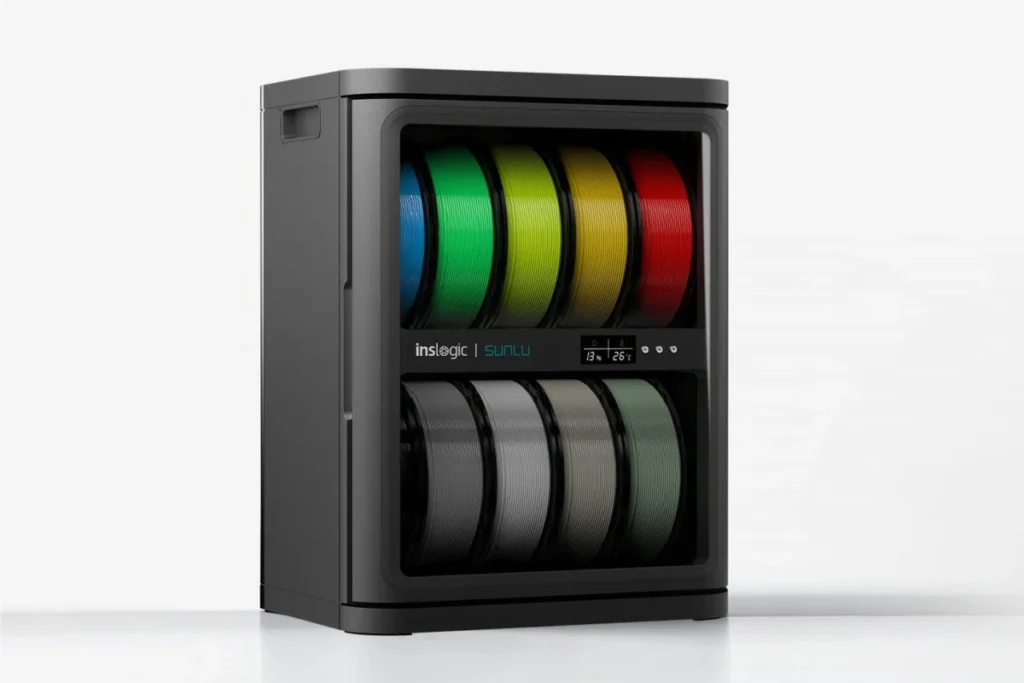
The FilaDC i10 filament dehumidifying cabinet, a collaborative engineering effort between Inslogic and Sunlu, represents a significant shift in how additive manufacturing enthusiasts and professionals manage material integrity. Priced at $199, the i10 is positioned as a high-capacity, specialized storage solution designed to combat the pervasive issue of filament hygroscopy—the tendency of 3D printing polymers to absorb moisture from the surrounding environment. Unlike traditional active drying units that rely on high-intensity heat and forced air, the i10 utilizes a sophisticated passive drying system, integrating Positive Temperature Coefficient (PTC) heating with a molecular sieve dual-effect dehumidification technology. This approach allows for room-temperature, non-damaging moisture removal, ensuring that the physical properties of the filament remain intact over long-term storage.
The Technical Framework: Molecular Sieve and PTC Technology
The core innovation of the FilaDC i10 lies in its departure from standard "oven-style" filament dryers. Traditional dryers often subject filament to temperatures ranging from 50°C to 70°C for several hours. While effective for rapid drying, consistent exposure to heat can lead to the degradation of certain polymers, causing them to become brittle or undergo premature crystallization. The i10 addresses this through a molecular sieve system. Molecular sieves are crystalline aluminosilicates—zeolites—that possess uniform pores capable of adsorbing water molecules while excluding larger molecules.
In the i10, this sieve acts as a chemical sponge. When the internal humidity exceeds the user-defined threshold, the system activates to draw moisture into the sieve. The PTC element is then used strategically to "regenerate" the sieve, heating the material to release the trapped moisture outside the cabinet without subjecting the filament spools to direct, high-intensity heat. This dual-effect technology enables the cabinet to maintain an ultra-low humidity environment (often below 10% Relative Humidity) while consuming significantly less power than active dryers. The result is a "set-and-forget" appliance that operates silently in the background of a workshop or laboratory.
Operational Capacity and Physical Design
The physical footprint of the FilaDC i10 is designed for high-volume users, accommodating up to 10 standard 1kg spools of filament. This capacity makes it an essential hub for users managing multiple machines or a diverse library of materials, such as PLA, PETG, TPU, and more sensitive engineering-grade filaments like Nylon (PA) or Polycarbonate (PC). The cabinet features a transparent front door, allowing for easy inventory management, and a robust chassis that provides a sealed environment against external contaminants.
Setup is engineered for simplicity. Upon unboxing, the unit requires only a single power connection via a rear-mounted cord and the activation of a primary power switch. The interface is intuitive, allowing users to toggle between humidity settings and monitor real-time internal conditions via a digital display. The unit’s ability to reach target humidity levels rapidly—even when loaded with five or more spools—demonstrates the efficiency of its internal air circulation and desiccation cycle.
The Impact of Moisture on Additive Manufacturing
To understand the necessity of the FilaDC i10, one must consider the chemical behavior of 3D printing filaments. Most common thermoplastics are hygroscopic. When moisture is absorbed into the polymer chain, it causes several detrimental effects during the extrusion process. As the filament passes through the 3D printer’s hot end (often heated to 200°C–300°C), the trapped water molecules instantly turn into steam. This rapid expansion creates micro-explosions within the nozzle, leading to:
- Stringing and Oozing: The internal pressure caused by steam forces molten plastic out of the nozzle even when the extruder is not actively pushing filament.
- Poor Surface Finish: The escaping steam creates bubbles and pits on the surface of the printed part.
- Reduced Inter-layer Adhesion: Moisture can interfere with the molecular bonding between layers, significantly reducing the structural integrity of the final object.
- Clogging: In some cases, the inconsistent pressure caused by moisture can lead to partial or full nozzle clogs.
In practical testing, filament that had previously exhibited severe stringing issues showed immediate improvement after being stored in the i10. By returning the filament to a dry state, the extrusion becomes predictable, and the "popping" sounds associated with wet filament are eliminated.

Comparative Market Analysis and Efficiency
The $199 price point places the FilaDC i10 in a competitive middle ground. It is more expensive than basic single-spool active dryers, which typically retail between $40 and $60, but it is significantly more affordable than industrial-grade dry cabinets used in electronics manufacturing, which can cost upwards of $1,000. For the prosumer market, the i10 offers a compelling value proposition by combining the high capacity of a storage cabinet with the active dehumidification technology of a dedicated dryer.
Power consumption is another area where the i10 excels. Because it does not need to maintain high internal air temperatures constantly, its energy draw is intermittent. Once the internal atmosphere reaches the desired humidity percentage, the unit enters a low-power monitoring mode. It only reactivates the regeneration cycle when the sensors detect a rise in humidity, such as after the door has been opened to retrieve a spool. This makes it a more sustainable choice for 24/7 operation compared to running multiple active dryers simultaneously.
Manufacturer Collaboration: Inslogic and Sunlu
The partnership between Inslogic and Sunlu is a strategic alignment of two significant players in the 3D printing ecosystem. Sunlu is widely recognized globally for its high-volume filament production and its "S1" and "S2" series of filament dryers, which helped popularize the concept of active drying among hobbyists. Inslogic brings a focus on specialized hardware and refined user experiences.
By co-developing the i10, the two companies have addressed a gap in the market for a mid-range, high-capacity solution. Official statements from the manufacturers emphasize that the i10 was developed in response to user feedback regarding the noise and energy costs associated with traditional hot-air dryers. The inclusion of a comprehensive instruction manual, which includes a detailed table for humidity levels tailored to different material types, reflects a commitment to user education and professional-grade standards.
Broader Implications for the Maker Community
The introduction of devices like the FilaDC i10 signals a maturing of the 3D printing industry. As users move beyond simple PLA printing and into more technical materials, the infrastructure surrounding the printer becomes as important as the printer itself. Moisture management is no longer viewed as an optional "tweak" but as a fundamental requirement for repeatable, high-quality results.
Furthermore, the i10 contributes to waste reduction in the manufacturing process. Filament that has absorbed too much moisture is often discarded by users who believe the material has "gone bad." By providing a reliable way to recover and maintain these materials, the i10 extends the shelf life of filaments, leading to fewer failed prints and less plastic waste. This aligns with broader industry trends toward sustainability and economic efficiency in digital fabrication.
Conclusion and Market Reception
The FilaDC i10 stands as a robust solution for the modern "maker" or small-scale production facility. Its quiet operation, ease of use, and effective moisture control address the primary pain points of filament storage. While the initial investment of $199 is higher than basic alternatives, the ability to protect and maintain ten spools of material simultaneously offers a clear return on investment through improved print quality and reduced material loss.
As the 3D printing landscape continues to evolve toward more professional applications, the demand for precision environmental control will only increase. The FilaDC i10, with its innovative use of molecular sieve technology and PTC heating, provides a blueprint for the future of material management in the additive manufacturing space. It is a highly recommended addition for any operator seeking to eliminate variables and achieve professional-grade reliability in their 3D printing workflow.