Nearly 90 years after theoretical physicist Werner Heisenberg first posited the existence of vacuum birefringence, a strange quantum effect where seemingly empty space alters the behavior of light, groundbreaking observations of an extreme celestial object may finally provide the conclusive evidence scientists have long sought. Heisenberg’s audacious prediction, rooted in the nascent field of quantum mechanics, suggested that even a perfect vacuum is not truly void, but rather a bustling arena of "virtual particles" that spontaneously flicker into existence and vanish. This ephemeral activity, according to the theory, should manifest as a measurable change in how light propagates through a vacuum exposed to an incredibly strong magnetic field.
Despite significant advancements in nuclear physics since the 1930s and decades of painstaking experimentation with high-energy particle accelerators, the elusive phenomenon of vacuum birefringence has remained beyond definitive laboratory confirmation. The sheer scale of magnetic fields required to induce a detectable effect has consistently surpassed Earth-bound capabilities. However, the universe itself, with its unparalleled extremes, has offered a natural laboratory: magnetars, a rare and enigmatic class of neutron stars boasting the most powerful magnetic fields known to exist. A collaborative team of scientists, leveraging observations from both ground-based radio telescopes and orbital X-ray observatories, has now published findings in the journal Nature that present the strongest indication yet of vacuum birefringence, potentially opening unprecedented avenues for investigating fundamental quantum physics under conditions utterly unattainable on Earth.
Heisenberg’s Vision: The Quantum Nature of Empty Space
Werner Heisenberg, one of the pioneers of quantum mechanics, made his prediction regarding vacuum birefringence in 1936. At the time, the full implications of quantum field theory were still being explored, but the idea that a vacuum was not simply "nothingness" was beginning to take hold. Quantum Electrodynamics (QED), the quantum field theory describing how light and matter interact, posits that the vacuum is not truly empty but rather a dynamic sea of "virtual" particles and antiparticles, such as electron-positron pairs, that constantly pop in and out of existence in accordance with Heisenberg’s uncertainty principle. These virtual particles exist for such fleeting moments that they cannot be directly observed, but their collective effect can, in theory, influence physical phenomena.
In the presence of an extraordinarily powerful magnetic field, QED predicts that these virtual particles would become temporarily polarized or aligned. This alignment would, in turn, subtly alter the optical properties of the vacuum itself, causing it to behave much like certain crystals that exhibit birefringence. Birefringence, a well-known classical optical phenomenon, refers to the double refraction of light in anisotropic materials, where light waves traveling in different polarizations experience different refractive indices. In the quantum realm, vacuum birefringence would mean that light passing through such a magnetized vacuum would have its polarization state modified, a direct consequence of the fleeting interactions with the aligned virtual particles.
The Elusive Quest: Why Laboratory Confirmation Proved Challenging
For decades, the challenge for physicists has been to create a magnetic field strong enough to make this subtle quantum effect detectable. On Earth, the strongest sustained magnetic fields generated in laboratories are on the order of tens of Tesla (T), with pulsed fields reaching hundreds of Tesla for fractions of a second. To put this in perspective, Earth’s magnetic field is roughly 0.00005 Tesla. While impressive, even these extreme laboratory fields fall vastly short of the theoretical threshold required to conclusively observe vacuum birefringence. Estimates suggest that fields exceeding 10^9 Tesla (a billion Tesla) or even 10^12 Tesla might be needed for a readily measurable effect, a staggering figure that is more than a hundred million times stronger than anything humanity has ever produced. This immense discrepancy between achievable laboratory conditions and theoretical requirements underscored the need for natural cosmic laboratories.
Cosmic Laboratories: The Extreme Realm of Magnetars
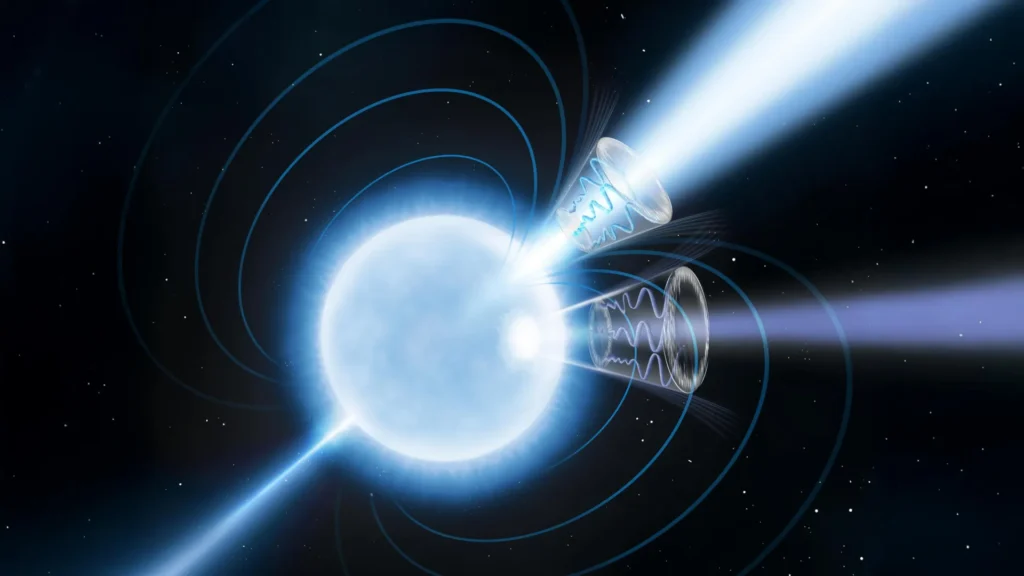
Nature, however, has provided a solution in the form of magnetars. These exotic celestial objects are a rare subtype of neutron stars, the ultra-dense remnants of massive stars that have collapsed under their own gravity following supernova explosions. What distinguishes magnetars is their phenomenal magnetic field strength, which can be thousands of times stronger than that of typical neutron stars, reaching magnitudes of 10^10 to 10^11 Tesla (10 to 100 billion Tesla) at their surface. To grasp this scale, a magnetar’s magnetic field could erase all the data on every credit card on Earth from a distance equivalent to the Moon.
Magnetars are characterized by their intense X-ray and gamma-ray bursts, often accompanied by radio emission, phenomena believed to be driven by the immense stresses within their crusts and magnetospheres due to these extreme fields. Their rapid rotation (periods of a few seconds) and the incredibly dense plasma surrounding them create an environment where the interaction between light and matter is pushed to its absolute limits, making them ideal cosmic testbeds for fundamental physics, including QED effects like vacuum birefringence. The research focused on magnetar 1E 1547.0-5408 (1E1547), a particularly active and well-studied example of this rare class.
A Global Collaboration: Unveiling the Signature
The multidisciplinary research effort behind these findings involved a consortium of leading scientific institutions from around the globe. Scientists from the Center for Space Sciences and Technology, the South African Radio Astronomy Observatory (SARAO), the Los Alamos National Laboratory, NASA’s Marshall Space Flight Center, the Center for Research and Exploration in Space Science & Technology (CRESST), and the Astrophysics Science Division at NASA’s Goddard Space Flight Center, alongside numerous international universities, pooled their expertise and observational resources. The study was spearheaded by Rachael E. Stewart, a Graduate Student of Physics at George Washington University, whose doctoral research has been instrumental in this breakthrough.
The methodology employed was a sophisticated blend of radio and X-ray astronomy, designed to meticulously track the polarization state of light emitted from the magnetar. Dr. Marcus Lower, an Australian Research Council DECRA Fellow at the Center for Astrophysics and Supercomputing (CAS) at the Swinburne University of Technology, played a pivotal role in leading the observational campaign. "Detecting vacuum birefringence requires a magnetic field that is over 100 million times stronger than any we’ve ever made on Earth," stated Lower. "Thankfully, nature has provided us with magnetars, which are the perfect cosmic laboratories to go looking for this effect."
Precision Observations: Watching an Extreme Magnetar Rotate
The team utilized CSIRO’s Murriyang (formerly known as the Parkes) radio telescope in Australia, a renowned 64-meter dish with exceptional sensitivity, to conduct observations of 1E1547.0-5408. Radio waves emitted by the magnetar carry information about its magnetic environment. The resulting vast datasets from Murriyang were then subjected to rigorous analysis using Swinburne University’s Ngarrgu Tindebeek supercomputer, a high-performance computing facility essential for processing complex astrophysical data.
Crucially, these ground-based radio observations were complemented by measurements from two advanced space-based X-ray telescopes: NASA’s Imaging X-ray Polarimetry Explorer (IXPE) and the Neutron Star Interior Composition Explorer (NICER) aboard the International Space Station. IXPE, launched in late 2021, is specifically designed to measure the polarization of X-rays from cosmic sources, providing a unique window into extreme astrophysical environments. NICER, meanwhile, provides precise timing and spectroscopic data, allowing for detailed studies of neutron star emissions.
As the researchers monitored 1E1547’s radio and X-ray emissions, they meticulously tracked the orientation of the waves’ oscillations – their "polarization state" – as the magnetar slowly rotated. The analysis revealed two key characteristics that made 1E1547 an exceptionally promising candidate for detecting vacuum birefringence: its magnetic axis and rotational axis are almost perfectly aligned, and observers on Earth view the object from a nearly pole-on perspective. These geometric alignments simplify the interpretation of polarization changes, as the viewing angle relative to the magnetic field remains relatively constant, making any subtle shifts attributable to the vacuum’s properties more discernible.
X-Rays Reveal a Possible Quantum Signature
The X-rays emanating from the magnetar, as detected by IXPE, exhibited an extremely high degree of polarization. More significantly, researchers found that the direction of this polarization remained steadfastly aligned with 1E1547’s magnetic field, mirroring the behavior observed in its radio waves. Both of these observations – the high degree of polarization and its consistent alignment with the magnetic field – are considered compelling indicators that vacuum birefringence may indeed be occurring in the magnetar’s immediate vicinity.
Dr. Lower elaborated on the theoretical underpinnings of this observation: "Because of the magnetic field’s strength, Heisenberg’s virtual particles become aligned with the direction the field is pointing. By carefully tracking the direction the radio waves and X-rays oscillate as the magnetar rotates, the team found that the alignment of 1E1547’s magnetic and rotational poles was ideal for detecting vacuum birefringence. With these future data on hand and our updated simulations, we may finally be able to complete the quest started by Heisenberg nearly 90 years ago." The consistent alignment suggests that the vacuum itself, under the influence of the magnetar’s colossal magnetic field, is acting as an optical medium that favors a particular polarization direction for the light passing through it.
The Path Forward: Confirming the Quantum Signature
While the current findings represent the most robust evidence to date, the scientific community emphasizes the need for further confirmation. The complex physics of magnetar magnetospheres can involve other processes that might mimic or contribute to polarization effects. Therefore, additional observations, potentially focusing on different magnetars or longer observation periods of 1E1547, coupled with more advanced and refined computer simulations, will be crucial. These future investigations will aim to distinguish unequivocally between vacuum birefringence and other possible astrophysical phenomena that could produce similar optical signatures. The ongoing analysis will involve developing more sophisticated models of light propagation through magnetar environments, incorporating all known physical processes to isolate the unique fingerprint of QED vacuum effects.
Profound Implications for Fundamental Physics
If these results are definitively confirmed, the implications for fundamental physics would be profound. It would not only validate a nearly century-old prediction by one of the architects of quantum theory but also provide an unprecedented experimental test of Quantum Electrodynamics in a regime far beyond Earth’s capabilities. This confirmation would solidify our understanding of the quantum vacuum, demonstrating that "empty space" is a dynamic medium susceptible to manipulation by extreme conditions.
Such a discovery would offer scientists a powerful new tool to probe the very fabric of spacetime and the fundamental forces of the universe. It could lead to a deeper understanding of how matter and energy behave under the most extreme magnetic fields, which are relevant not only in magnetars but also in the early universe and in theories exploring physics beyond the Standard Model. The ability to study quantum phenomena in these cosmic laboratories could unveil new physics that might be hidden or inaccessible in conventional terrestrial experiments, potentially revealing subtle deviations from current theoretical predictions and guiding the development of more comprehensive theories of everything. The universe, in its most violent and energetic corners, continues to serve as the ultimate laboratory, pushing the boundaries of human understanding and fulfilling the long-held quests of its most brilliant minds.