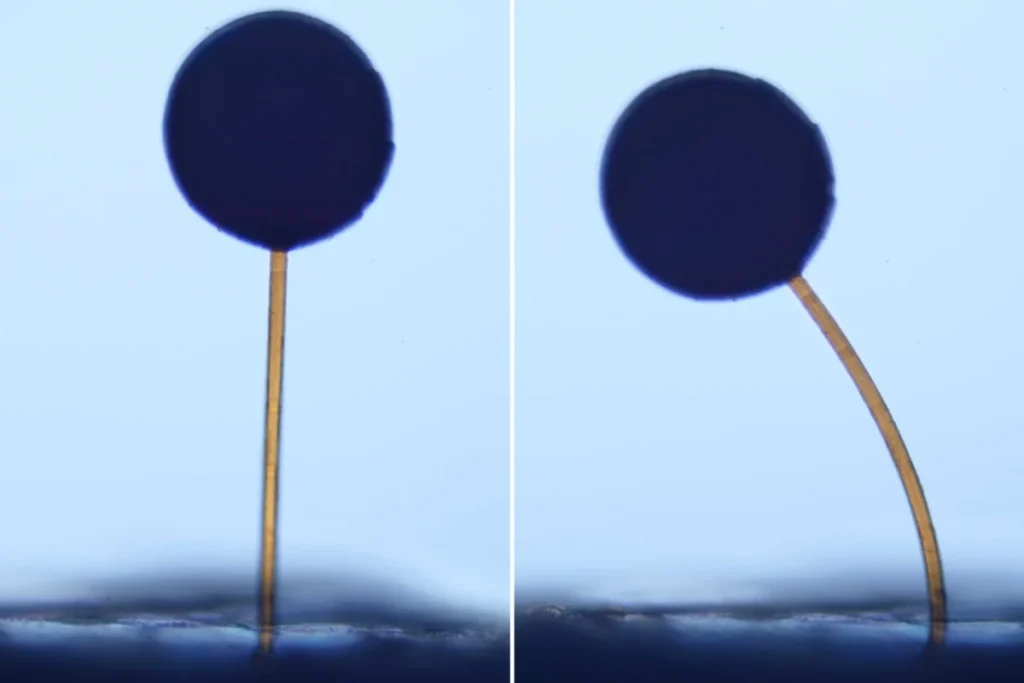
Under the focused gaze of a microscope, a cluster of minuscule, lollipop-shaped structures, each dwarfed by a grain of sand, drifts serenely in a petri dish. In a startling display of controlled motion, these delicate formations suddenly converge, snapping shut with the swift precision of a Venus flytrap. This transformation from passive entities to an active, robotic gripper is orchestrated by the subtle manipulation of an external magnet, a testament to a groundbreaking advancement in material science. Engineers at the Massachusetts Institute of Technology (MIT), in collaboration with researchers from the École Polytechnique Fédérale de Lausanne (EPFL) in Switzerland and the University of Cincinnati, have developed a novel soft magnetic hydrogel capable of forming intricate, magnetically activated three-dimensional structures at the microscopic scale. The findings, detailed in a study published today in the esteemed journal Matter, herald a new era for soft, microscopic, and magnetically responsive robots, with profound implications for fields ranging from medicine to advanced manufacturing.
Genesis of a Microscopic Marvel: The Journey to Programmable Materials
The concept of using magnetic fields to induce motion in objects is well-established, from the simple attraction of paperclips to a refrigerator magnet to the sophisticated propulsion of micro-swimmers. However, existing microscale magnetic devices typically rely on embedding magnetic particles directly into a printable resin. This approach often faces limitations, as the magnetic particles can scatter light during the high-resolution 3D printing process, weaken the resulting structures, or even lead to unintended agglomeration and sedimentation. These challenges have historically created a difficult trade-off between achieving strong magnetic functionality and maintaining structural integrity in microscopic designs.
The MIT team, led by Carlos Portela, the Robert N. Noyce Career Development Associate Professor of Mechanical Engineering, has been at the forefront of developing metamaterials – materials engineered with specific microscopic architectures to achieve extraordinary properties. Portela’s group has a proven track record in fabricating materials with remarkable toughness, elasticity, and the ability to manipulate sound waves or withstand significant impacts. Their recent focus has shifted towards "programmable" materials, which can dynamically alter their characteristics in response to external stimuli such as chemicals, light, electric fields, or magnetic fields. Among these stimuli, magnetic fields offer a distinct advantage: near-instantaneous response and precise control from a distance, without the need for physical contact.
"With a magnetically responsive material, we have control at a distance and the response is instantaneous," explained co-lead author Andrew Chen. "We don’t have to wait for a slow chemical reaction or physical process, and we can manipulate the material without touching it." This immediacy and non-contact control are crucial for applications demanding rapid and precise actuation at the microscopic level.
A Breakthrough Fabrication Technique: The "Double-Dip" Process
The core innovation lies in the researchers’ ingenious fabrication method, which circumvents the challenges associated with direct 3D printing of magnetic microstructures. Instead of attempting to embed magnetic particles into the resin from the outset, the team employs a two-step "double-dip" process.
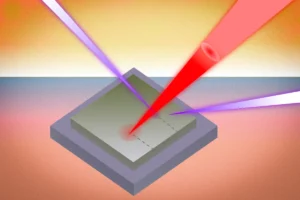
First, conventional high-resolution 3D printing, specifically two-photon lithography, is used to create intricate microscopic structures from a standard polymer gel. This technique involves precisely directing a laser beam into a pool of photocurable resin, solidifying it layer by layer to form complex three-dimensional shapes. In this initial stage, no magnetic particles are incorporated.
Following the printing of the basic gel structure, the researchers immerse the object in a solution containing iron ions. The porous hydrogel readily absorbs these iron ions. The crucial second step involves dipping the iron-infused structure into a second solution containing hydroxide ions. Within the gel, the absorbed iron ions react with the hydroxide ions, chemically forming iron-oxide nanoparticles. These nanoparticles are inherently magnetic, imbuing the previously passive gel structure with controllable magnetic properties.
This post-printing magnetization process offers a significant advantage: it decouples the structural integrity of the micro-architecture from the magnetic functionality. The intricate designs can be printed with high fidelity using established techniques, and then precisely endowed with magnetic responsiveness.
Precision Control and Multifunctional Designs
A key aspect of this new method is the ability to precisely control the magnetic properties of individual features within a single microscopic structure. The researchers discovered that by fine-tuning the laser power during the initial 3D printing phase, they could alter the cross-linking density of the polymer gel. A more tightly cross-linked gel, achieved with higher laser power, results in a denser structure that can accommodate fewer iron-oxide nanoparticles, thus exhibiting weaker magnetism. Conversely, a less cross-linked gel can absorb more magnetic material and become more strongly magnetic.
This level of control allows for the creation of "multifunctional structures," where different parts of the same microscopic object can possess distinct magnetic responses. This opens up unprecedented design freedom for creating complex micro-robots and smart materials. "This provides unprecedented design freedom to print multifunctional structures and materials at the microscale," stated Sun, a co-lead author of the study.
Demonstrating the Potential: From Lollipops to Bistable Switches
To illustrate the capabilities of their new material and fabrication technique, the team engineered several compelling demonstrations. One striking example is the "lollipop gripper." These structures, standing less than a millimeter tall with spherical heads smaller than a grain of sand, were printed from polymer gel and then infused with varying amounts of magnetic particles. When observed under a microscope, the application of an external refrigerator magnet caused these "lollipops" to bend and converge towards the magnet, mimicking the coordinated action of gripping fingers. The differential magnetism, controlled by the printing process, allowed for a nuanced and directed gripping motion.
The potential medical applications of such magnetically controlled micro-grippers are significant. "You could imagine a magnetic architecture like this could act as a small robot that you could guide through the body with an external magnet, and it could latch onto something, for instance to take a biopsy," Portela envisioned. This capability could revolutionize minimally invasive procedures, enabling targeted interventions within delicate biological environments with enhanced precision and reduced invasiveness.
Beyond intricate manipulation, the researchers also fabricated a magnetically responsive, "bistable" switch. This device consists of a small, millimeter-long rectangle of polymer gel with four tiny, oar-like magnetic structures attached to each side. Each "oar" measures approximately 8 microns in thickness – comparable to the size of a red blood cell. When a magnet is applied to one end of the rectangle, the oars pivot towards the magnet, drawing the rectangle with them and locking it into a new position. Applying the magnet to the opposite side reverses the motion, effectively switching the device to another stable state.
"We think this is a new kind of bistable mechanism that could be used, for instance, in a microfluidic device, as a magnetic valve to open or shut some flow," Portela suggested. Such micro-valves are critical components in lab-on-a-chip devices and microfluidic systems used for diagnostics, drug delivery, and scientific research, enabling precise control over fluid flow at the micro-scale.
Broader Implications and Future Directions
The development of this soft magnetic hydrogel and its associated fabrication technique has far-reaching implications across multiple scientific and engineering disciplines.
Medical Advancements
In medicine, the ability to create biocompatible, magnetically controlled micro-robots opens up a frontier of possibilities. Beyond biopsies and drug delivery, these "magno-bots" could be engineered for targeted therapy, navigating the bloodstream to deliver treatments directly to diseased cells, minimizing side effects on healthy tissues. They could also be used for minimally invasive surgery, performing delicate tasks within confined anatomical spaces. The development of such precise tools could dramatically improve patient outcomes and reduce recovery times for a wide range of conditions.
Advanced Materials and Robotics
In materials science, this technology paves the way for creating "stimuli-responsive" materials that can dynamically change their shape and function. This could lead to self-assembling structures, adaptive camouflage, or materials that can reconfigure themselves in response to environmental cues. For robotics, the advent of soft, micro-scale magnetic robots offers a new paradigm for exploration and manipulation in environments inaccessible to traditional rigid robots. These soft robots can navigate complex, confined spaces like pipes, electronic circuits, or biological systems without causing damage.
Industrial Applications
Beyond medicine and advanced materials, the principles behind this research could find applications in precision manufacturing and micro-assembly. Imagine microscopic robotic arms, guided by external magnetic fields, precisely placing components in microelectronics or assembling intricate micro-mechanical systems. The ability to create complex, actuated structures at such small scales could revolutionize the production of miniaturized devices.
Scientific Research
The ability to precisely manipulate microscopic structures with external magnetic fields also provides researchers with powerful new tools for studying biological processes at the cellular and sub-cellular levels. For instance, these magnetic structures could be used to exert controlled forces on individual cells, helping scientists to understand cellular mechanics, signaling pathways, and responses to physical stimuli.
A Collaborative Effort and Future Funding
The success of this research is a testament to the power of interdisciplinary collaboration. The study’s authors from MIT include graduate students Rachel Sun and Andrew Chen, alongside Yiming Ji and Daryl Yee from EPFL, and Eric Stewart from the University of Cincinnati. This international partnership highlights the global nature of scientific discovery and the pooling of diverse expertise to tackle complex challenges.
The research was generously supported by funding from the National Science Foundation and the MathWorks seed grant program, underscoring the critical role of foundational research grants in driving technological innovation. Additionally, the work benefited from the state-of-the-art facilities at MIT.nano, providing the researchers with access to cutting-edge fabrication and characterization tools essential for this advanced material development.
Looking ahead, the team is focused on further refining their fabrication processes and exploring the vast potential of these magnetic hydrogels. The ability to engineer complex, magnetically actuated microstructures with spatially tuned properties marks a significant leap forward, promising to unlock a new generation of soft miniature robots and smart materials with transformative capabilities. "For soft microscopic robotics, or stimuli-responsive matter, that could be a game-changing capability," Portela concluded, expressing optimism about the future impact of their work. The journey from a microscopic lollipop-like structure to a sophisticated robotic gripper serves as a powerful illustration of how fundamental material science research can pave the way for revolutionary technological advancements.