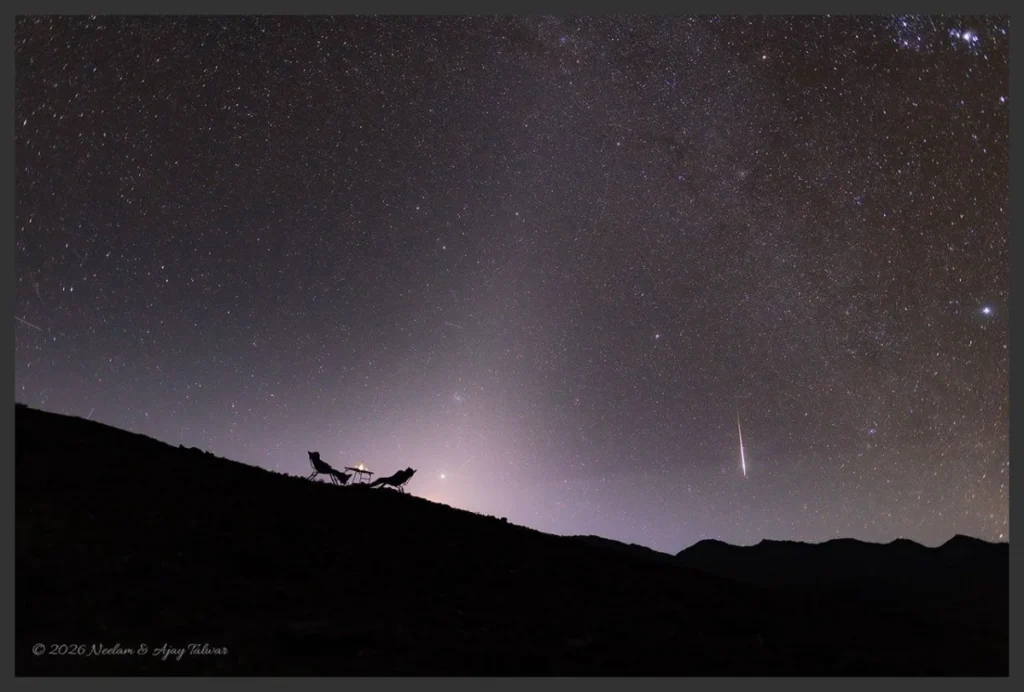
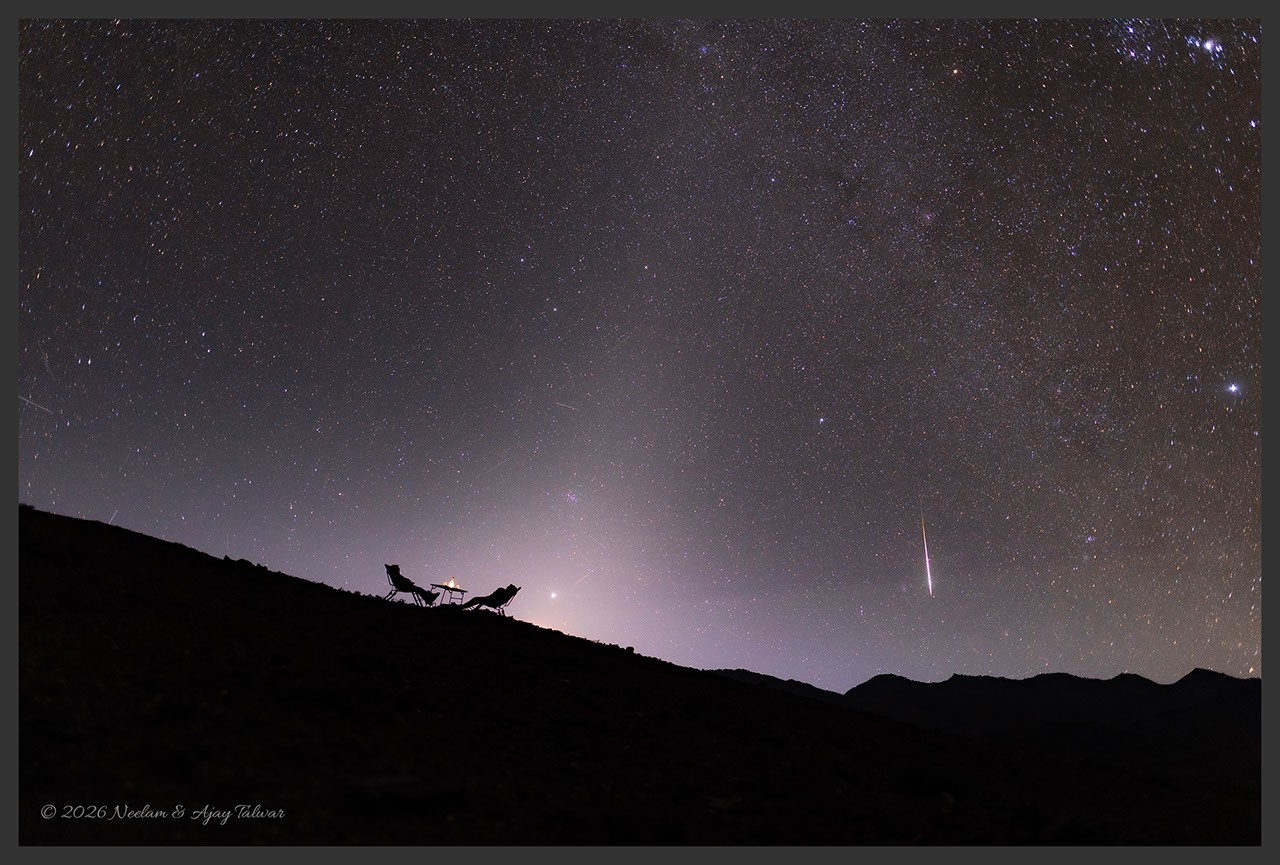
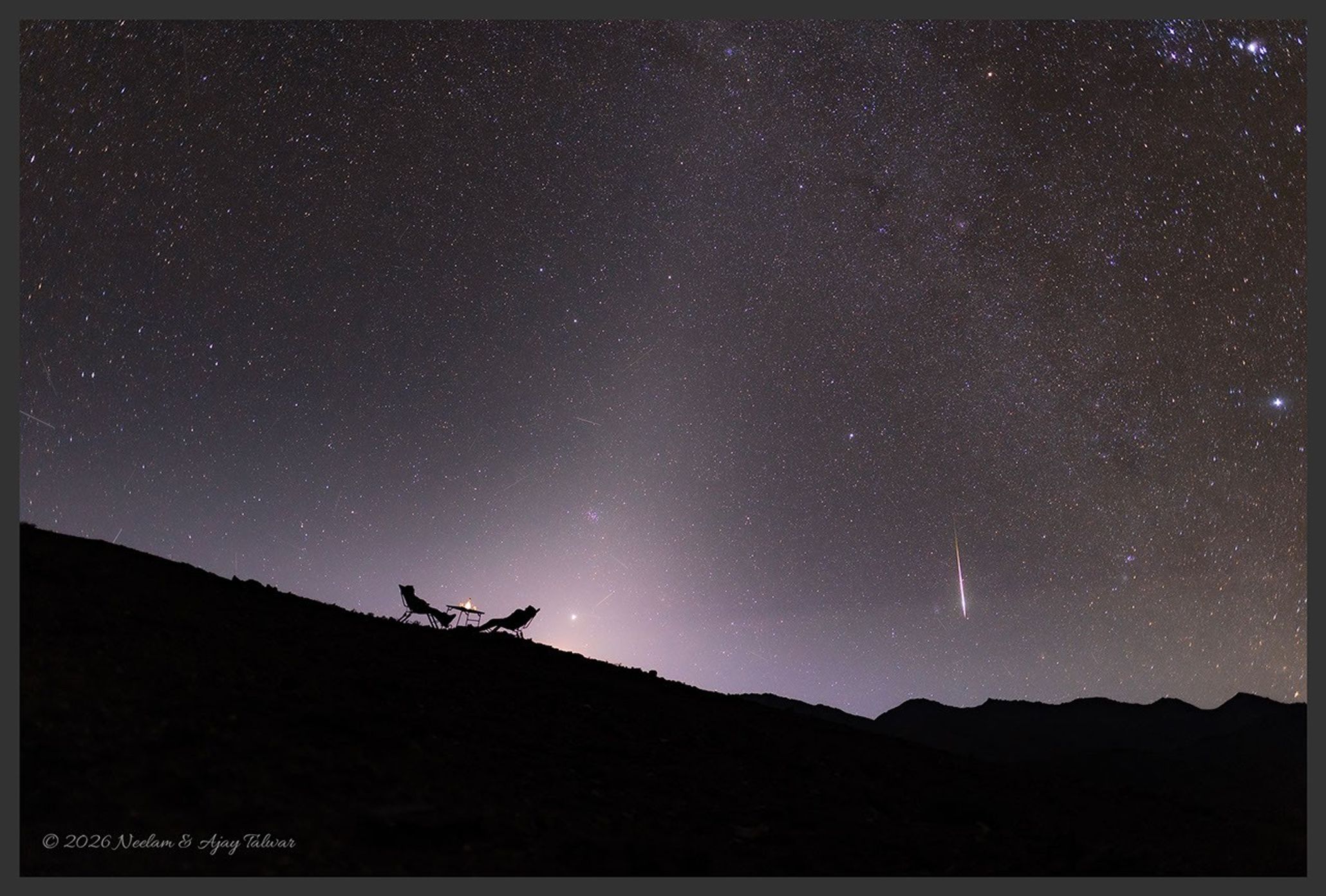
A breathtaking celestial spectacle, the zodiacal light, also known as the false dawn, has been captured in a stunning night skyscape from the remote Hanle Dark Sky Reserve in Ladakh, India. The image, a testament to the power of astrophotography and the pristine conditions of the reserve, showcases a luminous band stretching across the night sky, accompanied by celestial bodies like the bright planet Jupiter, the open star cluster M44, and the yellowish-tinged planet Mars. This visual marvel, recorded just before the onset of astronomical twilight during a September star party, offers a profound glimpse into the intricate workings of our solar system and the delicate dance of interplanetary dust.
The Hanle Dark Sky Reserve, situated at an altitude of approximately 4,500 meters, has emerged as a premier destination for stargazing and astrophotography enthusiasts. Its remote location and high altitude contribute to exceptionally dark skies, free from the pervasive light pollution that plagues most populated areas. This environment provides a unique haven for observing faint celestial phenomena like the zodiacal light, which is often obscured by atmospheric haze and artificial illumination. The presence of two individuals in the foreground, gazing upwards at this cosmic display, underscores the human connection to the universe and the enduring allure of the night sky.
Understanding the Zodiacal Light
The zodiacal light is a faint, triangular-shaped glow that appears in the night sky, extending from the direction of the Sun along the ecliptic – the apparent path of the Sun across the celestial sphere. It is most prominent in the evening twilight after sunset and in the morning twilight before sunrise. Its luminosity is a result of sunlight scattering off a vast cloud of dust particles that permeate the inner solar system, extending outwards from the Sun and reaching beyond the orbit of Earth. These dust particles are primarily composed of rocky material, remnants from comets and asteroids.
Historically, the zodiacal light has captivated observers for centuries. Ancient astronomers noted its appearance, and early theories about its origin varied. However, it was through meticulous observation and scientific inquiry that its connection to interplanetary dust became firmly established. The term "false dawn" aptly describes its appearance, as it can be mistaken for the first hints of the rising sun, particularly in regions with dark skies.
Celestial Companions in the Hanle Skyscape
The photograph from Hanle not only highlights the zodiacal light but also features several notable celestial objects. The bright planet Jupiter is visible, seemingly immersed in the faint glow near the eastern horizon. Jupiter, the largest planet in our solar system, is a gas giant with a prominent system of moons and a dynamic atmosphere. Its consistent presence in the night sky makes it a familiar and beloved celestial neighbor.
Following the zodiacal band towards the zenith reveals the open star cluster M44, also known as the Beehive Cluster. This collection of hundreds of stars, loosely bound by gravity, is a visually striking sight. Further along the band, the planet Mars makes an appearance, characterized by its distinct yellowish hue. Mars, the fourth planet from the Sun, has long been a subject of intense scientific interest due to its potential for past or present life.
The Role of Interplanetary Dust and a Serendipitous Discovery
The very phenomenon that creates the zodiacal light has recently been illuminated by a serendipitous discovery involving NASA’s Juno spacecraft. While on its mission to study Jupiter, Juno detected interplanetary dust particles in orbit around the Sun. In a groundbreaking development, analysis of these detections suggests that Mars itself may be a significant source of the dust responsible for the zodiacal light visible from Earth.
This finding challenges previous assumptions about the primary origin of this solar system-wide dust cloud. For a long time, comets were considered the principal contributors. However, the Juno data indicates that dust ejected from Mars, likely through the interaction of solar wind and micrometeoroid impacts on the Martian surface, could be backscattering sunlight and creating the zodiacal glow we observe. This suggests a more dynamic and interconnected interplanetary environment than previously understood, with planetary bodies actively contributing to phenomena observable from other worlds.
Hanle Dark Sky Reserve: A Sanctuary for the Cosmos
The choice of the Hanle Dark Sky Reserve for this exceptional capture is no coincidence. Established in 2019, it is recognized as India’s first Dark Sky Reserve and is a part of the larger Changthang Wildlife Sanctuary. The reserve’s remoteness, coupled with the local community’s commitment to preserving the night sky, has made it a vital hub for astronomical research and public outreach.
The reserve’s high altitude above sea level contributes to thinner, clearer air, reducing atmospheric distortion and enhancing the visibility of celestial objects. Furthermore, the sparse population density in the region ensures minimal light pollution. The local administration and the Indian Astronomical Observatory have actively worked with the community to implement measures that mitigate light pollution, such as promoting energy-efficient lighting and raising awareness about the importance of dark skies. This collaborative effort has transformed Hanle into a sanctuary where the wonders of the cosmos can be appreciated in their full glory.
Chronology of Observation and Discovery
While the precise date of the photograph’s capture is indicated as September 9, 2026, the understanding of the zodiacal light has a much longer history:
- Ancient Times: Observations of the zodiacal light by ancient civilizations, leading to early, often speculative, explanations.
- 17th-18th Centuries: Early scientific investigations into the nature of the zodiacal light, with astronomers like Cassini and Newton proposing theories. Cassini, in particular, suggested it was sunlight reflected from a cloud of small bodies.
- 19th Century: Continued observations and refinement of theories, with the consensus gradually shifting towards the presence of a dust cloud.
- 20th Century: The space age provided new tools for studying the solar system. Missions like Pioneer and Voyager gathered data about interplanetary dust.
- Early 21st Century: Advances in ground-based and space-based observatories allowed for more detailed studies of the zodiacal light and its composition.
- 2020-2021: Serendipitous detection of interplanetary dust by NASA’s Juno spacecraft during its mission at Jupiter, leading to new insights into the origin of zodiacal light, with a particular focus on Mars as a potential source.
- September 9, 2026: The specific capture of the zodiacal light over the Hanle Dark Sky Reserve, showcasing the phenomenon in a pristine environment and highlighting the celestial bodies within it.
Supporting Data and Analysis
The zodiacal light, though faint, is a persistent feature of our solar system. Its brightness varies depending on the observer’s location, time of year, and atmospheric conditions. For instance, the zodiacal light is typically brightest when the ecliptic makes a steep angle with the horizon, which occurs around the equinoxes.
The dust particles responsible for the zodiacal light are incredibly small, ranging from micrometers to millimeters in size. Their distribution is not uniform; they tend to be more concentrated closer to the Sun and within the plane of the planets’ orbits. The sunlight scattered by these particles covers a broad spectrum, but it appears as a whitish or yellowish glow to the human eye.
The recent findings suggesting Mars as a significant source of this dust are particularly compelling. If confirmed by further research, this would indicate a more active role for terrestrial planets in shaping the interplanetary environment. The rate at which Mars might eject dust, and the mechanisms involved, are now areas of active scientific investigation. Understanding these processes could provide insights into the evolution of planetary systems and the distribution of material within them.
Official Responses and Broader Impact
The capture of such a striking image from the Hanle Dark Sky Reserve, coupled with the ongoing scientific discoveries about the zodiacal light, has significant implications for both scientific research and public engagement with astronomy.
Organizations like NASA, which promotes astronomical research and public outreach through programs like Astronomy Picture of the Day (APOD), play a crucial role in disseminating such discoveries. The APOD website, which features a different image of our fascinating universe each day with explanations from professional astronomers, serves as a vital platform for sharing these celestial wonders. The move of APOD’s main site to science.nasa.gov/apod signifies NASA’s continued commitment to highlighting the achievements in space science.
The broader impact of these observations extends to inspiring future generations of scientists and encouraging greater appreciation for the night sky. Initiatives like the Hanle Dark Sky Reserve are critical in preserving dark sky sites for both scientific observation and for the public to connect with the cosmos. As light pollution continues to increase globally, such reserves serve as vital sanctuaries, reminding us of the vastness and beauty of the universe that lies beyond our immediate surroundings. The visual evidence, like the photograph from Hanle, combined with the scientific understanding of phenomena like the zodiacal light, can ignite curiosity and foster a deeper understanding of our place in the cosmos.
The ongoing research into the origin of zodiacal light, particularly the potential role of Mars, underscores the dynamic nature of our solar system. It suggests that seemingly static phenomena can be the result of complex, ongoing processes involving multiple celestial bodies. This continuous evolution of scientific understanding, driven by observation and technological advancement, is a hallmark of human exploration and our enduring quest to unravel the mysteries of the universe. The image from Hanle, therefore, is not just a beautiful photograph; it is a snapshot of a moment in our ongoing journey of cosmic discovery.