A seemingly routine examination of NASA lunar data has yielded a monumental discovery: the identification of the largest newly formed impact crater ever detected within our solar system. This significant find, unearthed by Robert Wagner, a scientist collaborating with NASA’s Lunar Reconnaissance Orbiter (LRO) mission, underscores the enduring value of long-term planetary observation and offers crucial insights into the dynamic nature of celestial bodies.
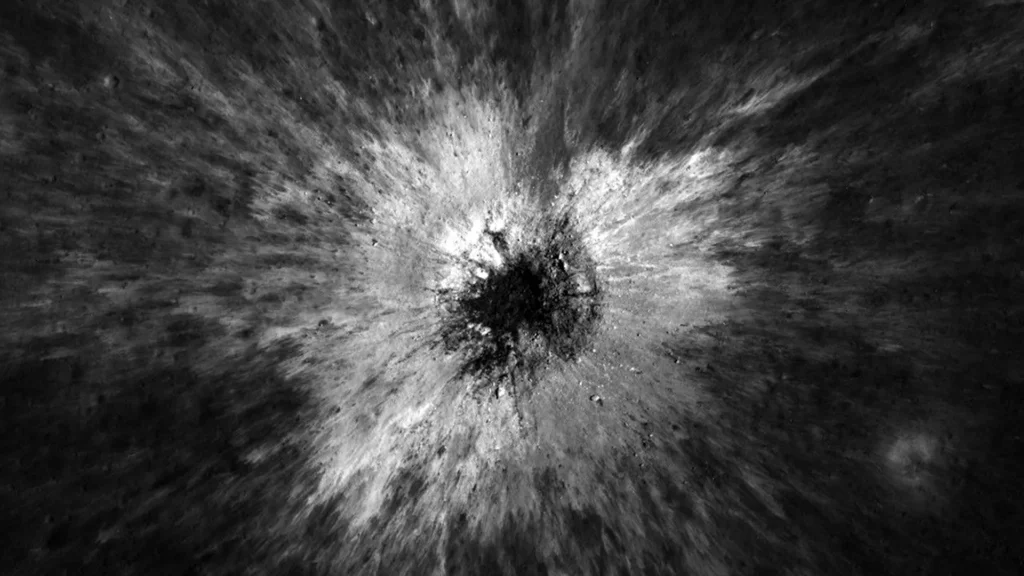
The discovery began not with a targeted search for cosmic impacts, but during a comprehensive review of extensive lunar imagery. Wagner, an image-processing specialist from Intuitive Machines working with the Lunar Reconnaissance Orbiter Camera (LROC) system, was meticulously sifting through a vast digital map of the Moon when an anomaly captured his attention. A distinctively bright patch, starkly contrasted by a dark halo, stood out on his computer display. This visual signature is a telltale sign of recent disturbance on the lunar surface, indicative of material being ejected and altered by a powerful event.
"I just stopped, dropped everything, and started looking into what that spot was," Wagner recounted, emphasizing the immediate intrigue sparked by the unusual observation. His focused investigation, which involved comparing older and more recent LRO images of the same lunar region, quickly confirmed his suspicions. The anomaly was not an artifact or a known geological feature, but a crater born from a recent impact.
The Genesis of McGetchin: A Monumental Impact
The scientific community officially announced the discovery on September 16, reporting in the prestigious journal Science Advances that the newly identified crater is indeed the largest of its kind ever documented. This colossal impact feature has been formally named McGetchin, in honor of the pioneering lunar scientist Tom McGetchin, who tragically perished in a climbing accident in 2010.
The impact event that sculpted McGetchin occurred in a specific timeframe: between April 11 and May 22, 2024. The celestial body responsible for this dramatic transformation was an asteroid or comet, estimated to be roughly the size of a three- to six-story building. This object slammed into the Moon’s surface with immense force, creating a scar of unprecedented scale for a recently formed crater.
The dimensions of McGetchin are staggering. The crater measures an impressive 728 feet in diameter, a span equivalent to the length of two American football fields laid end-to-end. Its depth is equally remarkable, plunging 141 feet below the lunar surface. To contextualize this depth, it would be large enough to accommodate three standard yellow school buses stacked vertically.
Scientists estimate that an impact of this magnitude is a rare occurrence on the Moon, happening perhaps only once every century, or even less frequently. This rarity amplifies the significance of Wagner’s discovery, transforming a routine data analysis into a landmark scientific event.
The Moon’s Unseen Bombardment: LRO’s Enduring Legacy
The discovery of McGetchin is a powerful testament to the invaluable contribution of NASA’s Lunar Reconnaissance Orbiter (LRO) and its ongoing mission. For over 17 years, LRO has been diligently orbiting the Moon, equipped with seven sophisticated instruments dedicated to studying its diverse landscape, surface composition, thermal characteristics, and radiation environment.
During its extensive tenure, LRO has become an unparalleled observer of lunar surface changes. Researchers have cataloged at least 1,000 new impact craters identified by the orbiter. Beyond these new craters, LRO has recorded approximately 100,000 additional alterations to the lunar surface, attributing them to either direct impacts from celestial objects or the outward dispersal of debris from existing impacts.
Unlike Earth, which benefits from a protective atmosphere that burns up smaller incoming meteors, the Moon is a starkly exposed world. Lacking any significant atmosphere, it offers no shield against the constant barrage of space rocks, meteoroids, and other extraterrestrial debris. This direct exposure means that asteroids, comets, and even smaller objects can strike the lunar surface unimpeded, leaving their mark.
While McGetchin represents a colossal impact, most lunar collisions are far more modest. The smallest craters reliably detectable in LRO images are around 30 feet across, comparable to the length of a three-story building lying on its side. These smaller craters are typically formed by rocks approximately 43 inches in width, roughly the size of a monster truck tire. Scientists estimate that impacts of this size contribute to the formation of about 140 new craters across the Moon each year. Microscopic impacts also occur continuously, but the resulting pits are too minute to be discerned from orbital imagery.
Beyond the Visible: A Chilling Thermal Anomaly
The scientific investigation into McGetchin did not end with its visual identification. LRO is equipped with a suite of instruments, some of which can reveal changes invisible to the naked eye or standard camera imagery. Following the crater’s detection, scientists directed the spacecraft’s Diviner thermal instrument to meticulously examine the region surrounding McGetchin.
These thermal observations yielded an unexpected and intriguing finding: an area approximately 4 miles wide surrounding the crater exhibits a noticeable temperature difference. At night, this expanse is about 16 degrees Fahrenheit colder than the adjacent terrain.
This phenomenon was further explored in a second paper, published concurrently with the initial discovery in Science Advances. Researchers have attributed this thermal anomaly to modifications in the lunar regolith, the loose, unconsolidated surface material. The immense force of the impact churned and loosened the regolith in the vicinity of the crater. This disturbance resulted in a less dense material that is less efficient at retaining heat after the sun sets on the lunar surface, leading to the observed cooling effect.
The extent of this "cold spot" surprised researchers, as it demonstrates that a significant impact event can alter the lunar surface far beyond the immediate rim of the crater itself.
Implications for Lunar Exploration and Science
The discovery of McGetchin and its associated thermal anomaly carries significant implications for future lunar exploration and scientific endeavors. Variations in the texture and density of the regolith, as evidenced by the cold spot, could have a tangible impact on the mobility of robotic rovers across the surface. Understanding these subtle yet significant geological changes is crucial for planning future missions and ensuring the success of lunar operations.
Moreover, the ability to identify and analyze such large, recent impact events highlights the critical role of persistent, high-resolution orbital monitoring. As humanity looks towards establishing a sustained human presence on the Moon, and as commercial activities increase, the need for accurate, up-to-date information about the lunar environment becomes paramount. LRO’s data serves as an indispensable resource for both scientific research and operational planning.
The Mechanics of Discovery: How NASA Found McGetchin
The LROC system, responsible for the visual identification of McGetchin, operates by capturing detailed black-and-white images of the Moon from an altitude of approximately 60 miles as LRO traverses its pole-to-pole orbit. The system comprises two high-resolution cameras and a moderate-resolution multispectral camera. Over years of operation, these instruments have meticulously mapped the lunar surface, enabling scientists to identify a wide array of features, including new craters, landslides, evidence of past volcanic activity, and even potential lava tubes.
The routine inspection of close-up images from LROC’s Narrow-Angle Camera is typically focused on detecting changes smaller than 30 feet. However, the team also undertakes periodic, broader surveys to identify larger geological events. This involves the creation of global lunar maps and their comparison with earlier versions, specifically searching for changes exceeding 150 feet in width.
It was during one of these comprehensive global mapping efforts, on October 24, 2025, that Robert Wagner encountered the distinctive signature of McGetchin. Utilizing images from LROC’s Wide-Angle Camera, which captures broader swathes of the lunar surface with a resolution where individual pixels can be as large as a football field, Wagner employed specialized software. This software is designed to highlight discrepancies between hundreds of "before" and "after" images. Unchanged features appear as gray, while any alteration registers as a bright or dark patch.
A Crater Impossible to Miss
While this comparative imaging technique is highly effective, the identification of genuine new craters requires meticulous manual review. Minor fluctuations in lighting or shadows can often trigger the software, generating a multitude of false positives. Wagner’s usual method for verifying potential impacts involves searching for small, fuzzy halos around bright, single-pixel points. These halos are characteristic of ejected regolith from a fresh impact.
McGetchin, however, presented a dramatically different scenario. Its debris pattern was not a subtle halo, but an extensive spray stretching across hundreds of pixels, immediately setting it apart from its surroundings. "It was by far the most obvious impact debris pattern I’ve ever seen in one of these images," Wagner stated, underscoring the unprecedented clarity of the find.
Following this initial identification, LROC’s Narrow-Angle Camera was deployed for a more detailed examination, capable of resolving features at approximately 3 feet per pixel. Images captured during subsequent passes over the impact site allowed scientists to precisely measure the crater’s dimensions, analyze its morphology, and assess the alterations to the surrounding landscape. These high-resolution observations also provided critical data for estimating the size and energy of the object that created McGetchin, with more detailed findings anticipated in future publications. The discovery of McGetchin serves as a powerful reminder that even seemingly quiescent celestial bodies like the Moon are constantly evolving, shaped by the relentless forces of the cosmos.