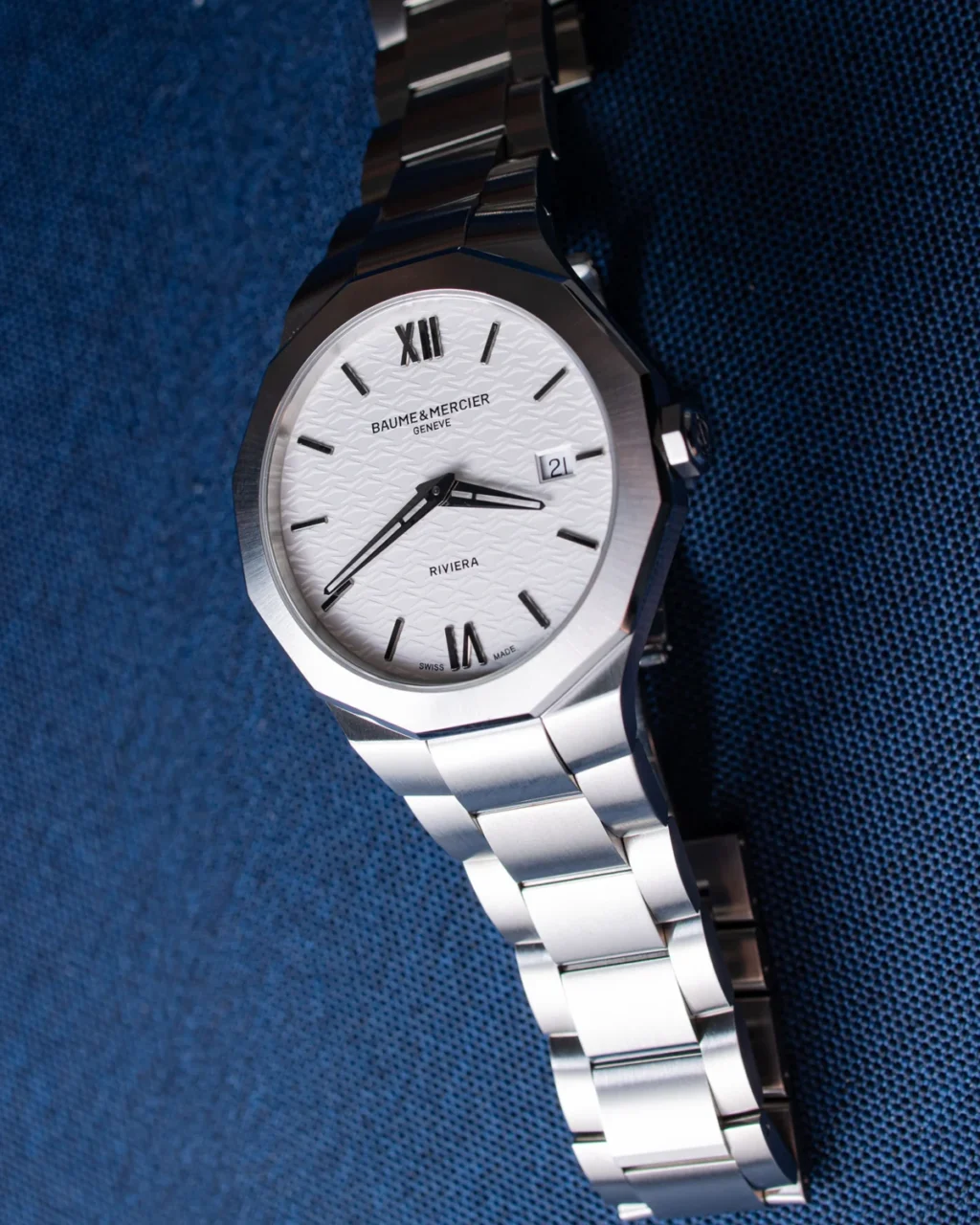
The Baume & Mercier Riviera collection, a storied name in watchmaking, is making a significant statement with its latest iteration, the Riviera 73. This new release signifies a deliberate pivot back towards the original design ethos that first captivated watch enthusiasts in 1973, aiming to carve out a distinct identity in the increasingly competitive integrated bracelet sports watch market. While Baume & Mercier has historically offered a more accessible entry point into luxury timepieces, the Riviera 73 seeks to recapture the elegance and refined proportions that defined its pioneering predecessors, potentially appealing to a new generation of collectors and solidifying its place under the brand’s evolving ownership.
A Historic Claim in a Modern Arena
The integrated bracelet sports watch category, currently experiencing an unprecedented surge in popularity, is often dominated by a few iconic names. However, the Baume & Mercier Riviera holds a surprisingly strong, albeit often overlooked, historical claim to this segment. Debuting in 1973, the original Riviera predates many of its more celebrated contemporaries, including the Girard-Perregaux Laureato, Audemars Piguet Royal Oak, Patek Philippe Nautilus, and Vacheron Constantin 222. Despite this early lineage, the Riviera line has, in recent decades, sometimes appeared to chase trends rather than lean into its inherent strengths. The Riviera 73 marks a conscious effort to rectify this, presenting a vision that is both faithful to its heritage and relevant to contemporary tastes. This strategic repositioning is particularly noteworthy as Baume & Mercier navigates a new chapter under different ownership, signaling a renewed focus on core brand values and historical significance.

Design Philosophy: Reinterpreting the Original Riviera
The Baume & Mercier Riviera 73 distinguishes itself with a case measuring 39mm in width, a size that, while not diminutive by modern standards, strikes a harmonious balance between presence and svelte wearability. The most striking aspect of its design is the remarkably slim 7.65mm case thickness. This allows the watch to sit exceptionally low on the wrist, emphasizing its diameter without introducing unnecessary bulk. This slenderness is a direct nod to the original Riviera’s design, which prioritized elegance and comfort.
Compared to other contemporary models within the Riviera line, the Riviera 73 subtly reinterprets the case form to better align with its 1973 inspiration. The integrated lugs are rendered with a softer, more tapered profile, creating a smoother, more rounded transition from the case body to the bracelet. This design choice serves to enhance the prominence of the Riviera’s signature 12-sided bezel. The bezel, a defining feature of the collection since its inception, now appears to "float" atop the bracelet, evoking the visual impression of the first-generation ref. 5112 Riviera.
The finishing of the bezel is a testament to Baume & Mercier’s craftsmanship. It features crisp, sunburst brushing on the upper surfaces, which then transitions to two levels of meticulously mirror-polished facets. The dodecagonal shape, with its sharp angles, demands precision in its execution, and the brand has delivered a level of finishing that imparts a pleasingly keen aesthetic. The caseback, while simple, is thoughtfully detailed with a deeply engraved "73" motif set against a textured background reminiscent of deck planks, adding a subtle nautical touch that aligns with the Riviera’s name. Despite its sporty connotations, the Riviera 73 offers a water resistance of 50 meters, which is adequate for daily wear but positions it more as an elegant timepiece than a robust dive watch.

Dial Aesthetics: Simplicity and Subtle Refinements
The dial of the Baume & Mercier Riviera 73 is a masterclass in minimalist design, stripping back the elements to their most essential forms. The significant amount of negative space on the dial allows the applied Roman numerals and indices, which are handsomely polished, to stand out without distraction. These markers appear to float above a subtly ridged surface, textured with a shallow wave motif. While the Riviera line’s repeating V-pattern texture has not always been universally praised, the open layout and the silvery-white colorway of this particular dial play to its strengths effectively.
The semi-skeletonized dauphine hands maintain the dial’s minimalist character while adding a touch of visual interest with their brushed and polished facets. However, the unframed date window positioned at the 3 o’clock mark stands as a notable departure from the dial’s otherwise restrained and open symmetry, potentially disrupting the overall sense of visual harmony for some observers. This design choice, while functional, may be a point of discussion among purists who value absolute symmetry in dial layouts.
Powertrain: Embracing Quartz Heritage
In a move that might initially raise eyebrows among some mechanical watch enthusiasts, the Baume & Mercier Riviera 73 is powered by the ETA F06.115 quartz movement. This choice is, however, historically accurate. The original Riviera collection was quartz-powered, and for much of its heyday in the 1970s and 1980s, mechanical variants were virtually non-existent. The resurgence of interest in high-quality quartz movements, often driven by their practicality and affordability, is increasingly recognized within the horological community.

The ETA F06.115 offers several practical advantages that complement the Riviera 73’s design and market positioning. It boasts an impressive five-year battery life, significantly reducing the frequency of servicing. Its shock resistance is above average for a quartz movement, contributing to its durability. Crucially, its slender profile is instrumental in achieving the Riviera 73’s exceptionally thin case. Furthermore, the absence of a constantly ticking quartz seconds hand contributes to a more elegant and fluid visual presentation, akin to that of a mechanical movement at a glance. This deliberate embrace of its quartz heritage underscores Baume & Mercier’s commitment to honoring the original spirit of the Riviera.
The Bracelet: A Seamless Integration
The character of any integrated bracelet sports watch is intrinsically linked to its bracelet design, and the Baume & Mercier Riviera 73 is no exception. The swept-back, three-link design is a familiar element shared across the current Riviera series. However, it finds a particularly harmonious integration with the Riviera 73’s slimmer and more flowing case form. This synergy makes the existing bracelet design feel more cohesive and thoughtfully incorporated into the overall aesthetic.
The bracelet itself is well-executed, featuring broad, linearly brushed planes that are artfully contrasted by polished center-link chamfers. These polished accents catch the light, creating subtle highlights that add dynamism to the bracelet’s appearance. A potential point of contention for some enthusiasts might be the fully hidden butterfly clasp. In an era where micro-adjustment capabilities are becoming increasingly common and desired for fine-tuning fit, the absence of such a feature on this clasp might be seen as a drawback. However, for those who prioritize the clean, uninterrupted lines of the bracelet and case, the hidden clasp contributes to a seamless and elegant overall design.

Market Position and Future Implications
Despite being one of the earliest pioneers in the integrated bracelet sports watch genre, the Baume & Mercier Riviera has historically faced challenges in establishing a prominent niche within the fiercely competitive modern market. The Riviera 73, with its emphasis on slim, restrained, and elegant proportions, coupled with an approachable price point, represents a strategic attempt to capture a new segment of buyers.
The MSRP for the Baume & Mercier Riviera 73 stands at $1,950 USD, positioning it as a compelling entry-level luxury option. This pricing strategy, combined with the watch’s historical significance and refined aesthetics, could prove instrumental in attracting a new generation of collectors who are increasingly appreciating the value and historical context offered by brands like Baume & Mercier.
The brand’s transition to new ownership under the control of the Hong Kong-based company Addvalue Sourcing Holdings Limited, finalized in 2018, has signaled a period of re-evaluation and strategic recalibration. The Riviera 73’s return to its design roots can be interpreted as a key element of this broader strategy, aiming to leverage Baume & Mercier’s rich heritage to forge a stronger identity and a more defined market presence. This focus on core strengths and historical accuracy suggests a long-term vision to revitalize the brand’s appeal and re-establish its position as a purveyor of accessible yet sophisticated Swiss watchmaking. The success of the Riviera 73 will likely serve as an important indicator of the effectiveness of this renewed brand direction.