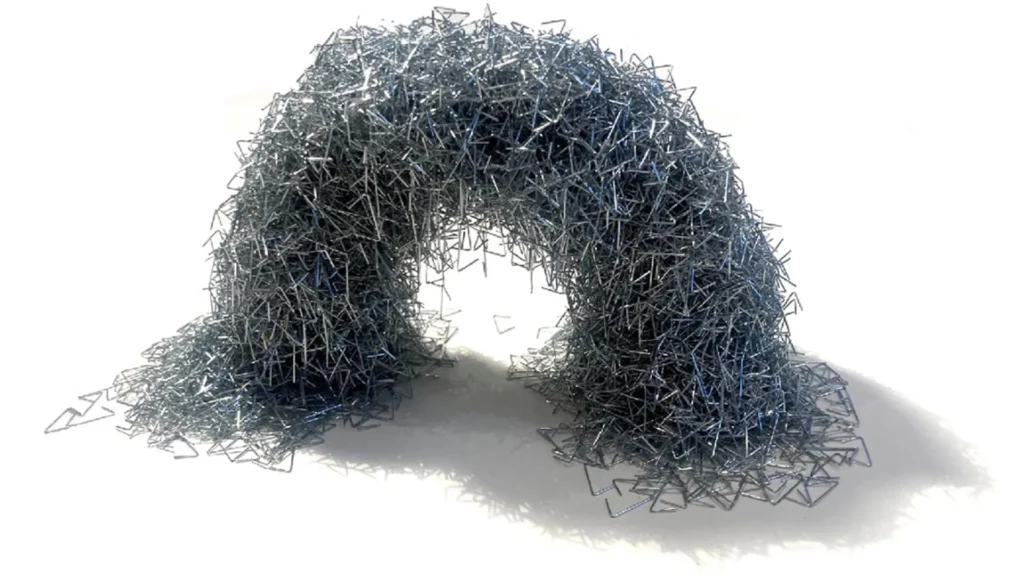
A tightly compressed bundle of common office staples, despite being an aggregate of numerous distinct metallic pieces, exhibits a remarkable collective behavior. This entangled mass can become exceptionally difficult to pull apart, often behaving with the cohesive integrity of a single, solid object. Yet, this very same bundle possesses an equally surprising reversibility; with the application of specific vibrations or movements, the staples can rapidly separate, reverting to their original state as a loose collection of individual components. This unusual combination of robust strength and instantaneous reversibility is now inspiring researchers at the Paul M. Rady Department of Mechanical Engineering at CU Boulder, who believe it could lay the groundwork for a groundbreaking generation of engineered materials. By meticulously designing particles that mimic the interlocking mechanism of staples, the team aims to develop materials characterized by exceptional strength, adaptability, and crucially, inherent recyclability.
"We’ve been playing around with the idea of building blocks and geometry for many years, but we started looking at interlocking, entangled particles only recently," stated Professor Francois Barthelat, who leads the Laboratory for Advanced Materials & Bioinspiration. He added, "We are excited about the combination of properties we can get out of these systems and we believe this technology has the potential to go in many directions." The initial findings of this transformative research were recently detailed in the Journal of Applied Physics, sparking considerable interest within the materials science community.
The Fundamental Principle: Harnessing Entanglement
The core of this research revolves around the phenomenon of entanglement, a state where individual particles become intricately intertwined, forming complex, interconnected networks. This principle is not new to science or nature; it is a ubiquitous mechanism that confers strength and stability across diverse systems. Bird nests, for instance, owe their surprising structural integrity to a sophisticated network of interwoven twigs and fibers, demonstrating how seemingly fragile elements can create a resilient whole through entanglement. Similarly, the remarkable strength and resilience of bones are partly derived from the intricate interaction and interlocking of hard mineral components (hydroxyapatite) with more pliable protein matrices (collagen fibers) at the nanoscale. Beyond these examples, one can observe entanglement in the root systems of plants stabilizing soil, or in the intricate weave of natural fabrics providing durability.
For centuries, materials scientists and engineers have sought to replicate and harness such natural principles in manufactured materials. The CU Boulder team’s work represents a significant stride in this direction, specifically focusing on how to manipulate particle geometry to induce and control entanglement. Their investigations quickly pointed to one paramount factor: the precise shape of the particles themselves.
"Let’s take sand as an example. Sand is smooth and convex-shaped, meaning it cannot interlock from grain to grain," explained PhD student Youhan Sohn. "However, we found that if we change the shape of a grain of sand, we can drastically affect its behavior and mechanical properties, including the particle’s ability to link with other particles." This insight underscored the potential for bespoke particle design to fundamentally alter the macro-mechanical properties of granular materials. Historically, granular materials have been studied for their complex behaviors, often defying simple categorization as solids or liquids. Pioneering work by scientists like Osborne Reynolds in the late 19th century highlighted phenomena like dilatancy, where granular materials change volume under shear, hinting at the intricate inter-particle interactions that govern their bulk properties. The CU Boulder research builds upon this legacy, pushing the boundaries of what can be achieved by deliberately engineering these interactions.
To systematically investigate this hypothesis, the researchers employed Monte Carlo simulations, a powerful computational technique that utilizes random sampling to model complex systems where deterministic approaches are intractable. In this context, the simulations allowed them to explore how various particle shapes would interact under different conditions, predicting their propensity for entanglement. The primary objective was to identify a geometry that would maximize interlocking and, consequently, the desired mechanical properties. This computational phase was critical, enabling the team to sift through countless design permutations efficiently before committing to physical experimentation.
The Staple-Like Revelation: Strength, Toughness, and Reversibility
Following the identification of several promising designs through simulation, the CU Boulder team moved to empirical validation. They conducted a series of "pickup tests," a direct and intuitive method to observe how the designed particles behaved in real-world scenarios. In these tests, masses of the specially shaped particles were subjected to various manipulations to gauge their cohesion and ability to form stable aggregates.
The results from these experiments were highly illuminating. Among the geometries tested, a "two-legged" particle, strikingly resembling a common office staple, consistently produced the highest degree of entanglement. This shape demonstrated a superior ability to interlock with its neighbors, forming a robust, cohesive structure. Moreover, the researchers discovered that this staple-like geometry offered several unexpected and highly beneficial characteristics, distinguishing it from conventional material designs.
One of the most significant findings was the material’s ability to combine high tensile strength with remarkable toughness – two properties that are notoriously difficult to achieve simultaneously in traditional engineering materials. Tensile strength refers to a material’s resistance to breaking under tension, while toughness describes its ability to absorb energy and deform plastically without fracturing. For instance, ceramics boast high compressive strength but are brittle and lack toughness, failing catastrophically under tensile loads. Many metals, while tough, may not always achieve the highest specific strengths. Polymers can be very tough but often lack the stiffness and strength of metals or ceramics.
"Our entangled granular material using the staple-like particle demonstrates both high strength and toughness at the same time," affirmed PhD student Saeed Pezeshki. This dual capability is a holy grail in materials science, opening doors for applications where both resilience and resistance to deformation are paramount. The entanglement mechanism provides the necessary strength by distributing loads across a vast network of interlocked particles, while the ability of these particles to subtly shift and reconfigure under stress contributes to the material’s overall toughness, preventing localized crack propagation.
Beyond its impressive mechanical properties, the staple-like particles exhibited another extraordinary characteristic: their capacity for rapid, controlled reversibility. The material could quickly transition into a stronger, entangled structure and then, just as swiftly, separate again into individual components. The researchers found that by applying different vibration patterns, they could precisely control the degree of entanglement. Gentle, low-frequency vibrations encouraged the particles to settle into their interlocked configurations, thereby strengthening the material. Conversely, stronger, higher-frequency vibrations provided enough kinetic energy to overcome the inter-particle frictional and geometric locking forces, causing the network to unravel and the material to fluidize.
"It’s a strange material because it’s obviously not a liquid. However, it’s also not quite solid. This opens new and intriguing engineering possibilities," Professor Barthelat remarked, highlighting the material’s unique phase-like behavior. He added, "Handling a bundle of these entangled particles feels very remote and exotic," underscoring the novelty of this new state of matter. This controllable transition between solid-like and fluid-like states, mediated by external stimuli, places it within an emerging class of "smart materials" that can adapt their properties on demand.
Broadening Horizons: Sustainable Construction and Transformative Robotics
The potential applications of this novel entangled material technology are vast and transformative, extending across multiple industries. One of the most immediate and impactful areas identified by the researchers is sustainable construction.
In an era increasingly focused on environmental stewardship and resource efficiency, conventional construction practices often generate massive amounts of waste. Buildings and infrastructure, once reaching the end of their service life, are typically demolished, leading to significant landfill contributions and substantial embodied energy losses. The CU Boulder team envisions a future where bridges, buildings, and other large structures are constructed using entangled materials that can be easily disassembled rather than destructively demolished. Such materials could then be either fully recycled, with their constituent particles separated and re-used for new structures, or even reconfigured on-site for adaptive reuse. This approach aligns perfectly with the principles of a circular economy, drastically reducing construction and demolition waste, lowering the carbon footprint associated with new material production, and conserving valuable resources. Industry experts in sustainable architecture have long called for such innovations, noting that the ability to "deconstruct" rather than "demolish" could revolutionize urban planning and material life cycles. While scaling up production and ensuring cost-effectiveness remain significant challenges, the environmental imperative provides a powerful driving force for overcoming these hurdles.
Beyond civil engineering, the concept also holds immense promise for advancements in robotics. The ability of these materials to rapidly transition between rigid and fluid states makes them ideal candidates for next-generation robotic systems.
"I was talking with other students who believe this technology can be used in swarm robotics – where small robots can entangle, do a task and then disentangle when they are done," Pezeshki shared. Imagine miniature robots that can coalesce into a larger, stronger structure to perform heavy lifting or complex manipulations, and then fluidize to navigate tight spaces or reconfigure for different tasks. This adaptability could lead to highly versatile and resilient robotic systems capable of operating in dynamic, unpredictable environments.
Professor Barthelat offered a more vivid, albeit speculative, analogy to illustrate this potential: "Yes, kind of like that liquid metal T-1000 in Terminator 2 who can change shape to slide under a door and then transform back to a human’s size on the other side." While the sophisticated self-assembly and sentient control depicted in science fiction are far beyond current capabilities, the underlying principle of programmable material reconfigurability is precisely what the CU Boulder research is exploring. He acknowledged the practical hurdles, stating, "It’s expensive and scaling up is a challenge, but it’s something that’s on everybody’s mind." Such adaptive materials could also find applications in soft robotics, where flexibility and gentle interaction with delicate objects are crucial, or even in advanced protective gear that can stiffen on impact.
Other nascent applications could include rapidly deployable emergency shelters for disaster relief, reconfigurable packaging that minimizes waste, or even components for aerospace engineering where lightweight, strong, and easily repairable materials are highly valued. The ability to control material properties on demand offers unprecedented design freedom for engineers across a spectrum of disciplines.
The Path Forward: Engineering Enhanced Entanglement
The CU Boulder team is not resting on its laurels; they are already progressing into the next phase of this groundbreaking research. Their latest experiments are focused on developing and testing even more complex particle designs, aiming to unlock greater degrees of entanglement and further enhance material properties.
Their current focus is on a new particle design that incorporates additional protruding "legs" or features. The researchers draw an analogy to the spiky burrs commonly found clinging to shoes and clothing outdoors – natural structures designed for maximum adherence and entanglement. The rationale behind these added features is multifaceted: more "legs" mean an increased number of potential contact points between particles, leading to more intricate interlocking geometries. This, in turn, is expected to result in significantly higher frictional forces and mechanical interlocks, requiring substantially greater energy to disentangle the material.
These enhanced entanglement effects could lead to materials with even higher strength-to-weight ratios, greater toughness, and potentially finer control over their reversible properties. The challenges in this next stage involve not only designing these complex geometries but also developing efficient and cost-effective manufacturing processes for such intricate particle shapes at scale. Furthermore, the development of precise, low-energy control mechanisms for inducing and reversing entanglement will be critical for practical applications. The journey from fundamental scientific discovery to widespread industrial application is long and arduous, but the foundational work being done at CU Boulder promises a future where materials are not static entities but dynamic, adaptable components of a more sustainable and technologically advanced world.