Researchers at the Massachusetts Institute of Technology (MIT) have unveiled a groundbreaking system that leverages novel mechanical metamaterials, dubbed "bifur-circuits," to create interactive, shape-changing objects capable of sensing their own configurations. This innovative approach promises to revolutionize product design, from adaptable furniture and advanced robotics to dynamic communication antennas, by embedding intrinsic intelligence directly into hardware through sophisticated geometry and integrated electronics. The team’s findings, presented in a recent paper and slated for discussion at the ACM Symposium on User Interface Software and Technology, highlight a significant leap forward in the field of reconfigurable structures.
The Genesis of "Bifur-Circuits": Overcoming Static Limitations
The concept of metamaterials – engineered materials with properties not found in nature, derived from their structure rather than composition – has captivated scientists for decades. Mechanical metamaterials, a subset of this field, are three-dimensional structures built from repeating units designed to exhibit unusual mechanical behaviors when subjected to external forces. A prime example is "auxetic" metamaterials, which expand perpendicularly when stretched, contrary to conventional materials that narrow. These properties enable them to form complex, predetermined shapes through simple manipulations like squeezing, pushing, or pulling.
Prior research at MIT had successfully utilized auxetic metamaterials to construct reconfigurable antennas. These early prototypes could adopt three distinct shapes based on how they were stretched, allowing them to dynamically adjust their frequency range without the need for cumbersome, traditional mechanical components. This was a significant advancement, particularly for applications requiring adaptable communication or sensing capabilities in varying environmental conditions. However, the limitation of only three fixed configurations presented a bottleneck for broader applicability and more complex adaptive systems.
The challenge then became how to expand this reconfigurability beyond a few static states. This quest led to the development of "bifur-circuits." Marwa AlAlawi, a mechanical engineering graduate student and lead author of the paper, explains the core philosophy: "Metamaterials can make complex mechanical assemblies easy to manufacture just by using repeating units. Our work expands on this design space. If we think of mechanical metamaterials as building blocks, then our work is one way to take advantage of their geometry to embed intrinsic intelligence into hardware, which could open many possibilities." The innovation lies in designing these auxetic metamaterials to form a far greater multitude of shapes, not just through stretching, but by intelligently connecting and rotating their modular units.
Unpacking the Technology: Mechanical Bifurcation and Modular Design
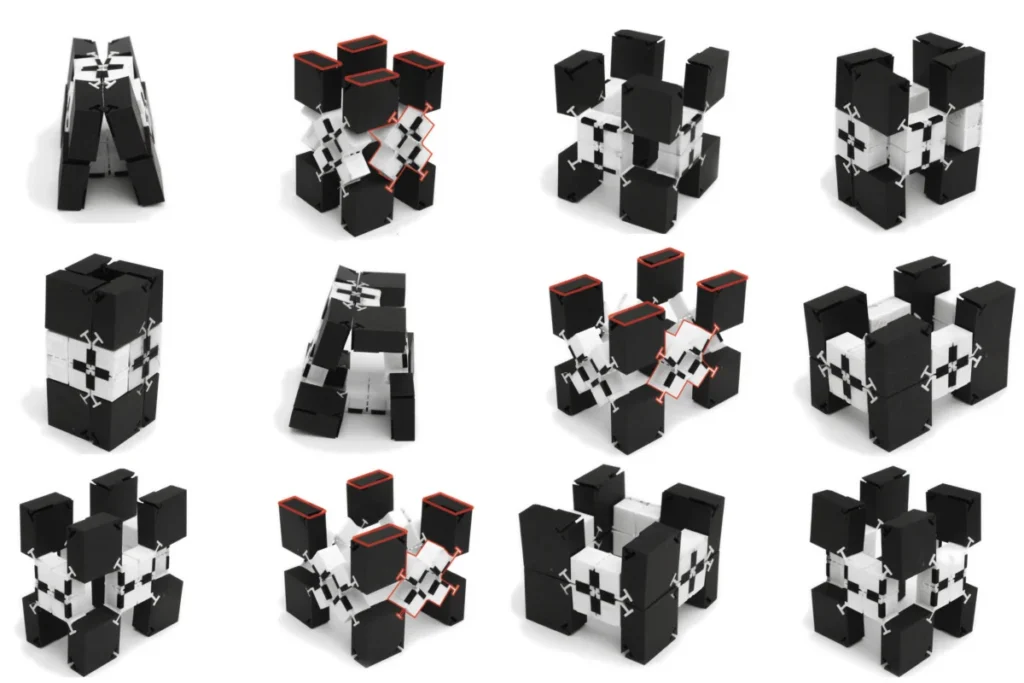
At the heart of bifur-circuits is the principle of mechanical bifurcation. This phenomenon describes a sudden, often dramatic, change in a system’s behavior when an applied force crosses a critical threshold. A common analogy is bending a plastic ruler: gently flexing it produces a smooth curve, but beyond a certain point, it suddenly "bucks" or snaps into a new stable configuration. In bifur-circuits, this property is meticulously engineered into the connections between individual blocks. When these blocks are rotated in specific ways around their pivot points, the system undergoes bifurcation, allowing connected units to settle into a wider array of stable configurations than a single unit could achieve on its own.
Crucially, adding more bifur-circuit units to a structure doesn’t just add linearly to the possibilities; it exponentially increases the number of potential configurations. This exponential growth in reconfigurability is what truly sets bifur-circuits apart from their predecessors. AlAlawi underscores this advantage, stating, "Bifurcation allow us to significantly expand on this reconfigurability space. Just adding one extra unit gives us so many more combinations out of the same structure." This capability is paramount for creating truly versatile and adaptable objects.
Beyond their mechanical ingenuity, bifur-circuits are also designed to be electrically modular. Conductive material is seamlessly integrated into the structure of these repeating units. This ensures that electrical connections are maintained throughout the entire assembly, regardless of how the object is rotated, pressed, or twisted into a new shape. This continuous electrical pathway is what enables the structure to "sense" its configuration. Each unique connection and rotation between adjacent units activates a distinct circuit, allowing the integrated intelligence to interpret the current physical state of the object.
Embedding Intelligence: Sensing and Connectivity Challenges
The integration of electrical intelligence into dynamically changing mechanical structures presented one of the most significant engineering hurdles. The research team faced the complex task of incorporating a conductive material that was flexible enough to bend and twist repeatedly without breaking, yet efficient enough to reliably conduct electricity for sensing purposes. Traditional rigid circuits would simply fail under such dynamic deformation.
"The conductive material was a constraint we had to work around in the design process, and it dictated how the sensing between blocks would happen," AlAlawi noted. This required careful material selection and innovative design for the conductive pathways within each modular unit. The researchers ultimately perfected a design that proved remarkably robust. In durability tests, reconfigurable structures built with bifur-circuits were compressed over 10,000 times, showing no degradation in electrical connectivity. This rigorous testing validates the practical viability of the technology for real-world applications where repeated reconfigurations are expected.
To facilitate the design and fabrication of these complex structures, the MIT team also developed a user-friendly construction and simulation tool. This software simplifies the bifur-circuit design process, allowing engineers and designers to experiment with different configurations and predict their mechanical and electrical behaviors. Once a design is finalized, the software generates instructions for a multimaterial 3D printer, enabling the fabrication of these sophisticated reconfigurable objects in a single pass. This streamlines the prototyping and manufacturing process, making the technology more accessible for further research and commercial development.
Practical Demonstrations and Early Applications
To illustrate the versatility and practical potential of bifur-circuits, the researchers showcased several interactive objects. One compelling demonstration involved a piece of furniture: a chair that could transform into a tea table with integrated storage. When its shape was altered, the bifur-circuit structure sensed its new geometry and transmitted corresponding messages to an electronic display, showing its current functional state. This exemplifies the potential for "smart furniture" that intuitively adapts to user needs and communicates its form.
Another demonstration featured a shape-shifting controller. This device could launch one of several different video games based on its physical configuration. Imagine a controller that physically reconfigures its grip or button layout to match the specific demands of a racing game versus a flight simulator, all while sensing and communicating that change to the gaming system. This opens up new avenues for human-computer interaction, offering more immersive and adaptive interfaces.
These demonstrations are just initial glimpses into a much broader spectrum of potential applications. The inherent reconfigurability and integrated sensing capabilities of bifur-circuits position them as a foundational technology for future innovations.
A Chronology of Development and Collaborative Research
The journey to bifur-circuits represents a logical progression in metamaterials research. It began with the foundational understanding of auxetic geometries and their application in simple reconfigurable structures like the earlier three-state antennas. The realization of the limitations of these fixed states spurred the subsequent inquiry into more complex, dynamically reconfigurable systems, leading directly to the conceptualization and development of bifur-circuits.
This cutting-edge research is a testament to interdisciplinary collaboration. Marwa AlAlawi, from mechanical engineering, spearheaded the project. She was joined by co-senior authors Ticha Sethapakdi, an electrical engineering and computer science (EECS) graduate student at MIT, and Stefanie Mueller, an associate professor in MIT’s departments of EECS and Mechanical Engineering, who also leads the Human-Computer Interaction Group at the Computer Science and Artificial Intelligence Lab (CSAIL). This blend of mechanical engineering, electrical engineering, and computer science expertise was crucial for tackling the multifaceted challenges of integrating dynamic mechanics with robust electrical sensing.
The collaborative spirit extended beyond MIT’s campus. Co-authors on the paper include researchers from the University of Tokyo and the University of Michigan, indicating a broader academic network contributing to this advancement. The presentation of their work at the prestigious ACM Symposium on User Interface Software and Technology further underscores its significance within the broader scientific community, particularly at the intersection of materials science, engineering, and human-computer interaction.
Broader Implications Across Industries
The implications of bifur-circuits stretch across numerous sectors, promising to redefine how we interact with our physical environment and design adaptive systems.
- Smart Environments and Furniture: Beyond the chair-to-table example, imagine entire living spaces where walls, partitions, and furniture dynamically reconfigure to suit different activities or user preferences, all while remaining connected to a central smart home system. This could lead to highly efficient use of space in urban environments or flexible office layouts. The global smart furniture market, valued at approximately $150 billion in 2022, is projected to grow significantly, driven by demand for space-saving and multi-functional designs – a market ripe for bifur-circuit integration.
- Advanced Robotics: Bifur-circuits could be transformative for modular soft robots. Current soft robots often lack precise control over their shape changes or the ability to communicate their exact configuration. By integrating bifur-circuits, these robots could achieve more complex, stable, and sensed forms, enabling them to adapt their grippers or manipulators to various objects or navigate challenging, unpredictable terrains with greater intelligence. The soft robotics market is a rapidly emerging field, with innovations focused on dexterity, safety, and adaptability, all areas where bifur-circuits could provide a competitive edge.
- Next-Generation Communications and Sensing: The initial inspiration for bifur-circuits came from reconfigurable antennas. This technology can significantly advance the design of adaptive antennas for 5G networks, satellite communications, and defense applications. These antennas could dynamically adjust their frequencies and beam patterns in response to changing environmental conditions, atmospheric interference, or specific communication needs, all without bulky, power-intensive mechanical parts. This passive adaptation through structural change offers substantial advantages in terms of energy efficiency, resilience, and stealth.
- Disaster Relief and Humanitarian Aid: Rapidly deployable and reconfigurable shelters are a critical need in post-disaster scenarios. Bifur-circuit-enabled structures could be quickly assembled and then adapted on-site to respond to changing weather patterns, population needs, or specific functional requirements (e.g., medical triage, sleeping quarters, supply storage). Their inherent sensing capabilities could even provide feedback on structural integrity or environmental conditions.
- Interactive Systems and Human-Computer Interaction: The shape-shifting game controller is a powerful illustration of new paradigms for HCI. This extends to interactive rehabilitation tools that adapt to a patient’s progress or specific exercises, or educational toys that change form to teach different concepts.
- Manufacturing and Engineering: The ability to simplify complex mechanical assemblies using repeating, intelligent units could streamline manufacturing processes and reduce material waste. Engineers could design more versatile prototypes and products with embedded functionality from the ground up, rather than adding sensors and actuators as afterthoughts.
The economic implications are substantial. By reducing the complexity, bulk, and energy consumption associated with traditional adaptive systems, bifur-circuits could lead to more cost-effective and sustainable solutions across industries. The inherent modularity also suggests potential for easier repair and upgrades, contributing to a circular economy model.
Future Outlook and Remaining Challenges
While bifur-circuits represent a significant breakthrough, the researchers acknowledge that there is further work to be done. In the immediate future, they plan to explore more applications to fully understand the breadth of this technology’s potential. They also aim to add even more interactivity into the structures and investigate additional metamaterial shapes beyond the current auxetic designs, which could unlock even more complex and nuanced reconfigurations.
A key challenge for broader adoption will be scaling up manufacturing processes for these multi-material, geometrically intricate units. While 3D printing offers a flexible fabrication method for prototyping, mass production will require developing more efficient and cost-effective techniques. Furthermore, integrating bifur-circuits with active actuation systems – allowing the structures to change shape autonomously rather than through manual manipulation – will be a critical next step for many applications, particularly in robotics and autonomous systems.
Marwa AlAlawi articulates a compelling long-term vision: "Bifur-circuits are one step toward developing mechanical building blocks with integrated intelligence. It would be interesting to build on this work and come up with building blocks that allow us to create a structure with any form or shape we want, and which are structurally stable and can be actuated." This vision points towards a future where everyday objects and advanced machines alike are built from inherently intelligent, adaptive components, ushering in an era of truly dynamic and responsive hardware.
This foundational research was made possible, in part, by critical funding from Japan’s Science and Technology Agency and the Bahrain Crown Prince International Scholarship Program, highlighting the global interest and investment in the future of intelligent materials and adaptive technologies.