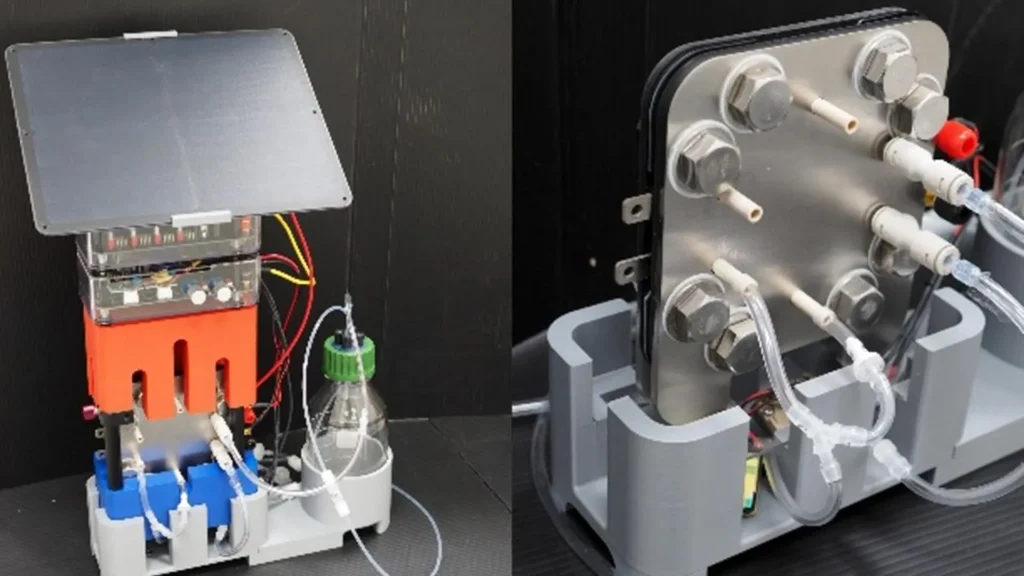
This groundbreaking development from Japan’s Osaka Metropolitan University (OMU) represents a significant leap forward in the quest for sustainable energy, addressing one of the most persistent challenges in solar energy conversion: the intermittency of sunlight. By engineering an electrolyzer that can autonomously adapt to varying solar input, the OMU team, in collaboration with Iida Group Holdings Co., Ltd., has paved the way for more efficient, reliable, and cost-effective production of solar fuels, such as formic acid, an energy-rich compound with diverse applications.
The Global Pursuit of Artificial Photosynthesis: A Backgrounder
Artificial photosynthesis is a captivating field of research that seeks to replicate nature’s most fundamental energy conversion process—photosynthesis in plants—to produce clean fuels. Unlike natural photosynthesis, which creates sugars, artificial systems typically convert water and carbon dioxide into hydrogen, methane, or more complex organic molecules like formic acid, using sunlight as the primary energy source. This technology holds immense promise for tackling climate change by offering a pathway for carbon dioxide utilization, transforming a greenhouse gas into a valuable resource, and simultaneously providing a renewable alternative to fossil fuels.
Formic acid (HCOOH) stands out as a particularly attractive product of artificial photosynthesis. It is a colorless liquid with a pungent odor, naturally occurring in ant venom, and widely used in various industrial sectors. As a chemical feedstock, formic acid is essential in the leather, textile, rubber, and agriculture industries. More importantly, it can serve as a hydrogen carrier, making it a viable fuel for direct formic acid fuel cells or a stable medium for storing energy. Its liquid state at room temperature and relatively low toxicity make it easier to handle and store compared to gaseous fuels like hydrogen, enhancing its potential for practical applications, including powering vehicles or providing backup electricity. The global market for formic acid is projected to grow steadily, driven by increasing demand from its various end-use industries, underscoring the commercial relevance of efficient and sustainable production methods.
Overcoming Solar’s Intermittency: The MPPT Challenge
The inherent variability of sunlight poses a formidable challenge for any solar energy system. Clouds, changing angles of the sun throughout the day, and the cycle of day and night mean that the energy input from solar panels is rarely constant. For artificial photosynthesis systems, this fluctuation directly impacts the efficiency and stability of fuel production. An electrolyzer, which is at the core of these systems, converts electrical energy from solar cells into chemical energy stored in the form of fuels. To maximize this conversion efficiency, it is crucial to operate the solar cells at their Maximum Power Point (MPP).
Maximum Power Point Tracking (MPPT) is a sophisticated technique employed to ensure that solar photovoltaic (PV) systems extract the maximum possible power from solar panels under all operating conditions. MPPT algorithms continuously adjust the electrical load on the solar panel to keep its operating voltage and current at the point where power output is highest. In conventional artificial photosynthesis setups, achieving MPPT typically necessitates a complex array of external electronic components. These often include power converters (DC-DC converters), sophisticated control circuits, and, critically, battery banks. Batteries serve to buffer the intermittent energy flow, storing excess energy during peak sunlight hours and discharging it during periods of lower irradiance or demand, thereby stabilizing the power supply to the electrolyzer. While effective in maintaining system performance, this reliance on external electronics and batteries introduces several significant drawbacks. These additions increase the overall system cost, expand the physical footprint, add complexity in terms of installation and maintenance, and contribute to energy losses through multiple conversion steps and battery cycling inefficiencies. The capital expenditure (CAPEX) associated with these components can be substantial, and the operational expenditure (OPEX) further increases due to battery degradation and the need for periodic replacement.
Osaka Metropolitan University’s Game-Changing Innovation: Self-Regulating Electrolyzers
Recognizing the limitations of conventional MPPT approaches, the research team at Osaka Metropolitan University, led by Associate Professor Yasuo Matsubara and Professor Yutaka Amao at the Research Center for Artificial Photosynthesis, embarked on a mission to fundamentally redesign the electrolyzer itself. Their innovative approach, developed in collaboration with Iida Group Holdings Co., Ltd., centers on integrating a self-regulating chemical component directly into the device, effectively eliminating the need for external battery-based control systems.
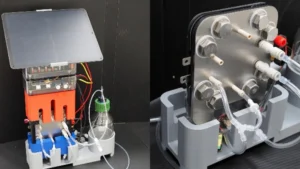
The core of this breakthrough lies in a specially designed solid electrolyte built directly into the electrolyzer. This novel component allows the electrolyzer to automatically perform the MPPT function on its own, a departure from traditional systems that rely on external electronics, converters, or batteries. The genius of the design resides in its exploitation of the electrolyzer’s own intrinsic thermal and impedance properties. Professor Amao elucidated the mechanism: "As sunlight increases, the electrolyzer naturally heats up. The system is designed so that this warming causes the electrical resistance to drop, allowing electricity to flow more freely." This elegantly simple yet profound principle enables the system to autonomously adjust its electrical behavior in response to varying solar input. When sunlight intensifies, the increased energy absorbed by the system leads to a rise in temperature. This temperature increase, in turn, causes a programmed decrease in the electrical resistance of the solid electrolyte. A lower resistance means that the electrolyzer can draw more current from the solar cells, effectively matching the increased power output potential of the panels at higher irradiance. Conversely, when sunlight diminishes, the electrolyzer cools, its resistance increases, and it draws less current, maintaining optimal operation. This direct, internal feedback loop mimics the function of an MPPT controller without any active electronic intervention.
"This self-regulating behavior helps keep fuel production more stable throughout the day and automates the system, while reducing dependence on batteries and costly external components," Professor Amao added. The implications of this self-regulation are far-reaching. By removing the need for batteries and complex power electronics, the system’s capital cost is significantly reduced. Its footprint shrinks, making it more amenable to diverse installation environments, from industrial sites to potentially even smaller, decentralized applications. The reduction in component count inherently boosts system reliability, as fewer parts mean fewer points of failure and lower maintenance requirements. Furthermore, by minimizing energy conversions and avoiding battery storage losses, the overall energy efficiency of the solar-to-fuel process is enhanced.
A Collaborative Journey: From Lab to Exhibition
The development of this innovative system was not a solitary academic endeavor but a testament to successful industry-academia collaboration. The partnership with Iida Group Holdings Co., Ltd., a prominent Japanese company, provided crucial industrial perspective and resources, helping bridge the gap between fundamental research and practical application. Such collaborations are vital for accelerating the translation of scientific discoveries into deployable technologies.
The research journey for this self-regulating electrolyzer followed a logical progression, moving from initial conceptualization and rigorous laboratory-scale experiments to robust outdoor testing. A significant milestone in this chronology was the public showcasing of the technology. "We were confident that it would be successful, as we previously showcased this research at the ‘Joint Pavilion Iida Group × Osaka Metropolitan University’ exhibition as part of the Osaka Kansai Expo 2025," Professor Matsubara stated. This pre-publication public demonstration at a major international event like the Osaka Kansai Expo 2025 served as both a validation of the technology’s readiness and a powerful platform to introduce it to a global audience of potential stakeholders and investors. The successful operation of the system at the Expo, generating enough formic acid to power a miniature diorama, provided tangible proof of concept under real-world conditions, demonstrating its potential beyond theoretical models. This public exhibition not only boosted confidence in the technology but also set a clear trajectory towards its future commercialization and widespread adoption.
Expert Perspectives and Industry Endorsement
The statements from the lead researchers underscore the profound impact of their innovation. Professor Amao’s explanation of the intrinsic thermal and impedance properties highlights the elegance of the solution—leveraging natural physical phenomena rather than forced electronic control. His emphasis on stable fuel production and reduced dependence on external components directly addresses the core challenges faced by existing artificial photosynthesis systems.
Professor Matsubara’s reference to the Osaka Kansai Expo 2025 showcase not only confirms the technology’s robustness but also signals a readiness for broader deployment. His vision of using generated formic acid to power miniature dioramas, and potentially charge applications in homes, paints a vivid picture of decentralized, consumer-level energy solutions enabled by this breakthrough.
While no direct statement from Iida Group Holdings Co., Ltd. was provided in the original text, their involvement as an industrial partner strongly implies a strategic interest in sustainable technologies and the commercial potential of this self-regulating system. A hypothetical statement from Iida Group Holdings might emphasize their commitment to environmental innovation and the importance of bridging academic research with industrial application to accelerate the transition to a carbon-neutral society. They would likely highlight the economic advantages—cost reduction, increased reliability—as key drivers for their investment and collaboration, positioning the technology as a scalable solution for future energy demands.
Testing Under Real-World Conditions: Stable Production Confirmed
The ultimate test for any solar-powered system is its performance under actual outdoor conditions, where environmental factors like fluctuating sunlight, temperature variations, and humidity can significantly impact efficiency. The OMU team rigorously tested their self-regulating electrolyzer under such real-world scenarios. The results were highly encouraging: the system consistently produced formic acid from water and CO2, even as sunlight levels fluctuated throughout the day. This consistent output is critical for the practical viability of solar fuel production, ensuring a reliable supply for subsequent applications or storage.
The ability to maintain stable production despite environmental variability differentiates this system from many predecessors that would require constant recalibration or external energy buffering. This stability translates directly into higher overall efficiency over extended operating periods and simplifies the integration of the system into existing or new energy infrastructures. The consistent generation of formic acid under dynamic conditions validates the self-regulating mechanism, confirming that the intrinsic thermal and impedance adjustments effectively compensate for changes in solar input, maintaining the electrolyzer at or near its optimal operating point without external intervention.
Broader Implications: Revolutionizing Solar Fuel and Carbon Utilization
The Osaka Metropolitan University’s innovation holds transformative potential across several critical domains:
Energy Independence and Decentralization: By simplifying artificial photosynthesis systems and reducing their cost, this technology could accelerate the deployment of decentralized solar fuel production units. Communities, industries, or even individual households could potentially generate their own fuel, reducing reliance on centralized grids and imported fossil fuels, especially in remote or off-grid locations.
Carbon Utilization and Circular Economy: The ability to convert carbon dioxide into a valuable chemical like formic acid directly contributes to the circular economy model. Instead of releasing CO2 into the atmosphere, it becomes a feedstock for fuel and chemical production, simultaneously mitigating climate change and creating economic value from waste. This aligns with global efforts to achieve net-zero emissions.
Economic Viability of Solar Fuels: The elimination of expensive batteries and complex control electronics drastically lowers the capital and operational costs of artificial photosynthesis systems. This cost reduction is crucial for making solar fuels competitive with fossil fuels and other renewable energy sources, accelerating their market penetration. Lower costs also make the technology more accessible to a wider range of users and regions.
Industrial Applications and Feedstock Security: Formic acid is a commodity chemical with a stable demand. Producing it sustainably from CO2 and water using solar energy can enhance feedstock security for industries that rely on it, reducing their dependence on fossil-fuel-derived chemicals and volatile supply chains.
Environmental Impact: Beyond CO2 reduction, the system offers a cleaner method of fuel production. It avoids the environmental footprint associated with battery manufacturing and disposal, and the direct conversion process inherently minimizes waste products.
Advancement of Fundamental Science: This research pushes the boundaries of material science and electrochemistry, demonstrating a novel approach to system control through intrinsic material properties rather than external electronics. This could inspire similar innovations in other areas of energy conversion and storage.
The Road Ahead: Scaling Up and Commercialization
While the laboratory and exhibition successes are highly promising, the next critical phase for this technology will involve scaling up the system for larger-scale production and commercial deployment. This will entail optimizing the solid electrolyte materials for even greater efficiency and durability, engineering robust designs for industrial applications, and further reducing manufacturing costs. Research will likely focus on improving the quantum efficiency of the solar energy conversion and the catalytic selectivity towards formic acid.
The collaboration with Iida Group Holdings Co., Ltd. suggests a clear path towards commercialization, leveraging their industrial expertise in manufacturing, marketing, and distribution. Future research might also explore the adaptability of this self-regulating electrolyzer design to produce other solar fuels, such as hydrogen or methanol, further expanding its versatility and impact. The publication in EES Solar, a reputable journal in energy and environmental science, solidifies the scientific credibility of the findings and will likely attract further research and investment interest from the global scientific and industrial communities. This innovation from Osaka Metropolitan University marks a significant step towards a future powered by clean, consistent, and cost-effective solar fuels, bringing the vision of a sustainable energy economy closer to reality.