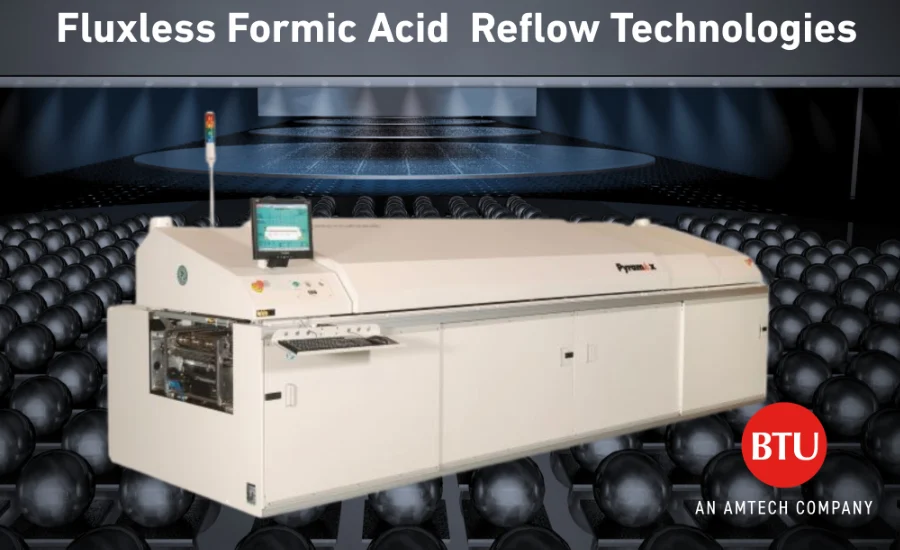
WESTFORD, Mass. – BTU International, a leading global supplier of advanced thermal processing equipment, has officially introduced its innovative Formic Acid Reflow capability, meticulously engineered to meet the stringent demands of advanced semiconductor packaging and high-reliability electronic assemblies. This groundbreaking solution represents a significant leap forward in soldering technology, enabling fluxless processing with unparalleled precision and efficiency, directly addressing the evolving challenges within the microelectronics manufacturing landscape.
The core innovation lies in the system’s ability to facilitate fluxless soldering through the strategic application of targeted formic acid zones. This sophisticated approach allows for the precise removal of oxides only where necessary, a critical distinction from older methods that expose the entire thermal process to the corrosive chemistry. According to BTU, this targeted application not only achieves ultra-low oxygen levels, specifically single-digit parts-per-million (ppm), but also drastically reduces formic acid consumption. This efficiency stands in stark contrast to conventional systems, which often require higher chemical volumes and broader exposure, thereby minimizing operational costs and environmental impact.
The Imperative for Fluxless Soldering in Modern Electronics
The introduction of BTU’s Formic Acid Reflow capability arrives at a pivotal moment for the electronics industry. As devices become smaller, more powerful, and increasingly complex, the traditional methods of soldering, which heavily rely on flux, are encountering significant limitations. Flux, while essential for removing oxides and facilitating solder wetting, leaves behind residues that can compromise long-term reliability, especially in densely packed components and fine-pitch interconnects. These residues can lead to corrosion, electrical leakage, and mechanical failures, necessitating expensive and time-consuming post-soldering cleaning processes.
The "transition toward finer interconnects, thinner substrates, and higher reliability requirements" is not merely an industry buzzword but a fundamental shift driving the adoption of advanced manufacturing techniques. Rob DiMatteo, General Manager of BTU International, underscored this trend, stating, "By combining ultra-low oxygen processing, highly efficient formic acid utilization, and compatibility with our TrueFlat and other industry-leading reflow platforms, BTU is delivering a solution that helps customers improve process performance while reducing operating costs." His statement highlights the dual benefits of enhanced technical performance and economic viability, both crucial factors for manufacturers operating in highly competitive markets.
Technical Mechanics: How Formic Acid Delivers Superior Results
At its heart, the Formic Acid Reflow process leverages the chemical properties of formic acid (HCOOH) as a powerful reducing agent. When heated, formic acid vapor dissociates to produce hydrogen (H2) and carbon dioxide (CO2). The nascent hydrogen then reacts with metal oxides (e.g., tin oxides on solder, copper oxides on pads) to form water vapor, effectively cleaning the metal surface without leaving solid residues. The chemical reaction can be simplified as:
SnO (solid) + 2HCOOH (gas) → Sn (solid) + 2CO2 (gas) + H2O (gas)
This elegant chemical process replaces the need for traditional organic fluxes, eliminating the associated residue and cleaning steps. The critical advancement by BTU lies in its ability to precisely control the delivery and concentration of formic acid vapor to specific zones within the reflow oven. This targeted approach ensures that the reducing atmosphere is present only where and when needed, preventing unnecessary exposure of components and maximizing the efficiency of the chemical.
Achieving single-digit parts-per-million oxygen levels is paramount. Oxygen, even in trace amounts, can lead to re-oxidation of the cleaned metal surfaces before or during soldering, resulting in poor wetting, void formation, and weakened solder joints. BTU’s capability to maintain such an inert environment ensures that the solder can flow and bond optimally, creating robust and reliable interconnects that meet the stringent demands of advanced applications.
BTU’s Integrated Platform and TrueFlat Technology

The new Formic Acid Reflow capability is not a standalone system but an integrated feature available across multiple BTU reflow platforms. This compatibility is a significant advantage for existing BTU customers, allowing for seamless upgrades and leveraging their established infrastructure. A key component of this integration is its compatibility with BTU’s proprietary TrueFlat technology.
TrueFlat technology is a crucial innovation designed to control substrate warpage during the reflow process. Substrate warpage, or bowing, can be a significant problem, particularly with large, thin, or complex substrates common in advanced packaging. It can lead to misalignment of components, incomplete solder joints, and ultimately, device failure. TrueFlat actively manages the thermal gradients across the substrate, minimizing stress and maintaining planarity throughout the heating and cooling cycles. When combined with fluxless soldering, TrueFlat technology ensures not only clean and strong solder joints but also precise alignment and structural integrity of the entire assembly, a critical factor for high-yield manufacturing.
The synergy between ultra-low oxygen processing, efficient formic acid utilization, and warpage control through TrueFlat technology positions BTU’s solution as a comprehensive offering for manufacturers seeking to push the boundaries of miniaturization and reliability. This holistic approach addresses several critical challenges simultaneously, delivering a robust and repeatable process.
Applications Spanning the Semiconductor Spectrum
The breadth of applications for BTU’s new Formic Acid Reflow capability underscores its versatility and critical role in modern electronics manufacturing. These applications include:
- Advanced Packaging: This encompasses a wide range of sophisticated packaging techniques, such as System-in-Package (SiP), Package-on-Package (PoP), and 3D-stacked Integrated Circuits (3D ICs). In these complex architectures, multiple dies or components are integrated into a single package, demanding extremely fine-pitch interconnects and absolute cleanliness to ensure signal integrity and long-term reliability. Fluxless soldering is essential here to prevent residues from interfering with intricate routing or future underfill operations.
- Flip-Chip Assembly: Flip-chip technology involves inverting a semiconductor die and connecting its solder bumps directly to pads on a substrate. The very fine pitch of these bumps (often less than 100 micrometers) makes flux residue removal exceptionally challenging. Formic Acid Reflow provides a clean, residue-free bonding process, which is critical for the subsequent underfill encapsulation, ensuring mechanical stability and protection of the solder joints.
- Power Devices: Power semiconductors, such as MOSFETs, IGBTs, and diodes, operate under high current and temperature conditions. The reliability of their internal interconnects is paramount to prevent thermal runaway or catastrophic failure. Fluxless soldering ensures robust, void-free solder joints with excellent thermal and electrical conductivity, directly contributing to the enhanced performance and longevity of power modules used in electric vehicles, renewable energy systems, and industrial applications.
- Wafer-Level Packaging (WLP): WLP involves performing packaging steps directly on the wafer before dicing, enabling smaller form factors and reduced manufacturing costs. Processes like Wafer-Level Chip Scale Packaging (WLCSP) require extremely precise and clean soldering for redistribution layers (RDLs) and solder bump formation. The cleanliness offered by formic acid reflow is indispensable for achieving the high yields and miniaturization benefits of WLP.
The global advanced packaging market, valued at approximately $30 billion in 2022, is projected to grow significantly, reaching over $50 billion by 2028, driven by the demand for high-performance computing, artificial intelligence, 5G, and automotive electronics. BTU’s investment in this technology directly supports this growth trajectory by providing an enabling manufacturing solution.
Broader Industry Impact and Future Outlook
BTU International’s Formic Acid Reflow capability represents more than just a product launch; it signifies a strategic response to macro trends in the electronics industry. The relentless pursuit of miniaturization, higher performance, and enhanced reliability demands equally advanced manufacturing processes. By offering a solution that not only meets but exceeds these requirements, BTU is contributing to the acceleration of innovation across various sectors.
The reduction in chemical consumption and the elimination of cleaning processes also align with the industry’s increasing focus on sustainable manufacturing practices. Less chemical waste, lower energy consumption associated with cleaning, and a safer working environment are tangible benefits that contribute to a greener footprint for electronics production. This resonates with corporate social responsibility initiatives and regulatory pressures worldwide.
Looking ahead, the demand for fluxless soldering technologies is expected to continue its upward trajectory. As new materials and more complex heterogeneous integration techniques emerge, the need for ultra-clean and precise bonding will only intensify. Equipment manufacturers like BTU International play a crucial role in enabling these future advancements. Continuous research and development in thermal processing, atmospheric control, and material science will be key to addressing the next generation of challenges in semiconductor packaging. BTU’s commitment to innovation, as demonstrated by this new capability, positions it as a vital partner for companies at the forefront of electronic device development.
In summary, BTU International’s new Formic Acid Reflow capability is a timely and significant advancement for the electronics manufacturing sector. By offering a high-performance, cost-effective, and environmentally conscious solution for fluxless soldering, compatible with leading reflow platforms and warpage control technology, BTU is empowering its customers to achieve superior process performance and reliability in the most demanding advanced packaging and high-reliability applications. This innovation underscores the critical role of specialized equipment in shaping the future of microelectronics.