Backyard Brains, a pioneer in accessible neuroscience tools, has unveiled SpikerBot, an innovative educational robot designed to demystify complex neural processes and engage a new generation in the fundamentals of brain science and robotics. This groundbreaking platform eschews traditional line-by-line coding in favor of a visual, neuron-based programming interface, allowing users to build virtual brains that dictate the robot’s "lifelike" behaviors. The initiative aims to make robotics and neuroscience education more intuitive, enjoyable, and broadly accessible, addressing a significant educational void that often exists between basic biological concepts taught in elementary school and advanced studies at the collegiate level.
The SpikerBot project, spearheaded by Backyard Brains Co-Founder & CEO Greg Gage and Designer Alex Hatch, represents a paradigm shift in how students interact with robotics. Instead of grappling with abstract computer logic, such as if-then statements or complex algorithms, users construct "sketches" entirely out of virtual neurons and synapses within a dedicated application. As Gage and Hatch articulate, the core philosophy is "no code, no LLMs, just neurons, synapses, and behavior emerging from a circuit a kid designed." This approach draws inspiration from Valentino Braitenberg’s seminal work, Vehicles, which demonstrated how surprisingly complex, lifelike behaviors can arise from simple, direct connections between sensors and motors. Braitenberg’s thought experiments, involving hypothetical vehicles with rudimentary neural networks, illustrate how basic excitatory and inhibitory links can lead to behaviors like fear, aggression, or love, purely through their structural organization. SpikerBot translates this theoretical elegance into a tangible, interactive learning experience.

The conventional path for robotics education often involves a steep learning curve in programming languages, which can deter beginners. SpikerBot aims to flatten this curve by making the creation of responsive, intelligent agents an immediate and engaging process. The visual programming environment allows users to drag and drop virtual neurons and axons, connecting them to simulate neural circuits. This visual metaphor is akin to patching cables on a modular synthesizer, where the entire system’s functionality is visible at a glance, fostering a holistic understanding of how different components interact to produce emergent behaviors. The app provides a "brain on screen" where users can visualize the spiking activity of their virtual neurons in real-time as the robot interacts with its environment, offering immediate feedback on their designs.
A central tenet of SpikerBot’s development is its grounding in scientific accuracy and pedagogical effectiveness. Backyard Brains has long been dedicated to filling what they identify as a critical gap in neuroscience education. While elementary students might learn about the basic structure of a single neuron, the continuity of this learning thread often breaks until college, where advanced students delve into the intricate workings of millions of interconnected neurons. This chasm, according to the team, is akin to learning what a transistor is without any further electronics knowledge before being expected to program in Python. SpikerBot is designed to bridge this "neuroscience illiteracy" by providing an intermediate, hands-on platform where students can explore how neural networks, even simple ones, generate complex actions and cognitive functions. This approach has been rigorously vetted through feedback from both child educators and professional neuroscientists, ensuring its curriculum is both engaging and scientifically sound.
The user experience is meticulously crafted for intuitive interaction. One of the most striking features is the instantaneous feedback loop. Unlike traditional programming, which often requires compilation and uploading new code versions, changes made to SpikerBot’s neural circuit within the app are reflected immediately in the robot’s behavior. Modifying a neuron from excitatory to inhibitory, for instance, results in an instant, observable change, allowing for rapid experimentation and iterative learning at the pace of thought. This real-time responsiveness significantly enhances engagement and understanding, transforming abstract concepts into concrete experiences.

Interestingly, this neuron-centric programming introduces a unique inversion of complexity. Behaviors typically challenging for beginner robotics, such as a robot following a person, become remarkably straightforward with SpikerBot. A creature that chases objects, for example, can be constructed with as few as two neurons. Conversely, tasks that are trivial in traditional computer logic, like making a robot count in binary, become an intricate web of connections when designed purely through neural circuits. This inversion offers profound pedagogical insights, highlighting the fundamental differences between biological and silicon-based computation and illustrating why certain problems are inherently more "natural" for a neural network to solve. The emphasis on natural behaviors and intuitive interaction is expected to sustain user engagement longer than conventional robotics kits, allowing learners to build complex, "dog-like" responses at a gradual, comfortable pace.
Beyond basic programming, SpikerBot introduces users to genuine neuroscience principles. The library of sample brain models provides a rich starting point, allowing users to deconstruct, edit, and learn from pre-designed neural circuits. Through this exploration, students can discover fundamental neurological patterns such as recurrent pairs, lateral inhibition, and even rudimentary working memory mechanisms. These patterns are not merely abstract concepts but are directly observed in the robot’s dynamic responses. For instance, lateral inhibition, a key process in sensory perception, can be demonstrated by designing a robot that enhances the contrast between different light levels, mirroring how biological systems sharpen sensory input. Recurrent neural networks, fundamental to memory and learning, can be explored by creating circuits that maintain a "state" over time, enabling the robot to remember recent events or actions.
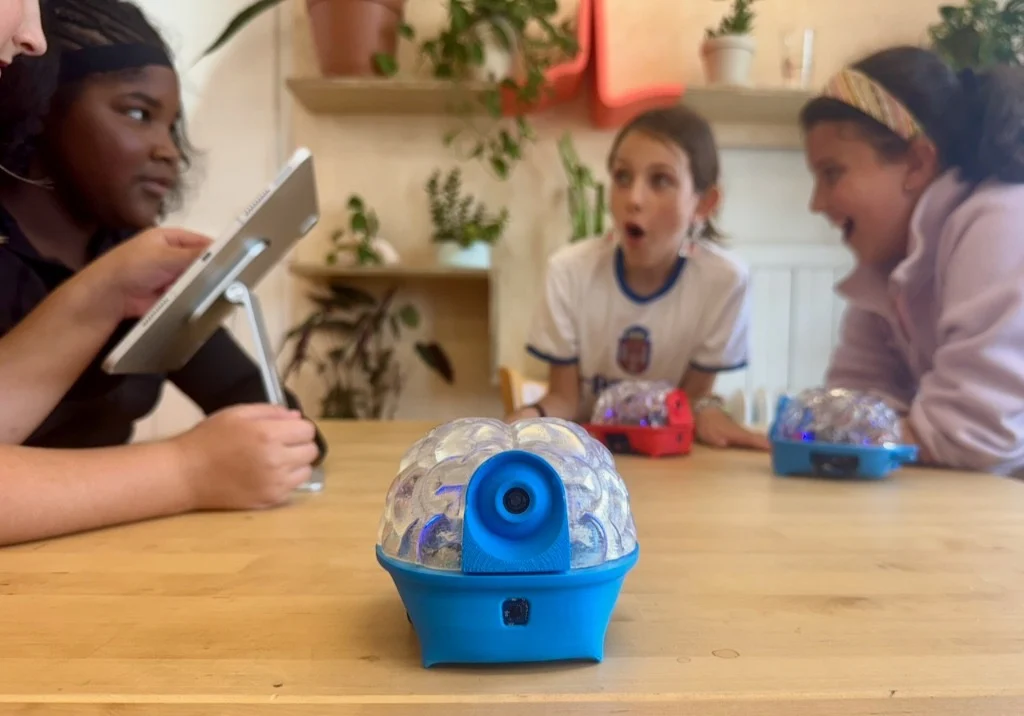
The SpikerBot hardware itself is a testament to thoughtful design. Modeled after Backyard Brains’ distinctive brain-shaped logo, the robot is equipped with a suite of sensors—a camera, microphone, and distance sensor—enabling it to perceive and react to its real-world environment. Its output capabilities include lights and sounds, carefully designed to mimic natural, organic responses rather than typical machine outputs. The lights, for instance, glow and fade like bioluminescent cells, while the sound effects are described as charming and quirky, contributing to the robot’s personality. The chassis also features strategic connection points for 3D-printed attachments, allowing users to customize their bot’s appearance and functional extensions, further encouraging creativity and personalization. This design philosophy extends to its peripheral support, with compatibility for existing Backyard Brains products like the Spiker:bit board, enabling advanced users to control their SpikerBot using real-time muscle signals from their own bodies, a truly immersive bio-robotics experience.

The implications of SpikerBot extend beyond pure STEM education. The team highlights a broader societal benefit: improving neuroscience literacy. With approximately one in five people experiencing a neurological condition, fostering a shared language and understanding of basic brain patterns can significantly enhance public comprehension and empathy regarding various neurological disorders. By demystifying how brains work at a foundational level, SpikerBot can contribute to a more informed public discourse on mental health, neurodevelopmental disorders, and neurodegenerative diseases. This foundational understanding can empower individuals, families, and communities to better navigate the complexities of neurological health.
Backyard Brains has also committed to a long-term vision for SpikerBot’s sustainability and accessibility. The accompanying application is free and operates without the need for cloud-based authentication, ensuring continued functionality regardless of internet access or server availability. The robot itself runs on easily swappable AA batteries, a deliberate choice over non-replaceable, constantly decaying lithium-ion cells, promoting repairability and longevity. To support this, Backyard Brains offers its own custom, high-performance NiMh AA batteries, combining the convenience of standard cells with enhanced performance and rechargeability. This commitment to open, sustainable design practices stands in contrast to the increasingly common trend of planned obsolescence in consumer electronics, reinforcing SpikerBot’s role as a durable educational tool.
The SpikerBot, showcased through a successful Kickstarter campaign, underscores a growing demand for accessible, high-quality educational robotics. The campaign, which concludes on June 14, offers early bird pledges at $219, a significant discount from the eventual retail price of $299. Backyard Brains’ established track record of delivering successful, impactful projects, such as the original SpikerBox and the SpikerShield, instills confidence in their ability to bring SpikerBot to fruition. Their previous crowdfunding successes and consistent delivery on promises have built a strong community trust, mitigating the inherent risks associated with crowdfunding new technologies.

Looking ahead, Backyard Brains envisions SpikerBot as a platform for continuous innovation, driven by its user community. While the robot already possesses a wide array of built-in behaviors and learning opportunities, the true potential, as Alex Hatch notes, remains largely undiscovered. "A lot we haven’t seen because you guys haven’t built anything yet," he remarked, emphasizing the open-ended nature of the platform. This collaborative approach encourages users to experiment, create, and share their unique neural circuit designs, fostering a vibrant community of learners and innovators who will collectively push the boundaries of what SpikerBot can achieve. This strategy ensures that SpikerBot will not only be a tool for learning existing neuroscience concepts but also a platform for discovering new ways to understand and simulate intelligence, embodying the true spirit of scientific exploration and the maker movement.