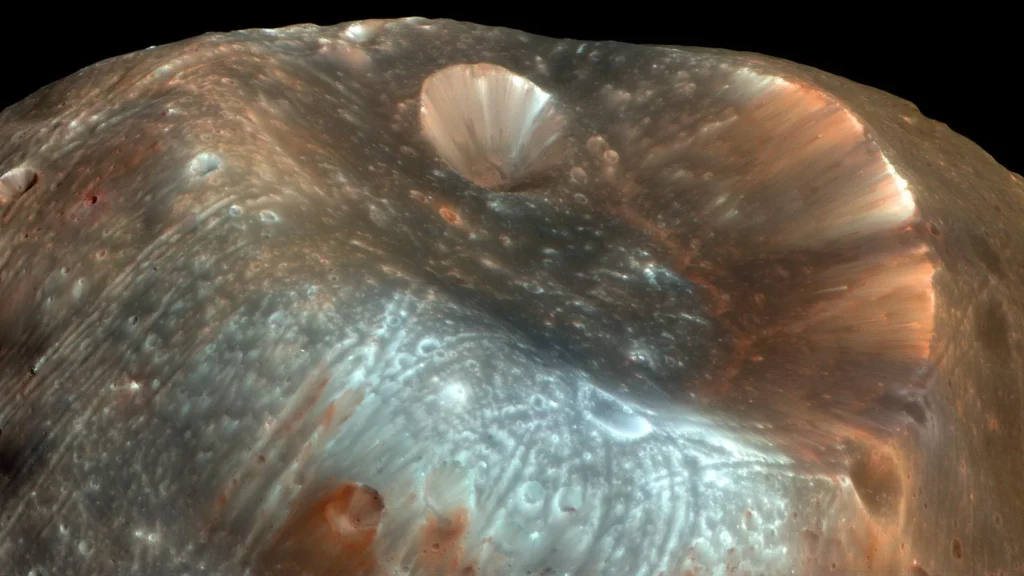
For decades, Phobos, the innermost moon of Mars, has been a celestial enigma, its very existence a puzzle for planetary scientists. At the heart of this mystery lies a fundamental question: where did this peculiar moon come from? Two prominent theories vie for dominance in the scientific community. One posits that Phobos is an errant asteroid, ensnared by the gravitational pull of the Red Planet. The other suggests a more dramatic genesis: Phobos coalesced from the colossal debris field ejected into orbit following a cataclysmic impact on Mars itself. The key to unlocking this ancient secret, however, may lie not in observing Phobos from afar, but in understanding its hidden interior – a realm about which scientists still possess surprisingly limited knowledge.
Delving into the Geophysical Landscape of Phobos
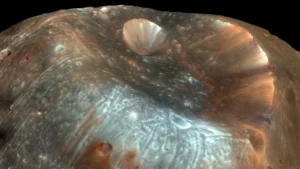
Current research is meticulously dissecting subtle characteristics of Phobos, including its gravitational field and orbital dynamics, in an effort to refine these competing origin theories. A significant focal point of this investigation is Stickney Crater, the moon’s most prominent and dramatic surface feature. At the recent European Geosciences Union (EGU) General Assembly in Vienna, researchers presented compelling new work modeling geophysical measurements around this colossal impact scar. These geophysical insights are not merely academic curiosities; they are vital clues in reconstructing Phobos’ violent and uncertain past.
Stickney Crater: A Scar with a Story
The sheer scale of Stickney Crater, measuring approximately 9 kilometers (5.6 miles) in diameter, places it at the epicenter of the debate surrounding Phobos’ origin. If Phobos indeed formed from debris generated by a massive impact on Mars, the event that carved out Stickney Crater could have occurred as early as 4.2 billion years ago, during the Hadean Eon, a period of intense bombardment in the early solar system. Conversely, if Phobos is an asteroid captured by Mars, the Stickney impact event would have transpired much later, perhaps around 2.6 billion years ago, during the Astian period of Martian history.
Recent analyses, notably a 2026 paper published in The Monthly Notices of the Royal Astronomical Society (MNRAS) by Benjamin Haser and co-author Thomas Andert, suggest that Phobos possesses a porous interior, potentially harboring reserves of water ice. This porous nature could have profound implications for how the moon has weathered impacts.
One of the most promising avenues for investigating these possibilities involves a more detailed mapping of Phobos’ gravity. Scientists are particularly keen to determine if the Stickney impact created a concentrated region of denser material beneath the crater. Such a density anomaly could serve as a telltale signature of the impact’s aftermath and provide critical data for distinguishing between the capture and impact-debris formation scenarios.
Benjamin Haser, a doctoral student in planetary science at Germany’s Universität der Bundeswehr München, emphasized the significance of the Stickney event in Vienna. "The Stickney event is one of the most important episodes in Phobos’ history," Haser stated, "and learning more about it could help scientists determine where the moon came from."
Beyond a Simple Rock: The Complex Nature of Phobos
Despite its diminutive size and irregularly shaped form, Haser stresses that Phobos should not be relegated to the status of a mere "rock in orbit." The moon boasts a mean diameter of a mere 22.2 kilometers (13.8 miles) and completes an astonishingly rapid orbit around Mars, circling the planet in just 7 hours and 39 minutes. This close proximity and swift revolution contribute to its unique orbital dynamics and its ultimate fate.
Two Competing Narratives of Origin
The scientific community has coalesced around two primary explanations for Phobos’ genesis:
-
The Impact-Debris Hypothesis: In this scenario, a colossal object struck Mars with immense force, blasting a significant amount of planetary material into orbit. This ejected debris eventually coalesced into a disc around Mars, from which Phobos and its larger sibling, Deimos, subsequently formed. Haser and Andert’s research in MNRAS provides support for this model, as it elegantly explains the presence of two moons in relatively close orbits.
-
The Captured Asteroid Hypothesis: The alternative theory suggests that Phobos and Deimos originated as asteroids in the outer solar system. These rogue bodies were then gravitationally captured by Mars as they passed too close to the planet. The spectral properties of Phobos, which bear some resemblance to certain types of asteroids, along with theoretical models of asteroid capture dynamics, lend credence to this possibility.
Unraveling Gravity to Reveal Internal Structure
Understanding Phobos’ gravitational field is therefore a critical step toward deciphering the distribution of mass within the moon. This, in turn, is essential for determining its formation mechanism. Haser’s EGU 2026 presentation highlighted that current estimates point towards a porous interior, potentially containing water ice, and a denser concentration of material localized near Phobos’ equatorial region.
Could Phobos Be a Celestial Sponge?
The existence of Stickney Crater also presents a profound paradox. An impact of such magnitude would intuitively be expected to shatter a moon as small and fragile as Phobos. Haser proposes a compelling explanation: the moon’s survival may have been facilitated by an exceptionally low and relatively uniform density. This characteristic could have allowed Phobos to absorb the immense shock of the impact, much like a sponge absorbs water.
"You would assume that such an impact would have shattered Phobos, unless it has a very low homogeneous density, like a sponge that can absorb that kind of impact," Haser elaborated.
Furthermore, the Stickney impact would have generated an extraordinary amount of heat at the impact site. "And at that impact region, there must be very high temperature that melted and compressed the stone beneath it," he explained. This intense thermal and mechanical stress could have resulted in a region of compressed, denser material directly beneath Stickney Crater, leaving behind a subtle gravitational signature that scientists are now working to detect.
The Rubble Pile Analogy
Haser notes that several characteristics of Phobos align remarkably well with the concept of a "rubble pile asteroid." Such celestial bodies are understood to be loosely held together agglomerations of rock fragments, their integrity maintained primarily by their own weak gravitational forces. This description fits Phobos’ irregular shape and its tendency to fracture rather than deform elastically.
However, reconciling all observational evidence into a single, cohesive geophysical model remains a significant challenge. The moon’s present-day gravity field, its highly irregular shape, its density, its spectral properties, and its dynamically evolving orbit must all be explained simultaneously. The extreme proximity of Phobos to Mars, and the dominant gravitational influence of the Red Planet, further complicate the interpretation of its internal structure and gravitational anomalies.
"In the paper, we investigate how a compressed mass beneath Stickney crater affects the tiny moon’s gravitational signal, moments of inertia, and libration amplitude (essentially how Phobos wobbles and oscillates)," Haser explained. These subtle, almost imperceptible changes in Phobos’ movement are the very clues that could ultimately reveal the arrangement of material within its interior.
A Dynamic System in Motion
Phobos is remarkable not only for its enigmatic past but also for its present-day dynamic behavior. Its orbit is exceptionally close to Mars, and it is gradually spiraling inward. Scientific models predict that, within tens of millions of years, Phobos will either disintegrate into a ring of debris around Mars or collide directly with the planet.
"Phobos’ orbit is dynamically very special; it is very close to Mars, slowly spiraling inward, and will eventually be disrupted or impact Mars," Haser stated. This ongoing evolution means that Phobos serves as both a frozen record of ancient solar system events and a dynamically active geophysical system, continuously changing under the influence of its parent planet.
The Dawn of a New Era: Sample Return Missions
Fortunately, scientists may soon have their most direct opportunity yet to investigate Phobos. Japan’s upcoming Martian Moons Exploration (MMX) mission, slated for launch in late 2026, is designed to conduct in-depth studies of Phobos and, crucially, to return samples of its surface to Earth. The MMX spacecraft will attempt to operate in a quasi-stable orbit around the moon, a maneuver that presents considerable technical hurdles due to Phobos’ weak gravity and lack of a stable orbital environment comparable to larger celestial bodies.
As Haser pointed out, "there truly is no stable orbit around Phobos." This difficulty arises primarily from the overwhelming gravitational influence of Mars. "Phobos’ gravity field is strongly overshadowed by Mars’ gravity field," he noted.
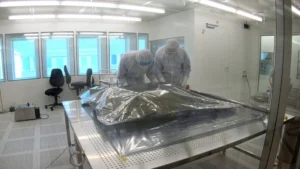
Despite these challenges, the MMX mission is equipped with sophisticated systems for material collection. A core sampler will retrieve material from depths of up to 2 centimeters, while a pneumatic sampler, a NASA-provided instrument, will use pressurized gas to "loft material into a sample container." The precious samples are expected to arrive back on Earth by mid-2031, housed within a capsule engineered to withstand the rigors of atmospheric re-entry.
The Ultimate Puzzle: Phobos’ Internal Architecture
When asked about the most perplexing aspect of Phobos, Haser identifies the overarching challenge of understanding its internal structure. The critical question extends beyond simply identifying the constituent materials; it involves determining what kind of internal architecture can simultaneously account for all of Phobos’ observed anomalies.
For Haser and his colleagues, answering this question is paramount to definitively distinguishing among the competing origin theories: asteroid capture, formation from impact ejecta, or perhaps a more complex scenario that blends elements of both. The data returned by the MMX mission, combined with ongoing geophysical modeling, promises to shed unprecedented light on the interior of this enigmatic Martian moon, potentially solving a puzzle that has captivated planetary scientists for generations. The secrets held within Phobos’ porous depths may finally be within our grasp, offering a profound glimpse into the violent, formative epochs of the inner solar system.