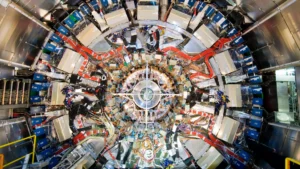
The fundamental understanding of the proton, a cornerstone of the visible universe, is undergoing a significant transformation following groundbreaking experimental results from the Relativistic Heavy Ion Collider (RHIC). For decades, physics textbooks have taught that the proton’s baryon number—a strictly conserved quantum property that defines its identity as matter—is carried by its three constituent valence quarks. However, new data from the STAR (Solenoidal Tracker at RHIC) detector suggests a far more complex reality. The findings indicate that the baryon number may actually be localized in a Y-shaped "junction" of gluons, the force-carrying particles that bind quarks together through the strong nuclear interaction. This discovery, published in the journal Science, not only reshapes nuclear physics but also offers potential clues to one of the greatest mysteries in cosmology: the overwhelming prevalence of matter over antimatter in the universe.
The Evolution of the Baryon Junction Hypothesis
The concept of the baryon junction is not entirely new, but it has remained largely theoretical for nearly half a century. Physicists first proposed the existence of a gluon junction in the 1970s as a mathematical necessity within Quantum Chromodynamics (QCD), the theory describing the strong force. In this framework, gluons do not just pass between quarks; they interact with one another, forming a complex network. When three quarks are bound together, the gluons are theorized to meet at a central point, forming a Y-shaped configuration.
In 1996, four years before the RHIC facility at Brookhaven National Laboratory (BNL) began its first experimental runs, theoretical physicist Dmitri Kharzeev proposed a radical extension of this idea. Kharzeev, a professor at Stony Brook University and a scientist at BNL, suggested that this junction might be the true "carrier" of the baryon number. While the valence quarks provide the proton with its electric charge and flavor, the junction itself represents the topological essence of the baryon. For nearly thirty years, this remained a provocative but unverified hypothesis, as the internal dynamics of a proton moving at nearly the speed of light are notoriously difficult to probe.
The STAR collaboration, an international team of hundreds of scientists, finally developed a methodology to test this theory by analyzing the remnants of high-energy nuclear collisions. By observing how baryon number and electric charge are redistributed during these violent events, the team found evidence that the "glue" is just as vital as the "bricks" in defining subatomic identity.
Experimental Evidence from the STAR Detector
The evidence for the gluon junction emerged from a meticulous analysis of various collision systems at RHIC, including the collision of gold nuclei and specialized "isobar" collisions involving ruthenium and zirconium. These collisions occur at 99.995% of the speed of light, creating conditions of temperature and density similar to those that existed microseconds after the Big Bang.
The researchers focused on a phenomenon known as "baryon transport." When two nuclei collide, most of the original protons and neutrons continue moving forward along the beamline. However, some of the baryon number is "stopped" and redirected perpendicular to the beam, appearing in the "midrapidity" region of the detector. According to the traditional quark model, for a baryon to appear at midrapidity, all three of its valence quarks would need to be decelerated significantly.
"Traditionally, scientists have assumed that each of the three main ‘valence’ quarks inside a proton or neutron carries one-third of the baryon number," explained Zhangbu Xu, a professor at Kent State University with a joint appointment at Brookhaven Lab. The STAR data, however, revealed a striking discrepancy. The researchers compared the "net baryon number" (the number of baryons minus antibaryons) to the "net electric charge" (the charge of quarks that were stopped).
If quarks carried the baryon number, the distribution of stopped electric charge should match the distribution of stopped baryons. Instead, the team observed a significant excess of baryons. "Measuring the electric charge coming out perpendicular to the collision gives you a definitive way of measuring how many quarks are stopped," said Zebo Tang, a professor at the University of Science and Technology of China. The analysis showed that roughly twice as many baryons were stopped as would be predicted by the movement of the quarks alone. This "mismatch" suggested that something other than quarks was transporting the baryon number to the center of the detector.
The Mechanics of the Gluon Junction
The proposed mechanism for this transport relies on the unique behavior of gluons at high energies. As a proton is accelerated toward the speed of light, the density of gluons within it increases dramatically—a state often referred to as a "Color Glass Condensate." In this high-energy regime, the momentum of the proton is shared among a vast sea of gluons and "sea quarks" that pop in and out of existence.
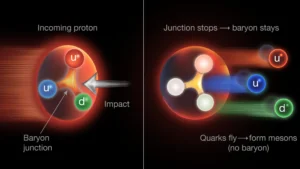
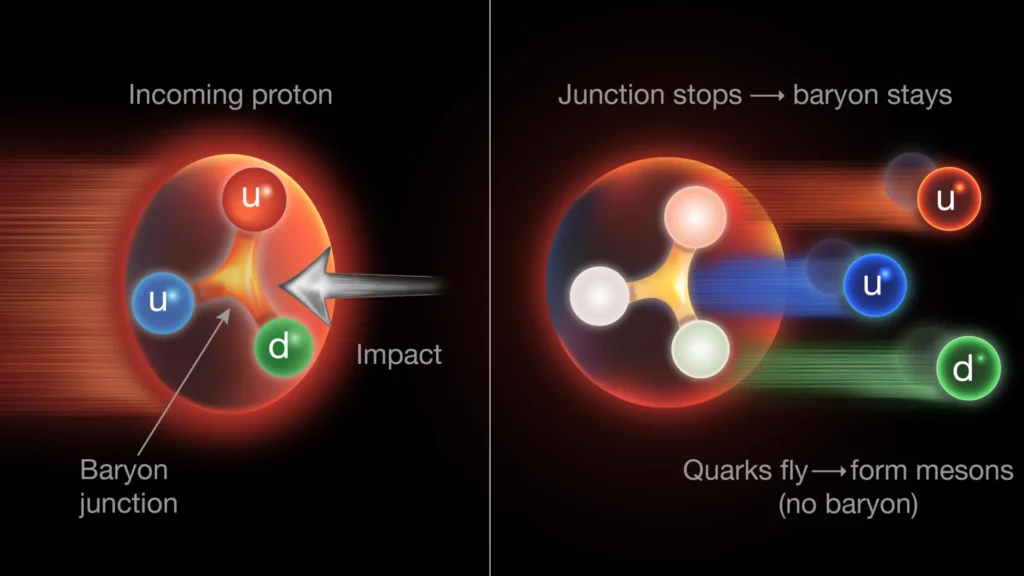
The Y-shaped gluon junction, while integral to the proton’s structure, carries a much smaller fraction of the proton’s total momentum than the valence quarks. When two protons or nuclei collide, the high-momentum valence quarks tend to "punch through" and continue their forward trajectory. However, the gluon junction, being a more "delicate" and lower-momentum topological structure, is much more likely to be snagged and stopped during the interaction.
"In the collision, the baryon junction gets held behind, and the quarks continue on," noted Prithwish Tribedy, a STAR physicist at Brookhaven Lab. Once the junction is stopped, the laws of QCD dictate that it cannot remain isolated. It acts as a topological "seed," pulling three new quarks from the vacuum—which is boiling with energy—to form a brand-new baryon. This explains why the STAR detector sees an excess of baryons at midrapidity that aren’t accompanied by the original valence quarks’ electric charge.
Implications for the Stability of Matter
The realization that the gluon junction carries the baryon number has profound implications for our understanding of the universe’s stability. The conservation of baryon number is the reason protons do not spontaneously decay into lighter particles like positrons or pions. If protons were to decay, atoms would disintegrate, and the complex structures of the universe, including stars, planets, and life, could not exist.
"It’s believed that the lifetime of a proton is longer than the lifespan of the universe," said Nicole Lewis, a STAR physicist at Rice University. "This allows atomic nuclei to form and be stable." By identifying the gluon junction as the carrier of this property, physicists are getting closer to understanding the fundamental "lock" that prevents matter from vanishing.
Furthermore, this discovery touches upon the cosmological "Baryon Asymmetry" problem. Current models of the Big Bang suggest that matter and antimatter should have been created in equal amounts, leading to total annihilation and a universe filled only with light. Yet, we live in a matter-dominated universe. Understanding how baryon number is transported and conserved at the most fundamental level may provide a pathway to discovering CP-violation (Charge Parity violation) mechanisms that favored matter in the early seconds of time.
A More Complex Portrait of the Proton
The STAR results effectively retire the "naive quark model" often found in introductory science curriculum. That model depicts the proton as a simple bag containing three quarks. Tommy Tsang, a researcher at Argonne National Laboratory, emphasized that the reality is far more "messy" and dynamic. "If we look at details inside, there are not only three quarks but also a lot of gluons interacting… it’s actually a really complex object," Tsang said.
This complexity is handled by the theory of Quantum Chromodynamics, but the theory is notoriously difficult to solve for low-energy interactions or for the internal structure of the proton at rest. The RHIC data provides a critical experimental anchor for theoretical physicists attempting to refine QCD models. It demonstrates that the vacuum is not empty but is a medium where gluons can form stable topological structures that define the very identity of matter.
Chronology and Future Research
The journey to this discovery spanned decades of theoretical work and over twenty years of data collection at RHIC.
- 1970s: The gluon junction is first proposed as a feature of QCD.
- 1996: Dmitri Kharzeev hypothesizes that the junction carries the baryon number.
- 2000: RHIC begins operations at Brookhaven National Laboratory.
- 2020: Specialized "isobar" runs (ruthenium and zirconium) provide the high-precision data needed to separate the effects of electric charge from baryon number.
- 2024: The STAR collaboration publishes their findings in Science, confirming the mismatch between quark transport and baryon transport.
While the current results are compelling, the scientific community views this as the beginning of a new chapter. The next step in this investigation will likely take place at the Electron-Ion Collider (EIC), a next-generation facility currently under construction at Brookhaven Lab. The EIC will use high-energy electrons to "scan" the inside of protons and nuclei with unprecedented resolution, potentially allowing scientists to directly image the gluon junction for the first time.
"Our research challenges the long-held idea that baryon number is simply divided among and carried by the three quarks," said Rongrong Ma, a physicist at Brookhaven Lab. "This new understanding reshapes how we think about the structure of matter and deepens our knowledge of the most fundamental element that is responsible for the universe in its current form."
The research was supported by the DOE Office of Science and the U.S. National Science Foundation, with computational support from the National Energy Research Scientific Computing Center (NERSC). As the physics community digests these results, the humble proton—once thought to be a simple building block—has revealed itself to be a sophisticated tapestry of energy and topology, held together by a junction of "glue" that defines its very existence.