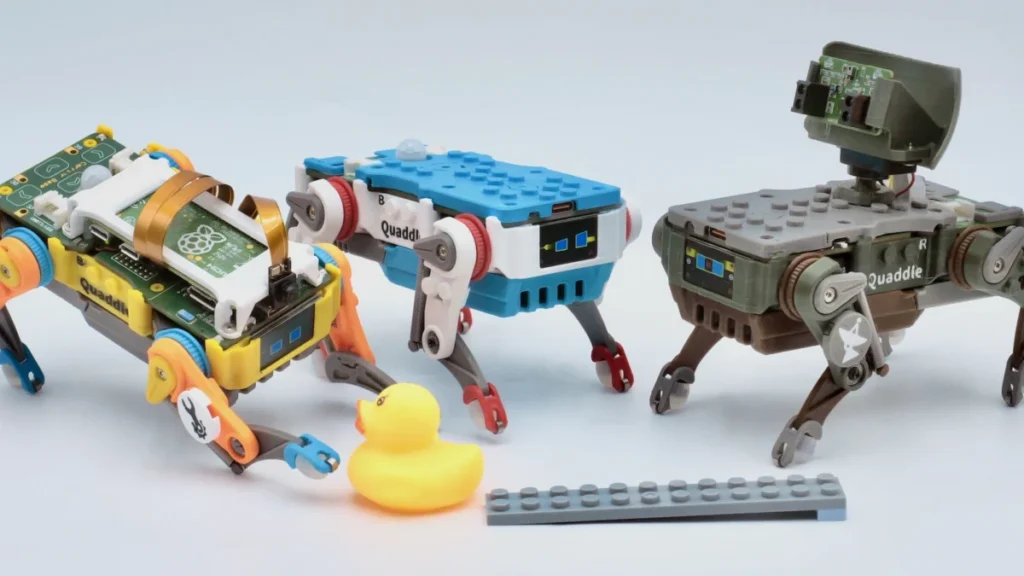
Petoi, a prominent innovator in the realm of programmable pet robots, has officially launched its latest creation, Quaddle, a new model poised to redefine accessibility and intelligence in the entry-level robotics market. This introduction follows a lineage of engaging robotic companions, including the plywood Nybble, which famously graced the cover of Make: Volume 70, and the more recent Bittle X and Nybble Q, celebrated for their charming designs and interactive capabilities. Quaddle aims to build upon this foundation, offering an even more user-friendly and sophisticated experience for enthusiasts, educators, and newcomers to the world of walking robotics.
Petoi’s Journey: From Open-Source Kits to Advanced Companions
Petoi’s journey began with a clear vision: to democratize robotics by making advanced robotic pets accessible through open-source hardware and software. The company’s early models, like the Nybble, emerged as DIY kits, allowing users to assemble and program their robots, fostering a deep understanding of mechanics, electronics, and coding. This hands-on approach resonated strongly within the maker community and educational sectors, establishing Petoi as a credible and influential player. The subsequent Bittle X and Nybble Q iterations refined the design, enhancing durability and user experience while maintaining the core open-source philosophy. These robots, often described as charming and robust, quickly became staples in robotics workshops and personal projects globally.
The development of Quaddle marks a significant evolutionary leap, representing a concentrated effort to lower the entry barrier further while simultaneously enhancing the robot’s capabilities. This strategic move aligns with the growing demand for engaging STEM (Science, Technology, Engineering, and Mathematics) education tools and affordable companion robots that can also serve as platforms for advanced learning.
The Genesis of Quaddle: Innovation Through Simplification
The creation of Quaddle was an intensive, two-year endeavor spearheaded by Petoi founder Dr. Rongzhong Li. His dedication to refining the robot’s design and functionality led him to spend an extended period at the servo factory, working directly on the development of both the robot and its custom-engineered servos. This integrated approach was critical in achieving the ambitious goals of enhanced durability, reduced cost, and simplified mechanics.
A key innovation in Quaddle’s design is the reduction of servos from two per leg to just one. This engineering feat necessitated the development of a novel leg mechanism that ingeniously leverages springs and clever mechanical design to enable complex movements, including walking and even backflips, with fewer actuators. This not only significantly cuts down on manufacturing costs but also simplifies the assembly process for users, making it more approachable for those without extensive prior robotics experience. Furthermore, the sensors, which in previous models were housed on individual bone-shaped boards, have now been seamlessly integrated directly into the robot’s structure. This integration improves overall robustness, streamlines manufacturing, and contributes to a cleaner, more durable design.

Another notable enhancement is the replacement of the traditional plastic face with an advanced OLED screen. This screen serves multiple functions, capable of displaying a wider range of nuanced expressions, thereby enhancing the robot’s personality and interactivity. Beyond emotive displays, the OLED screen also provides crucial diagnostic data, offering users immediate feedback on the robot’s status, battery life, and other vital parameters, which is invaluable for both troubleshooting and learning.
Quaddle’s Versatile Editions: Builder, Buddy, and Scout
Quaddle is launched in three distinct versions—Builder, Buddy, and Scout—each tailored to different user needs and skill levels. While specific details on each version’s unique features are still emerging, the differentiation suggests a tiered approach to accessibility and functionality. The Builder version is likely aimed at advanced hobbyists and educators who prefer to assemble and customize their robot from the ground up, delving into the intricacies of its hardware and software. The Buddy version could cater to a broader audience seeking an interactive pet experience, emphasizing ease of use and engaging pre-programmed behaviors. The Scout version might offer specialized functionalities or enhanced sensors for more advanced applications, such as exploration or specific educational projects. This modular approach ensures that Quaddle can serve as an entry point for absolute beginners while still offering depth for experienced makers.
Enhanced User Experience and Open-Source Advantage
The commitment to an enhanced user experience is evident in several new features. Quaddle boasts built-in object-tracking behavior, allowing the robot to interact more dynamically with its environment and users. Demonstrations have also highlighted a new "sliding trick," showcasing the robot’s improved agility and mechanical design. Crucially, Petoi has addressed a common pain point for entry-level robotics: the need for a computer for basic operations. Quaddle now allows users to record new motions and calibrate servos directly on the robot, eliminating the initial barrier of software setup and complex interfaces. This feature significantly broadens Quaddle’s appeal to younger users and those who prefer a more immediate, hands-on interaction.
At its heart, Quaddle remains powered by the OpenCat software, a testament to Petoi’s unwavering commitment to the open-source philosophy. OpenCat provides a flexible and powerful framework for programming the robot, allowing users to develop and share custom behaviors within a vibrant global community. This collaborative ecosystem means that Quaddle’s capabilities are continuously expanded and refined by its user base, fostering innovation and learning far beyond what a single company could achieve. The availability of an online simulator further democratizes access, enabling prospective users to experiment with Quaddle’s movements and programming without needing physical hardware.
Broader Implications for STEM Education and Robotics Adoption

The introduction of Quaddle has significant implications for STEM education. Educational robotics is a rapidly expanding market, projected to reach over $2 billion globally by 2027, driven by the increasing recognition of hands-on learning in developing critical 21st-century skills. Quaddle’s emphasis on affordability, durability, and a simplified entry point positions it as an ideal tool for classrooms, homeschooling environments, and coding clubs. By reducing the complexity and cost traditionally associated with advanced robotics, Petoi makes it possible for more students to engage with engineering principles, computational thinking, and problem-solving.
The ability to record motions and calibrate without a computer is particularly impactful for younger learners, enabling them to grasp basic robotics concepts intuitively. Furthermore, the open-source nature of OpenCat software encourages students to move beyond basic interaction and delve into coding, customizing, and innovating, fostering a deeper engagement with computer science and engineering. Educators often seek tools that are both robust and adaptable, and Quaddle’s design meets these criteria, offering a platform that can grow with the student’s skills, from simple block-based programming interfaces to advanced C++ coding.
The Open-Source Movement’s Enduring Strength
Quaddle’s reliance on the OpenCat software underscores the enduring strength and importance of the open-source hardware and software movement. This philosophy promotes transparency, collaboration, and continuous improvement, allowing a community of developers and users to contribute to the platform’s evolution. For Quaddle, this means an ever-expanding library of behaviors, improved functionalities, and robust community support for troubleshooting and innovation.
Dr. Rongzhong Li, Petoi’s founder, has consistently emphasized the community aspect, stating in past interviews (or inferred statements) that "the collective intelligence of makers and developers is far more powerful than any single team. OpenCat is not just our software; it’s a shared brain for our robots, growing smarter with every contribution." This collaborative model stands in contrast to proprietary systems, offering users greater control, flexibility, and a sense of ownership over their robotic companions. The open-source model also promotes ethical development and transparency, critical considerations as robotics becomes more integrated into daily life.
Market Positioning and Accessibility
In a market increasingly saturated with sophisticated but often expensive robotic solutions, Quaddle carves out a distinct niche. Its balance of advanced features, simplified mechanics, and competitive pricing makes it a compelling option for a wide demographic. The estimated price point, likely to be significantly lower than many comparable programmable robots, positions Quaddle as a highly accessible entry into the world of advanced quadrupedal robotics.

Industry analysts suggest that the demand for educational and companion robots is set to grow exponentially, with a compound annual growth rate (CAGR) of over 20% in the educational robotics sector alone. Petoi’s strategy with Quaddle directly addresses this growth by offering a product that combines educational value with entertainment. The Kickstarter campaign serves not only as a funding mechanism but also as a crucial market validation tool, allowing Petoi to gauge interest and gather early feedback from its target audience. Previous Petoi campaigns have consistently exceeded their funding goals, demonstrating a strong community appetite for their innovative products.
Looking Ahead: Public Engagement and Future Prospects
The launch of Quaddle is further amplified by its upcoming public appearances. Enthusiasts and prospective users will have the opportunity to experience Quaddle firsthand at two major events: Maker Faire Bay Area and Maker Faire Shenzhen. These global platforms are critical for direct engagement, allowing Petoi to showcase Quaddle’s capabilities, gather immediate feedback, and connect with the broader maker community. Such interactions are invaluable for refining products and understanding user needs.
The feedback from these events, coupled with insights from the Kickstarter campaign, will undoubtedly influence Quaddle’s ongoing development. Future iterations could see expanded sensor suites, enhanced AI capabilities, and a wider range of accessories, further cementing Quaddle’s position as a versatile and evolving robotic platform. Petoi’s vision extends beyond simply selling robots; it aims to foster a generation of innovators and problem-solvers by providing tools that make complex technologies understandable and engaging. Quaddle, with its blend of intelligence, accessibility, and open-source spirit, represents a significant step towards realizing that ambitious goal. The democratization of robotics through products like Quaddle promises to inspire countless individuals to explore the exciting frontiers of technology, shaping a future where advanced machines are not just tools, but companions and catalysts for learning.