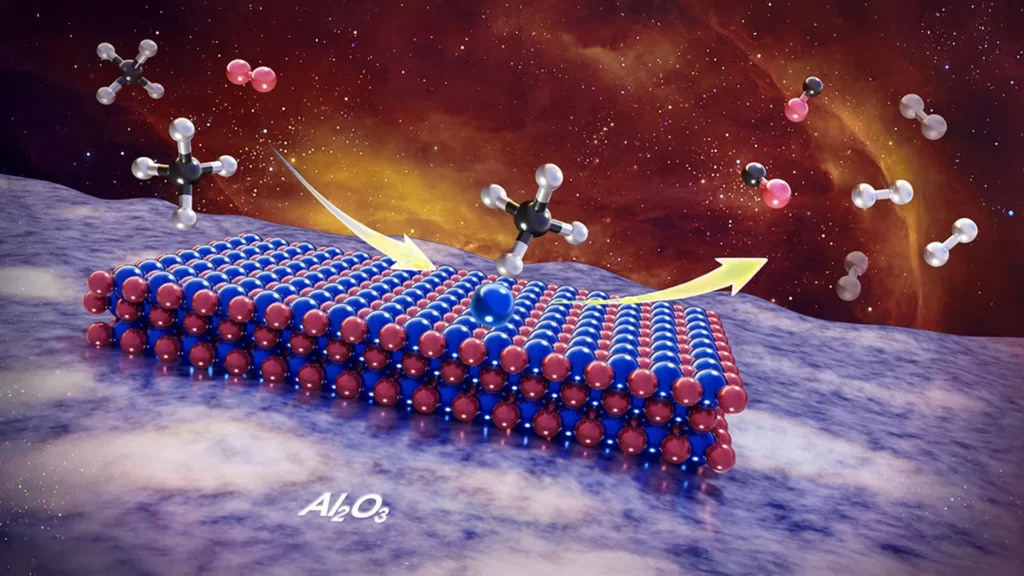
For decades, scientists have grappled with a fundamental question regarding the catalytic heart of this vital industrial process. The partial oxidation of methane (POM), a reaction critical for converting abundant natural gas into valuable syngas—a foundational mixture for fuels, fertilizers, and a vast array of chemicals—has long been associated with nickel (Ni) catalysts. Specifically, metallic nickel (Ni) nanoparticles were widely assumed to be the primary active centers driving this complex reaction. However, this assumption was plagued by a significant unresolved ambiguity: the metallic Ni observed after a reaction could simply be a product of nickel oxide being reduced by syngas at the high temperatures required for POM, rather than the true catalytic species performing the work. This long-standing uncertainty has hindered the rational design of more efficient and cost-effective catalysts, leaving a critical gap in our understanding of one of the most important reactions in heterogeneous catalysis.
The Global Imperative for Syngas Production
Syngas, short for synthesis gas, is a cornerstone of the modern chemical industry. Comprising primarily carbon monoxide (CO) and hydrogen (H₂), it serves as an essential intermediate for manufacturing a wide range of products. From the production of methanol, a versatile chemical precursor, to the Fischer-Tropsch synthesis of liquid fuels, and the Haber-Bosch process for ammonia (a key component in fertilizers), syngas underpins countless industrial processes worldwide. Its demand is inextricably linked to global energy consumption and agricultural output.
Traditional methods for syngas production, such as steam methane reforming (SMR) and autothermal reforming (ATR), are energy-intensive and often lead to significant carbon emissions. SMR, for instance, operates at very high temperatures (700-1100°C) and requires large amounts of steam, making it an energy-demanding process. The partial oxidation of methane (POM) offers a compelling alternative. It is an exothermic reaction, meaning it generates heat, and typically operates at lower temperatures than SMR, potentially leading to reduced energy consumption and a smaller carbon footprint. Moreover, POM can produce syngas with a hydrogen-to-carbon monoxide ratio closer to 2:1, which is ideal for many downstream applications, including methanol synthesis and Fischer-Tropsch processes. This inherent efficiency and economic appeal make POM a highly attractive pathway for sustainable chemical production, provided its catalytic mechanisms can be fully understood and optimized.
Unraveling the Nickel Mystery: A Decades-Long Challenge
The challenge in POM catalysis lies in the dynamic nature of nickel under the harsh reaction conditions. Nickel is known for its ability to readily change both its oxidation state and its atomic arrangement when subjected to the high-temperature redox (reduction-oxidation) environment characteristic of POM. This inherent plasticity has made it exceptionally difficult to track the catalyst’s true structure in real-time. Scientists knew that nickel, whether in its metallic (Ni⁰) or oxidized (NiO) state, was involved, but the precise identity of the active site—the specific atomic arrangement responsible for breaking methane’s strong C-H bonds—remained elusive. Without this fundamental knowledge, catalyst development largely proceeded through empirical trial and error, a costly and often inefficient process.
The high temperatures (typically 600-900°C) and varying partial pressures of reactants and products (methane, oxygen, carbon monoxide, hydrogen, water) create a highly dynamic environment. Metallic nickel nanoparticles, while effective, are prone to sintering (coalescing into larger particles) at high temperatures, which reduces their surface area and catalytic activity. They are also susceptible to carbon deposition (coking), which deactivates the catalyst. Nickel oxide, on the other hand, is more stable but historically not considered as active for the C-H bond activation step in POM. This conundrum fueled a persistent debate: was it metallic nickel that initiated the reaction, or was the observed metallic nickel merely a consequence of the reaction environment? The inability to observe catalysts in situ—that is, while they are actively performing catalysis under realistic conditions—was the primary barrier to resolving this critical question.
A Groundbreaking Discovery in Nature Catalysis
In a significant breakthrough that addresses this long-standing scientific puzzle, a collaborative research team, spearheaded by Profs. Tao Zhang, Aiqin Wang, and Xiaoyan Liu from the Dalian Institute of Chemical Physics (DICP) of the Chinese Academy of Sciences (CAS), alongside Prof. Wei Liu from DICP, Prof. Tao Yang from Xi’an Jiaotong University, and Prof. Graham J. Hutchings from Cardiff University, published their findings in the prestigious journal Nature Catalysis. Their study provides compelling evidence that highly active structures dynamically form in situ through the surface reconstruction of nickel oxide (NiO) during the partial oxidation of methane. This discovery not only pinpoints the atomic-scale source of catalytic activity but also powerfully underscores the indispensable value of observing catalysts under their actual operating conditions. The research marks a pivotal moment, shifting the paradigm from static catalyst models to dynamic, operando investigations, and offers profound implications for the future design of highly efficient and sustainable catalytic systems.
The Dalian Institute of Chemical Physics (DICP), a globally recognized leader in catalysis research, has a long history of contributing to fundamental and applied chemistry. This latest publication from their team reinforces their reputation for pushing the boundaries of scientific understanding in areas critical to energy and chemical production.
Innovative Catalyst Synthesis and Exceptional Performance
To meticulously investigate the complex catalytic process, the research team employed a sophisticated microemulsion method to synthesize a novel Ni/Al₂O₃ catalyst. This method allowed for precise control over nanoparticle size and dispersion, resulting in a catalyst containing an exceptionally low nickel content of merely 0.8 weight percent (wt%). Despite this remarkably low loading, the catalyst demonstrated outstanding performance during the partial oxidation of methane. It achieved a methane conversion rate of 92%, while simultaneously exhibiting impressive selectivities for CO and H₂ at 87.0%. Crucially, the H₂/CO molar ratio remained consistently stable at approximately 2.0, a highly desirable ratio for various industrial applications such as methanol synthesis.
The microemulsion method is a technique that uses a stable dispersion of two immiscible liquids (like oil and water) stabilized by surfactants. Within these nanometer-sized droplets, precursors can react to form highly uniform nanoparticles with controlled size and excellent dispersion, which is critical for maximizing catalytic surface area and activity. This contrasts sharply with simpler methods like impregnation, where a support material is soaked in a metal salt solution, often leading to less uniform distribution and larger particle sizes.
One of the most astonishing findings from the study was the almost complete absence of detectable metallic Ni in the catalyst after the reaction. This observation directly challenged the long-held assumption that metallic nickel was the primary active species. Even more remarkably, despite containing only one-tenth the amount of nickel, the overall catalytic performance of this low-loading (0.8 wt%) Ni/Al₂O₃ catalyst was comparable to that of a high-loading (8.0 wt%) Ni/Al₂O₃ catalyst prepared via the conventional impregnation method. This dramatic reduction in metal loading, without compromising performance, carries immense economic implications, as nickel, while less expensive than noble metals like platinum or rhodium, still represents a significant cost in industrial-scale catalysis.
Further highlighting the superiority of their synthesis approach, the low-loading catalyst prepared by the microemulsion method vastly outperformed another 0.8 wt% Ni/Al₂O₃ material prepared using the less sophisticated impregnation method. Under identical reaction conditions, the impregnation-derived catalyst failed to effectively carry out POM and instead primarily exhibited undesirable methane combustion activity, producing CO₂ and H₂O rather than the desired syngas. This stark difference underscored that not only the amount of nickel but also its precise dispersion and interaction with the support material, dictated by the synthesis method, play a critical role in determining catalytic performance.
The researchers also observed a crucial dynamic during the reaction: any metallic Ni nanoparticles present at the outset were rapidly oxidized into the NiO phase under the oxygen-rich conditions prevalent in POM. Yet, nickel oxide alone was not sufficient. A pre-formed, pure-phase NiO catalyst, when tested under the same conditions, showed absolutely no POM activity. Instead, it exclusively catalyzed the complete oxidation of methane, again yielding unwanted CO₂ and H₂O. These findings collectively demonstrated that neither metallic nickel nor bulk nickel oxide, in isolation, could explain the observed high performance in partial oxidation. This pointed strongly towards a more complex, dynamically formed active structure.
Atomic Reconstruction: The True Active Site Revealed
The true nature of the catalytic activity was unveiled through an intricate combination of in situ characterization techniques and advanced theoretical calculations. A closer, atomic-scale examination of the catalyst surface during the reaction—a feat made possible by sophisticated operando spectroscopy and microscopy techniques (though not explicitly detailed in the provided text, these are the typical methods for such observations)—revealed the in situ formation of a dynamically reconstructed [Ni₁O₄Ni₄] structural unit on the NiO(100) surface. This specific motif, a testament to the dynamic nature of the catalyst, was found to be the actual active center.
To validate and understand the mechanistic implications of this reconstructed structure, the team employed Density Functional Theory (DFT) calculations. DFT is a powerful quantum mechanical modeling method used in physics and chemistry to investigate the electronic structure of multi-electron systems. In this context, DFT allowed the researchers to simulate the interactions between methane molecules and the various nickel surfaces (intact NiO, metallic Ni, and the newly discovered reconstructed NiO) at an atomic level. These calculations indicated that the newly formed [Ni₁O₄Ni₄] motif significantly lowers the energy barrier for breaking the C-H bonds in methane, a critical initial step in activating the molecule for subsequent reactions. The calculated activation barrier for this reconstructed structure was remarkably low, only 12.5 kcal·mol⁻¹.
This calculated barrier stood in stark contrast to the values obtained for other nickel species. For the intact NiO(100) surface, the activation barrier was a much higher 38.5 kcal·mol⁻¹, explaining why pure NiO showed no POM activity. Even more tellingly, the barrier for the metallic Ni(111) surface, previously thought to be the primary active site, was 15.7 kcal·mol⁻¹, still higher than that of the reconstructed structure. This substantial kinetic advantage, demonstrated through rigorous theoretical modeling, provides compelling support for the conclusion that the dynamically formed, reconstructed [Ni₁O₄Ni₄] unit is indeed the true active center responsible for the high efficiency of partial oxidation of methane.
The synergy between experimental observations, which confirmed the formation of the structure under reaction conditions, and theoretical calculations, which elucidated its superior reactivity, paints a complete picture. It clearly demonstrates that catalytic activity in POM does not stem from simple metallic nickel or bulk nickel oxide, but rather from a specific, atomically precise structure that emerges and evolves dynamically as the reaction unfolds.
Broader Implications for Catalysis and Sustainable Chemistry
This groundbreaking research has profound implications that extend far beyond the partial oxidation of methane. As Prof. Liu articulated, "Our study highlights the critical role of in situ characterization in identifying dynamic active structures under reaction conditions. Dynamic reconstruction enables low-loading catalysts to achieve high performance, offering new opportunities for the rational design of efficient catalysts while reducing reliance on high metal loadings."
The findings underscore a paradigm shift in catalyst design. Historically, catalysts were often viewed as static entities, with their active sites considered immutable once formed. This study, however, reinforces the growing understanding that many catalysts are highly dynamic, undergoing significant structural and electronic transformations under reaction conditions. Recognizing and actively harnessing these dynamic reconstructions opens up entirely new avenues for catalyst development.
For the POM process specifically, the ability to achieve high performance with significantly reduced nickel content translates directly into substantial economic benefits for the chemical industry. Lowering the reliance on high metal loadings means reduced raw material costs, potentially leading to more competitive production of syngas and its derivatives. Furthermore, more efficient catalysts can lead to lower operating temperatures and pressures, further reducing energy consumption and the overall environmental footprint of syngas production. This aligns perfectly with global efforts towards more sustainable and green chemical processes.
Beyond economic advantages, the scientific implications are equally significant. This work provides a powerful impetus for the broader catalysis community to invest more heavily in advanced operando characterization techniques. These techniques, which allow scientists to "watch" catalysts in action, are crucial for uncovering the transient, yet highly active, species that are often missed by traditional ex situ analysis (analysis performed after the reaction). Understanding these dynamic processes is key to unlocking the full potential of many catalytic reactions across various industrial sectors.
Looking ahead, this research paves the way for the rational design of next-generation catalysts. Instead of merely optimizing bulk properties or static structures, future catalyst development can focus on engineering materials that are predisposed to form these highly active dynamic structures in situ. This could involve designing specific support materials that stabilize these reconstructed surfaces, or developing synthesis methods that favor their formation under operating conditions. This approach promises to yield catalysts that are not only more efficient and durable but also utilize less precious and critical raw materials, contributing to a more circular and sustainable chemical economy. The study by the DICP-led team serves as a beacon, illuminating the path forward in the quest for superior catalytic performance.