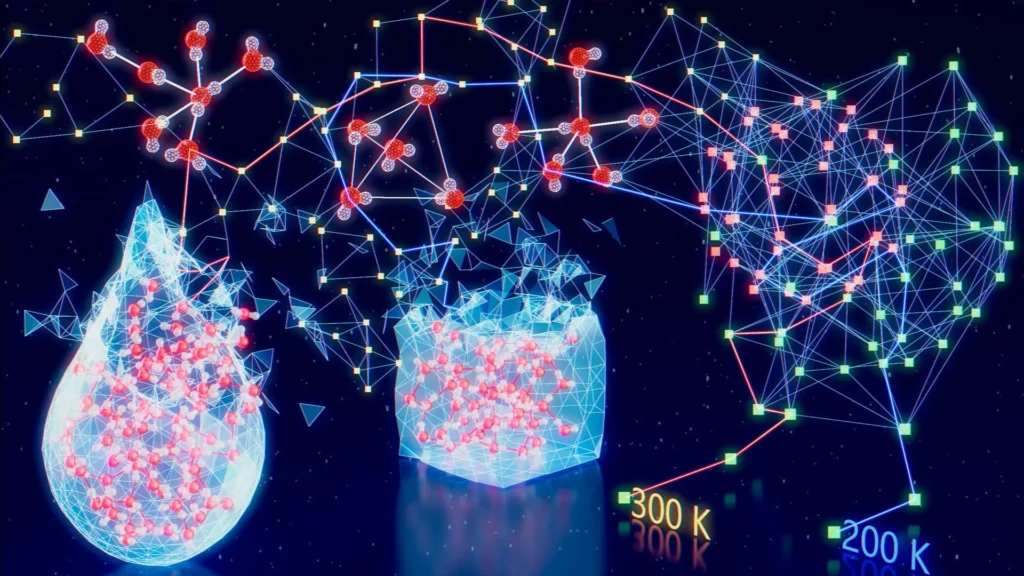
Water, the ubiquitous solvent covering over 70% of Earth’s surface, exhibits a remarkable suite of properties that defy conventional liquid behavior. Unlike nearly all other liquids, water expands upon freezing, leading to ice floating on liquid water – a fundamental characteristic crucial for aquatic life and global climate systems. This anomaly is just one among more than 70 known peculiarities, including its unusually high boiling point, specific heat capacity, and surface tension. For decades, scientists have attributed these deviations to the intricate, constantly shifting hydrogen-bonded network of water molecules at the microscopic level, where subtle changes in temperature and pressure induce profound structural rearrangements. However, a consistent and universally accepted framework for quantitatively describing and comparing these complex structural transformations has remained elusive.
Now, a pioneering research initiative at the University of Osaka has leveraged the power of artificial intelligence (AI) to address this long-standing scientific challenge. Their newly developed AI system offers a unified methodology to rigorously compare various existing descriptors of supercooled water’s structure, thereby identifying which metrics most effectively capture its critical features. This groundbreaking work, detailed in the prestigious journal Communications Chemistry, marks a significant leap forward in understanding the fundamental physics of water.
The Enduring Mystery of Water’s Anomalies
The anomalous properties of water have puzzled scientists for centuries. For most substances, density increases uniformly as temperature decreases, culminating in a solid state denser than its liquid counterpart. Water, however, reaches its maximum density at approximately 4 degrees Celsius (39.2 degrees Fahrenheit) before expanding as it cools further to its freezing point at 0 degrees Celsius. This expansion, a direct consequence of the specific arrangement of water molecules into a more open, crystalline lattice upon freezing, allows ice to float, preventing entire bodies of water from freezing solid from the bottom up and preserving aquatic ecosystems.
Beyond its density anomaly, water also possesses an extraordinarily high specific heat capacity, meaning it can absorb or release significant amounts of heat with only minor changes in its own temperature. This property is vital for regulating Earth’s climate, moderating global temperature fluctuations, and enabling biological systems to maintain thermal homeostasis. Other notable anomalies include its high surface tension, high dielectric constant, and its ability to act as a universal solvent. These macroscopic behaviors are universally understood to originate from the unique intermolecular forces – primarily hydrogen bonds – that govern the interactions between water molecules. Each water molecule (H₂O) can form up to four hydrogen bonds with neighboring molecules, creating a dynamic, three-dimensional network that is highly sensitive to external conditions.
Delving into Supercooled Water: An Extreme State
To fully appreciate the Osaka research, it’s crucial to understand the exotic state known as supercooled water. For liquid water to transition into ice, its molecules must organize into an orderly crystal lattice. This process typically initiates at a "nucleation site" – a microscopic impurity, a dust particle, or even a minute imperfection on a container’s surface – which acts as a template for ice crystal formation. In the absence of such nucleation sites, water can remain in a liquid state even when cooled significantly below its standard freezing point of 0°C. This metastable condition is supercooled water, a state where its anomalous properties become even more pronounced and complex.
Supercooled water is not merely a laboratory curiosity; it plays a critical role in natural phenomena. For instance, supercooled water droplets are prevalent in the upper atmosphere, contributing significantly to cloud formation and precipitation processes. Understanding its behavior is also vital for various technological applications, from cryopreservation techniques in biology and medicine to the design of de-icing systems for aircraft. However, studying supercooled water presents significant experimental challenges due to its inherent instability and tendency to rapidly freeze upon disturbance.
Scientists theorize that the exaggerated behaviors observed in supercooled water stem from a delicate balance between two distinct, competing forms of liquid water at the molecular level: a high-density liquid (HDL) and a low-density liquid (LDL). At the molecular scale, water molecules are constantly forming, breaking, and reforming networks of hydrogen bonds. The LDL structure is characterized by a more open, tetrahedral arrangement, akin to the structure of ice but disordered, leading to lower density. Conversely, the HDL structure involves a more compact, disordered packing of molecules, resulting in higher density. As temperature rises, the more compact HDL structures gain dominance over the more open LDL arrangements, influencing water’s overall density and other properties. The interplay and dynamic equilibrium between these two hypothetical liquid forms are believed to be central to water’s unusual phase diagram and its array of anomalies, particularly in the supercooled regime.
A Historical Perspective on Water’s Structural Models
The quest to model water’s microscopic structure has a rich and complex history. Early models, like the "mixture model" from the mid-20th century, proposed that water was a mixture of two distinct states – an ice-like state and a more dense, disordered state. Over time, these conceptual models evolved with advances in spectroscopy, X-ray diffraction, and neutron scattering techniques, providing increasingly detailed but often fragmented views of water’s structure.
The advent of computational chemistry, particularly molecular dynamics (MD) simulations in the latter half of the 20th century, revolutionized the field. MD simulations allow researchers to model the interactions of thousands of water molecules over picoseconds to nanoseconds, providing atomic-level insights into their movements and structural arrangements. These simulations have been instrumental in generating vast amounts of structural data, which, in turn, led to the development of numerous "structural descriptors." These descriptors are mathematical tools designed to quantify specific aspects of the local arrangement of water molecules, such as the "tetrahedral bond order parameter," which measures the deviation from an ideal tetrahedral coordination, or "local density," which quantifies molecular packing in a given region.
However, a significant hurdle emerged: these structural descriptors were often developed independently by different research groups, utilizing varying mathematical scales, dimensions, and underlying theoretical frameworks. This lack of standardization made direct comparisons between different descriptors exceedingly difficult, hindering the scientific community’s ability to identify which descriptors most accurately and comprehensively capture the essential structural information relevant to water’s anomalous behaviors. The absence of a unified comparative framework has fragmented research efforts and slowed the pace of discovery.
AI’s Role in Unifying Structural Descriptors
This is precisely where the University of Osaka team, led by corresponding author Kang Kim and senior author Nobuyuki Matubayasi, introduced their innovative AI-driven solution. Recognizing the power of machine learning in processing complex, high-dimensional data, the researchers sought to apply a neural network model to evaluate and compare the efficacy of various structural descriptors. "Past studies have shown that using machine learning to classify and understand structural data is effective," explains Kang Kim. "We specifically wanted to incorporate a neural network model into this study to evaluate how accurate the descriptors were at capturing key structural information, in a way that is like human cognition."
The methodology involved training a sophisticated neural network on structural data meticulously generated from molecular dynamics simulations of supercooled water. These simulations provided a rich dataset detailing the atomic positions and interactions of water molecules under varying conditions, effectively mapping the dynamic interplay between HDL and LDL structures. Through an iterative process of trial and error, the AI system progressively learned to discern meaningful patterns and correlations within the molecular structures, effectively recognizing the subtle differences that characterize HDL and LDL configurations.
Once trained, the neural network was tasked with evaluating how effectively 16 different, independently developed structural descriptors differentiated between the high-density and low-density liquid structures across a range of temperatures. As senior author Nobuyuki Matubayasi reports, "The network used what it had learned to compare how 16 descriptors differentiated between LDL and HDL structures at different temperatures. In this way, we determined the most efficient descriptors." The AI’s ability to process and cross-reference such diverse data sets with unparalleled speed and accuracy allowed the researchers to overcome the long-standing comparison problem. By providing an objective, data-driven evaluation, the AI system offered a clear hierarchy of descriptors based on their ability to capture the essential characteristics of water’s two competing liquid forms.
Implications and Future Directions
The findings from the Osaka University research represent a pivotal advancement in the fundamental understanding of water. By identifying the most efficient structural descriptors, this framework provides scientists with more precise tools to connect microscopic structural changes to the macroscopic thermodynamic behaviors of water. This enhanced understanding could clarify the precise molecular origins of water’s numerous unusual properties, moving the scientific community closer to a comprehensive theory of water.
The implications of this research extend far beyond academic curiosity. A deeper, more consistent understanding of water’s structure and dynamics could have profound impacts across multiple scientific and technological domains:
- Climate Science: Improved models of water’s behavior, particularly in its supercooled state, could lead to more accurate climate predictions, especially concerning cloud formation, atmospheric dynamics, and precipitation patterns, which are crucial for global hydrological cycles.
- Biology and Medicine: Water is the solvent of life, playing a critical role in protein folding, enzyme activity, and cellular processes. A better understanding of water’s microscopic structure could shed light on the mechanisms of biological hydration, protein denaturation, and even the development of more effective cryopreservation techniques for organs and tissues.
- Materials Science: The ability to precisely control water’s properties is invaluable in designing new materials. This research could guide the development of novel materials with specific wetting properties, such as superhydrophobic surfaces, or advanced membranes for water purification and desalination.
- Chemistry and Drug Discovery: Water’s unique solvent properties are fundamental to chemical reactions and drug efficacy. An enhanced structural understanding could inform the design of more efficient catalysts, better solvents, and drugs with optimized solubility and bioavailability.
Furthermore, the methodology itself – employing AI to evaluate and unify disparate scientific descriptors – offers a powerful paradigm for future research across various fields. As computational power continues to grow and AI algorithms become more sophisticated, such approaches could accelerate discovery in materials science, soft matter physics, and even theoretical chemistry by streamlining the analysis of complex simulation data.
The work by the University of Osaka team underscores the transformative potential of interdisciplinary research, where cutting-edge AI techniques are brought to bear on some of the oldest and most fundamental questions in physics and chemistry. This unified framework promises not only to resolve long-standing debates about water’s hidden structure but also to guide the development of even more powerful computational tools, paving the way for a new era of molecular discovery.