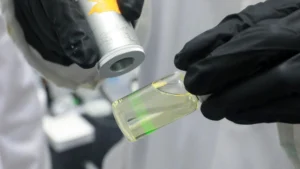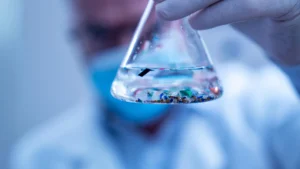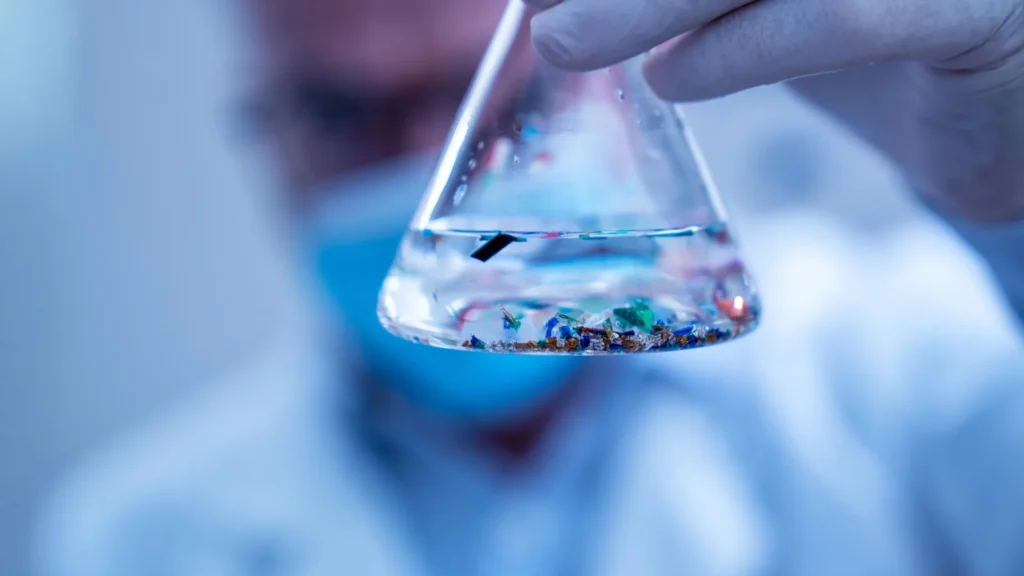
In a significant advancement for the field of chemical upcycling, researchers at the Department of Energy’s Oak Ridge National Laboratory (ORNL) have pioneered a novel method to transform polyethylene—the world’s most pervasive plastic—into high-quality liquid fuels. By utilizing a specialized molten salt medium, the team has successfully converted plastic waste into gasoline- and diesel-like hydrocarbons at temperatures significantly lower than traditional methods. This breakthrough, recently published in the Journal of the American Chemical Society, offers a potential pathway toward a circular economy for plastics, reducing the environmental burden of landfills while bolstering domestic energy production.
Polyethylene (PE) is ubiquitous in modern life, found in everything from grocery bags and food packaging to industrial pipes and white plastic cutting boards. Despite its utility, PE presents a monumental waste management challenge due to its chemical stability and the sheer volume produced globally. The ORNL team’s approach addresses this by employing molten salts containing aluminum chloride, which serve a dual role as both the reaction medium and the catalyst. This integrated system allows for the selective breakdown of long-chain polymers into smaller, fuel-grade molecules with unprecedented efficiency.
The Global Plastic Crisis and the Need for Upcycling
To understand the impact of the ORNL discovery, it is essential to consider the scale of the global plastic crisis. Current estimates suggest that over 400 million tons of plastic waste are generated annually worldwide, a figure expected to double by 2040 if current trends persist. Polyethylene accounts for approximately one-third of this total. While mechanical recycling—shredding and melting plastic to create new products—is the most common approach, it often results in "downcycling," where the quality of the plastic degrades with each cycle, eventually leading to the landfill.
Chemical recycling, or upcycling, seeks to break plastic down into its original chemical building blocks or convert it into higher-value products like fuels and lubricants. However, traditional chemical recycling methods, such as pyrolysis, are energy-intensive. Pyrolysis typically requires temperatures between 450 and 500 degrees Celsius to thermally crack the carbon-carbon bonds in polyethylene. Furthermore, these processes often require expensive noble-metal catalysts (such as platinum or palladium), external hydrogen gas to stabilize the resulting molecules, and organic solvents that can be difficult to manage.
The ORNL method disrupts this paradigm by operating at temperatures below 200 degrees Celsius—comparable to the heat of a standard kitchen oven—and eliminating the need for high-pressure hydrogen or costly precious metals.
The Chemistry of Molten Salts: A Dual-Purpose Solution
The core innovation of the ORNL study lies in the use of molten salts. Molten salts are inorganic compounds that, when heated, transition into a liquid state while maintaining remarkable thermal and chemical stability. In this specific application, the researchers utilized a mixture containing aluminum chloride ($AlCl_3$).
"We converted polymer waste to value-added fuels by using commercially available inorganic salts as the reaction media to provide the catalytic sites," explained Zhenzhen Yang, an ORNL staff scientist and co-corresponding author of the study. "This is the first time molten salts were used as media to produce high-value-added chemicals from waste without any catalytic initiator or solvent and at a temperature below 200 degrees Celsius."
The research team discovered that within the molten salt environment, charged aluminum atoms bind with three other atoms, creating highly acidic catalytic sites. These sites are chemically aggressive enough to attack the exceptionally stable carbon-carbon bonds that form the "backbone" of the polyethylene molecule. By snipping these long molecular chains into shorter segments, the process yields hydrocarbons that are chemically identical to those found in conventional gasoline and diesel.
Experimental Findings and Gasoline Yields
The efficiency of the molten salt process was demonstrated through a series of laboratory experiments that achieved a gasoline yield of approximately 60 percent. This is considered a high benchmark for low-temperature plastic conversion.
One of the most intriguing findings of the study was how the structure of the starting plastic influenced the final fuel product. The researchers used isotopic labeling and neutron scattering to track the transformation. They observed that simpler, linear polymer chains (like those found in high-density polyethylene) tended to produce gasoline-like compounds. In contrast, more complex or branched polymer chains resulted in the formation of diesel-like fuels. This selectivity suggests that the process could be "tuned" to produce specific types of fuel depending on the feedstock provided.
Liqi Qiu, a postdoctoral researcher at the University of Tennessee, Knoxville (UTK), who conducted the majority of the experiments, noted the industrial potential of the system. "We developed an efficient and selective polyethylene-to-gasoline conversion," Qiu said. "Polymer source material is abundantly available from consumer waste, and our catalyst system is very cheap. This advance may be promising for industry."
A Multi-Disciplinary Chronology of Discovery
The development of this technology was not a singular event but the culmination of decades of expertise at ORNL. The laboratory has a storied history with molten salts, dating back to the 1960s and the Molten Salt Reactor Experiment (MSRE). Originally designed for nuclear power applications, where molten salts served as both fuel and coolant, the expertise gained during that era provided the foundational knowledge for Sheng Dai, an ORNL Corporate Fellow, to propose their use in polymer chemistry.
The current study required a multi-disciplinary effort, utilizing some of the most advanced scientific tools in the United States:
- Soft X-ray Spectroscopy: Conducted at the Advanced Light Source at Lawrence Berkeley National Laboratory, this allowed researchers to observe interactions between aluminum and polyethylene at the atomic and electronic levels.
- Neutron Scattering: Performed at ORNL’s Spallation Neutron Source, this technique helped identify hydrocarbon products and monitor the behavior of hydrogen atoms within the system.
- Nuclear Magnetic Resonance (NMR): Used to investigate the specific structure of the aluminum catalytic sites.
- Computer Simulations: Bobby Sumpter at the Center for Nanophase Materials Sciences used quantum chemistry calculations to model the energy changes during the reaction, providing a theoretical roadmap for how stable carbon ions transition into fuel.
This collaborative approach allowed the team to track the chemistry "atom by atom," confirming that the aluminum sites were indeed the engine driving the conversion and identifying the formation of aromatic ring intermediates that facilitate the process.
Implications for Energy Security and the Environment
The implications of the ORNL research extend beyond the laboratory. If scaled successfully, this technology could contribute significantly to U.S. energy security. By converting a waste stream into a fuel source, the process creates a domestic, renewable-like supply of hydrocarbons, potentially reducing reliance on imported crude oil for certain industrial applications.
Furthermore, the economic benefits of the "mild" reaction conditions cannot be overstated. By operating at $200^circtextC$ instead of $500^circtextC$, industrial plants could realize massive savings in energy costs. The absence of noble-metal catalysts and external hydrogen further lowers the barrier to entry for commercial adoption.
From an environmental perspective, this process provides a high-value incentive for plastic collection. Currently, much of the plastic intended for recycling is discarded because the cost of processing it exceeds the value of the resulting material. By producing a high-demand commodity like gasoline with a 60% yield, the ORNL method could make plastic recycling a highly profitable venture for waste management companies.
Challenges and the Path to Commercialization
Despite the promising results, the researchers acknowledge that significant hurdles remain before the process can be deployed on an industrial scale. The primary challenge involves the stability of the molten salts. Aluminum-based catalytic systems are hygroscopic, meaning they readily absorb moisture from the air. When water enters the system, it can neutralize the acidic catalytic sites, reducing the efficiency and stability of the reaction.
To address this, the team is already looking into "confining" the molten salts. Future research will explore the use of halogens or carbon-based materials to house the salts, which could protect them from moisture and make them easier to separate from the fuel products after the reaction is complete.
"The ORNL system solves two fundamental issues," said Sheng Dai. "One, for a stable system, the process can be radically easier to scale up. Two, the previous system needed an initiator to kick off catalytic reactions. However, the ORNL system does not need one."
Conclusion: A New Frontier in Chemical Science
The work performed at Oak Ridge National Laboratory represents a bridge between 20th-century nuclear science and 21st-century environmental solutions. By repurposing molten salt technology, researchers have found a way to "crack" the plastic waste problem using less energy and fewer resources than ever before.
As the team continues to refine the stability of the catalysts and explore the conversion of other types of plastic waste, the goal remains clear: to turn a global environmental liability into a valuable economic asset. The transition from a linear "take-make-waste" model to a circular economy requires precisely this kind of fundamental scientific discovery—one that transforms a discarded shopping bag into the energy needed to power the next generation of industry.