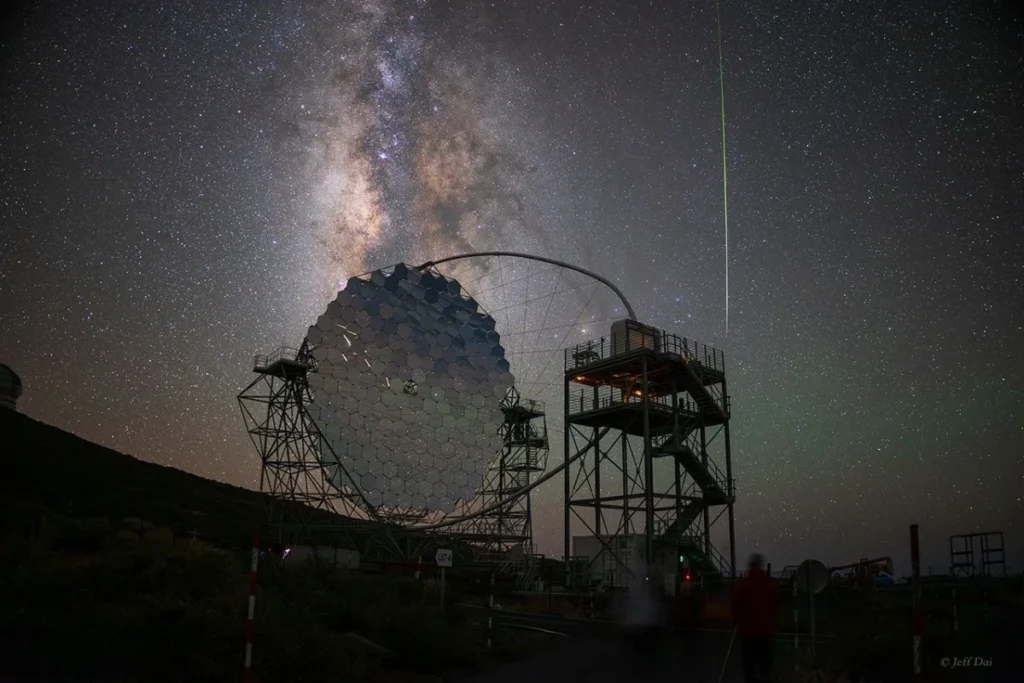
A spectacular celestial event, a brilliant Perseid meteor, blazed across the night sky over the Canary Islands on August 15th, creating a breathtaking tableau that also featured the majestic sweep of the Milky Way. Captured in a stunning photograph taken at the Observatorio del Roque de los Muchachos on La Palma, the meteor’s luminous trail cut through the darkness, framing the awe-inspiring band of our home galaxy. In the foreground, an imposing structure – the Large-Sized Telescope (LST-1) – stood as a sentinel, its segmented mirror reflecting not only the cosmic spectacle above but also the scientific endeavor to understand the universe’s most energetic phenomena.
A Fleeting Moment of Cosmic Wonder
The image, curated by NASA’s Astronomy Picture of the Day (APOD) initiative, immortalizes a fleeting moment that underscores the interconnectedness of celestial events and human scientific curiosity. The Perseid meteor, a common annual occurrence caused by Earth passing through the debris trail of Comet Swift-Tuttle, was particularly bright on this occasion, offering a dazzling display for observers. Its vibrant streak contrasted sharply with the deep black of the night sky, punctuated by the ethereal glow of billions of stars and the dark, intricate patterns of interstellar dust that define the Milky Way.
The Milky Way, visible in its full glory, provided a breathtaking backdrop. This colossal structure, containing an estimated 100 to 400 billion stars, showcases the vastness of our cosmic neighborhood. The photograph highlights its central band, where dense concentrations of stars and nebulae are most apparent, and where dark lanes of interstellar dust obscure the light, adding depth and drama to the view. These dust clouds are crucial nurseries for new stars, a testament to the ongoing cycle of creation and destruction in the galaxy.
The Guardian of Gamma Rays: LST-1 Takes Center Stage
Dominating the foreground of this celestial panorama is the impressive 23-meter diameter mirror of the Large-Sized Telescope (LST-1). This instrument is not merely an observer of passive cosmic beauty; it is a sophisticated tool designed to detect some of the most energetic and fleeting phenomena in the universe: gamma rays. LST-1 is the pioneering telescope for the Cherenkov Telescope Array (CTA) Observatory, a global project poised to revolutionize gamma-ray astronomy.
The LST-1’s mirror is composed of 198 hexagonal segments, meticulously arranged to focus faint light. Its primary function is to detect Cherenkov radiation, a brief flash of light produced when high-energy gamma rays interact with Earth’s atmosphere. These flashes, lasting mere nanoseconds, are triggered by incredibly energetic cosmic events emanating from distant sources such as active galactic nuclei (AGN) and gamma-ray bursts (GRBs). These GRBs are the most powerful explosions in the universe, thought to be associated with the collapse of massive stars or the merger of neutron stars.
The inclusion of LST-1 in the photograph is significant. It represents humanity’s relentless pursuit of knowledge, our drive to peer into the most extreme environments of the cosmos. While the meteor provided a spectacular, visible light show, LST-1 is designed to capture the invisible – the high-energy gamma rays that carry information about the most violent processes occurring light-years away. The fact that the mirror segments of LST-1 also reflected the atmospheric flash of the Perseid meteor is a poetic coincidence, a reminder that even the most advanced scientific instruments are subject to the same natural phenomena that inspire awe in all observers.
The Cherenkov Telescope Array: A New Era in Gamma-Ray Astronomy
The LST-1 is a crucial precursor to the full Cherenkov Telescope Array (CTA) Observatory, which will consist of two arrays: one in the Northern Hemisphere and another in the Southern Hemisphere. CTA is designed to be the most sensitive and highest-resolution gamma-ray observatory ever built. Its ambitious goal is to map the gamma-ray sky with unprecedented detail, investigate the nature of dark matter, explore the extreme physics of black holes and neutron stars, and unravel the mysteries of cosmic-ray origins.
The CTA will operate by detecting Cherenkov light using an array of telescopes of different sizes. The LSTs, like LST-1, are the largest telescopes in the array and are optimized for detecting lower-energy gamma rays. Smaller telescopes will be used to detect higher-energy photons. This multi-telescope approach allows CTA to cover a broad range of gamma-ray energies, providing a comprehensive view of the high-energy universe.

The site at the Observatorio del Roque de los Muchachos, where LST-1 is located, is one of the premier astronomical observing locations in the world. Its high altitude, clear skies, and low light pollution provide ideal conditions for astronomical observations. The development and deployment of CTA are a testament to international scientific collaboration, involving hundreds of scientists and engineers from institutions around the globe.
Background and Context of the Perseids
The Perseid meteor shower occurs annually between mid-July and late August, with its peak activity typically around August 11th-13th. The shower is named after the constellation Perseus, as the meteors appear to radiate from this part of the sky. The parent comet of the Perseids is Comet Swift-Tuttle, a large comet with an orbital period of about 133 years. As Earth traverses the debris trail left behind by this comet, small particles, often no larger than a grain of sand, enter our atmosphere at high speeds, burning up and creating the streaks of light we call meteors.
While the peak of the Perseid shower is generally around mid-August, meteors can be observed for several weeks. The bright meteor captured in the image on August 15th, though slightly past the typical peak, demonstrates that significant activity can still occur. The clarity of the sky in the Canary Islands would have significantly enhanced the visibility of this event, allowing for the capture of such a detailed and striking photograph.
Implications and Future Prospects
The image serves as a powerful reminder of the dual nature of astronomical observation: the awe-inspiring beauty of the cosmos and the scientific endeavor to understand its fundamental workings. The Perseid meteor, a natural spectacle, provided a visually stunning backdrop to the cutting-edge technology of LST-1. This juxtaposition highlights how both natural phenomena and human innovation contribute to our understanding of the universe.
The data gathered by LST-1 and the future CTA will undoubtedly lead to groundbreaking discoveries. By studying gamma rays, scientists can probe extreme environments that are inaccessible by other means. This could shed light on the nature of dark matter, the most abundant form of matter in the universe, which does not interact with light. It could also provide new insights into the physics of black holes, the engines of galaxies, and the origins of cosmic rays, the most energetic particles in the universe.
The APOD program itself plays a vital role in public outreach and education. By sharing stunning images like this one, accompanied by expert explanations, APOD inspires curiosity and fosters a greater appreciation for science and the universe we inhabit. The shift of APOD’s main NASA site to science.nasa.gov/apod signifies its continued commitment to making scientific discoveries accessible to a broad audience.
A Chronicle of Observation and Discovery
- July 15 – August 20 (Annually): The Perseid meteor shower is active, with peak activity typically around August 11th-13th.
- August 15 (Specific Date of the Image): A bright Perseid meteor streaks across the night sky over La Palma, Canary Islands, Spain. The image is captured, featuring the Milky Way and the LST-1 telescope.
- Ongoing: The LST-1 telescope continues its observations, detecting atmospheric Cherenkov flashes triggered by high-energy gamma rays from cosmic sources.
- Future: The full Cherenkov Telescope Array (CTA) Observatory will be completed, significantly enhancing humanity’s ability to observe the gamma-ray universe.
Supporting Data and Context
- Comet Parent: Comet Swift-Tuttle.
- Meteor Shower: Perseids.
- Location of Observation: Observatorio del Roque de los Muchachos, La Palma, Canary Islands, Spain.
- Telescope: Large-Sized Telescope (LST-1), prototype for the Cherenkov Telescope Array (CTA) Observatory.
- LST-1 Mirror Diameter: 23 meters.
- LST-1 Mirror Segments: 198 hexagonal segments.
- Detection Mechanism: Cherenkov radiation (visible light flashes produced by gamma rays interacting with the atmosphere).
- Target Phenomena: High-energy gamma rays from distant active galaxies and gamma-ray bursts.
- Duration of Cherenkov Flashes: Approximately one billionth of a second.
Official Announcements and Changes
NASA’s Astronomy Picture of the Day (APOD) has recently announced updates regarding image submissions and its primary web presence. The email address for submitting images to APOD has been changed, and users are directed to the updated submission guidelines available at https://apod.nasa.gov/apod/lib/apsubmit2015.html. Furthermore, APOD’s main NASA site is transitioning from its long-standing address at https://apod.nasa.gov/ to https://science.nasa.gov/apod. This move is part of a broader effort to consolidate NASA’s science-related content and enhance accessibility.
Broader Impact and Implications
This image and the accompanying narrative encapsulate the enduring human drive to explore the cosmos, from appreciating the sheer beauty of a meteor shower to building sophisticated instruments that probe the universe’s most energetic secrets. The Perseid meteor serves as a beautiful, ephemeral spectacle, a reminder of our place within a dynamic and active solar system. Simultaneously, the LST-1 represents our intellectual curiosity and our technological prowess, enabling us to unravel the complex and often violent processes that shape the universe on scales far beyond our immediate perception. The synergy between observing natural phenomena and advancing scientific instrumentation underscores the holistic approach to understanding our universe, where both wonder and rigorous inquiry play equally crucial roles.