The global semiconductor market is experiencing a robust upcycle as it progresses into the latter half of 2026, marked by sustained growth, increasing demand across critical applications, and a strengthening long-term outlook. This resurgence follows a period of market correction in 2023 and early 2024, where inventory adjustments and a softening of consumer demand led to a temporary slowdown. However, the current trajectory, highlighted by a revised market valuation and optimistic projections, signals a new era of expansion for the industry. While headline figures suggest a universally improving landscape, a deeper analysis reveals a complex terrain where growth is unevenly distributed, creating distinct challenges for product designers, component procurement teams, and program managers striving to avoid delays and secure essential parts.
A Broad Market Overview: The Semiconductor Upcycle Gathers Momentum
The semiconductor industry, often viewed as a bellwether for the broader technology sector, is firmly in an expansionary phase. Avnet Silica’s latest Q3 report underscores this positive shift, valuing the served-semiconductor market at an impressive $454 billion in 2026, a significant increase from its previous forecast of $433 billion. This upward revision reflects a stronger-than-anticipated recovery and robust underlying demand drivers. The report further projects substantial growth of 10.8% in 2027, pushing the market to $503 billion, with an anticipated climb to $584 billion by 2029. These figures are not indicative of a fleeting rebound but rather suggest a sustained period of expansion, a welcome development for an industry that faced considerable headwinds in the immediate post-pandemic period.
This upcycle is fundamentally different from the chaotic, demand-driven surge experienced during the peak of the COVID-19 pandemic, which was characterized by unprecedented lead times and widespread shortages across nearly all component categories. The current growth is more nuanced, propelled by strategic investments in cutting-edge technologies and the pervasive integration of semiconductors into an ever-widening array of applications. Key drivers include the exponential rise of artificial intelligence (AI), the accelerating transition to electric vehicles (EVs) and advanced driver-assistance systems (ADAS), continued expansion of industrial automation, and the ongoing digitalization across various economic sectors. However, this robust growth simultaneously introduces new layers of complexity, as the specific demands of these diverse applications translate into varied pressures on different semiconductor categories. For industry professionals, understanding the ‘where’ and ‘how’ of this growth is paramount to effective strategic planning.
Regional Dynamics: Europe’s Tentative Recovery Amidst Mixed Signals

While the global outlook brightens, regional performance remains varied, with Europe presenting a particularly interesting case study of mixed signals. The Eurozone manufacturing output index, a critical indicator of economic health, has shown encouraging signs, remaining in expansion for a fifth consecutive month in June and rising from 51.3 to 51.7. This performance has enabled the sector to achieve its strongest quarter since 2022, suggesting a gradual but discernible recovery after a period of uncertainty. This positive trend is a crucial development, as manufacturing forms the backbone of semiconductor consumption in the region.
However, a closer examination reveals that it would be premature to declare a broad-based recovery for European manufacturing. Several factors temper the optimism. Export demand across the Eurozone remains persistently weak, reflecting global economic uncertainties and geopolitical tensions. Furthermore, businesses are still actively drawing down existing inventories, a process that can temporarily mask true underlying demand. The International Monetary Fund (IMF) has also recalibrated its 2026 European Union (EU) growth forecast, reducing it from 1.1% to a more conservative 0.9%. This downward revision, even if slight, signals caution from leading economic institutions.
A critical aspect of current European demand patterns revolves around potential "brought-forward orders." There is evidence suggesting that some customers may have accelerated their procurement decisions to pre-empt possible future tariffs or to safeguard against further supply chain disruptions. Such tactical purchasing, while creating immediate semiconductor demand, does not necessarily reflect a fundamental increase in long-term consumption. This distinction is vital for procurement decisions; a sudden influx of orders might appear to signal sustained growth, but it could instead be a temporary surge driven by inventory rebuilding or strategic shifts in buying patterns. Suppliers must still respond to this immediate demand, which can paradoxically tighten availability even as the broader economic recovery remains fragile. Should domestic orders strengthen consistently and inventory levels stabilize over the coming quarters, Q2’s performance could indeed mark the beginning of a more robust European recovery. For now, the region is finding firmer ground, but comprehensive evidence for uniform market advancement is still developing.
Diversified Demand: Key Verticals Driving Growth
The current upcycle is characterized by growth emanating from several distinct industry verticals, each with unique technological requirements and market dynamics. In the Europe, Middle East, and Africa (EMEA) region, the automotive sector remains the largest semiconductor vertical, valued at a substantial $17 billion. This dominance is not surprising, given the profound technological transformation underway in the automotive industry. However, a notable shift is the increasing share of industrial applications in the regional market, rising from 25% to 27% and now valued at $12 billion. This expansion signifies that the recovery is broadening beyond automotive, with industrial demand becoming an increasingly significant contributor to regional semiconductor growth. It also highlights the far-reaching impact of macro trends such as growing electrification and enhanced autonomy within industrial operations.
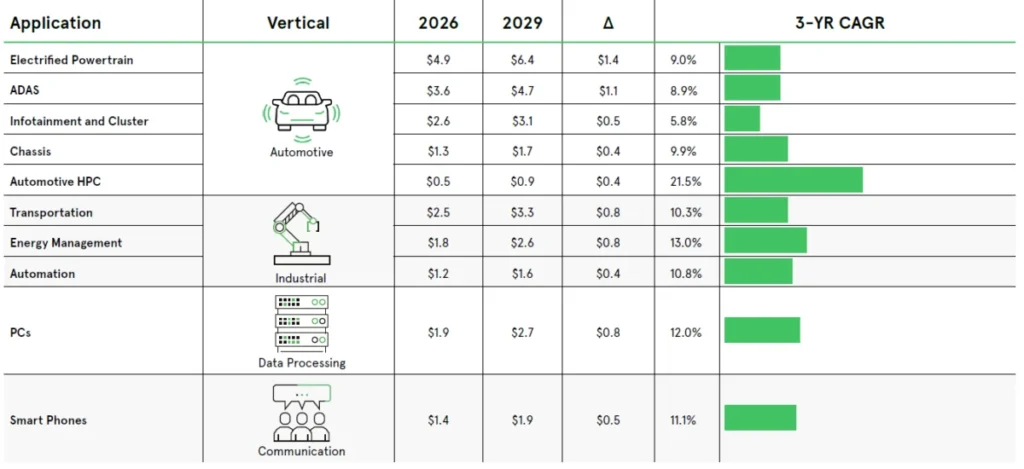
Within the automotive sector, high-performance computing (HPC) is projected to achieve an impressive three-year compound annual growth rate (CAGR) of 21.5%. This surge is directly linked to the rapid advancements in electrification, sophisticated advanced driver assistance systems (ADAS), and the emergence of software-defined vehicles (SDVs), all of which demand significantly increased processing capabilities. The tangible impact of this transition is already evident in vehicle sales data; battery-electric vehicles (BEVs) constituted 20.7% of new EU car registrations during the first half of 2026, a substantial increase from 15.6% just a year prior. This upward trend indicates a fundamental shift in vehicle production and consumer preference, underpinning long-term demand for power management ICs, microcontrollers, and various sensors.

Beyond automotive, other sectors are exhibiting strong growth trajectories. Energy management solutions are forecast to grow by 13.0% CAGR over three years, driven by global efforts towards energy efficiency, renewable energy integration, and smart grid technologies. The PC market, surprisingly resilient, is projected for 12.0% CAGR, benefiting from refresh cycles spurred by AI-enabled device requirements and evolving hybrid work models. Industrial automation is expected to grow by 10.8%, fueled by continued investment in smart factories, robotics, and the Internet of Things (IoT) for enhanced productivity and operational efficiency. These figures collectively illustrate that the semiconductor market’s expansion is not concentrated in a single sector but is a multi-faceted phenomenon, reflecting profound technological shifts across the global economy.
Emerging Availability Pressures: Beyond Headline Growth, Specific Component Challenges
While broader market growth is unequivocally positive, it concurrently reshapes the competitive landscape and introduces new pressures on supply chains. Automotive, industrial, computing, consumer electronics, and energy applications all rely on complex combinations of memory, processing units, sensing technologies, and power management components. When several of these critical markets accelerate in unison, the cumulative demand can quickly lead to pressure across component categories that might not initially seem interconnected.
Evidence of these emerging pressures is already becoming apparent. The latest Trendliner report highlights rising prices and extending lead times for various microprocessors (MPUs) and microcontrollers (MCUs), fundamental components across almost all electronic systems. Limited manufacturing capacity is also impacting the availability of certain specialized sensors, which are crucial for ADAS, industrial automation, and smart devices. Furthermore, lead times for many programmable logic devices (PLDs), essential for flexible and reconfigurable digital circuits, are approaching an alarming 52 weeks or more. This illustrates a critical paradox: an improving market does not necessarily translate into easier component procurement; in many cases, stronger demand can lead directly to tighter availability and increased supply chain fragility.
Artificial intelligence (AI) undeniably plays a significant role in this evolving landscape, particularly within the memory segment. The surging demand for High Bandwidth Memory (HBM), critical for AI accelerators and data centers, is profoundly influencing how semiconductor manufacturers allocate their advanced DRAM production capacities. This strategic prioritization of HBM is contributing to tighter conditions and increasing scarcity for established memory products such as DDR4, LPDDR4, and DDR5, which are still widely used in mainstream computing and embedded systems. Consequently, DDR4 and LPDDR4 are now frequently placed under allocation by manufacturers, meaning customers receive only a pre-determined portion of their requested volume, while general DRAM lead times have stretched to 26 weeks or even longer.
However, it is crucial to avoid attributing every supply constraint solely to AI. While AI’s influence is significant, other factors are at play. Lead times for NAND Flash, embedded MultiMediaCard (eMMC), and solid-state drives (SSDs) have also extended, but these technologies are being affected by a unique combination of supply-side constraints, evolving demand patterns, and product lifecycle management decisions. These could include shifts in manufacturing processes, consolidation among suppliers, or strategic decisions to prioritize newer generations of technology. Understanding these nuanced distinctions is paramount, as the appropriate response to a supply challenge depends entirely on its underlying cause. A blanket explanation risks misallocating resources and delaying effective solutions.

Strategic Imperatives for Industry Stakeholders: Proactive Planning and Collaboration
In this intricate market environment, effective market intelligence must transcend mere description and actively inform strategic decision-making. Engineering and procurement teams must first prioritize identifying components that pose disproportionate risks to their projects. This could involve a specialized device with limited alternative suppliers, an older memory generation approaching end-of-life (EOL) or facing significant lifecycle changes, or a critical part whose lead time could dictate the entire production schedule. By identifying these high-risk components early, engineers can strategically design for flexibility, incorporating compatible alternatives or modular architectures where feasible. Concurrently, procurement teams must diligently monitor supplier roadmaps, allocation statuses, and overall availability trends long before a design is finalized and production ramps up.
Visibility, however, is a two-way street. While customers benefit immensely from early and transparent supplier information, suppliers equally require a credible and stable view of customer demand. To foster this mutual understanding, demand forecasts should be shared proactively and updated frequently throughout the product development lifecycle. Once requirements become firm and production plans solidify, companies must commit to their needs as clearly and consistently as possible. In a constrained market, firm demand signals provide significantly greater visibility and confidence to manufacturers than tentative or fluctuating forecasts. This early planning and clear communication can be instrumental in securing manufacturing capacity and allocating resources before short-term availability issues escalate into critical constraints.
This is precisely where the strategic choice of a supplier and distribution partner becomes a critical differentiator. Partners such as Avnet Silica play an indispensable role by offering early visibility into evolving market conditions and impending lifecycle changes for components. They actively engage with manufacturers on behalf of their customers, advocating for forecast demand and assessing available capacity. Crucially, they empower engineers by helping them evaluate compatible alternative components and solutions, mitigating potential issues long before they impact production schedules. This synergistic combination of deep technical knowledge, privileged supplier access, and comprehensive commercial visibility is far more valuable than the reactive approach of scrambling for individual parts only after availability has tightened. Such partnerships enable a proactive approach, shifting the paradigm from crisis management to strategic foresight.
Looking Ahead: Navigating Future Volatility with Adaptability
The current semiconductor market trajectory, while largely positive, underscores an enduring truth about this vital industry: it is inherently dynamic and prone to volatility. The confluence of rapid technological innovation, evolving geopolitical landscapes, and the cyclical nature of demand and supply ensures that market conditions will continue to shift. For businesses operating within this ecosystem, the ultimate aim is to cultivate resilience. This involves maintaining strategic flexibility around the most vulnerable components in their bill of materials, establishing clear and credible visibility of genuine demand, and securing supply early through robust supplier relationships and long-term agreements. Simultaneously, it is crucial to avoid introducing unnecessary complexity or redundancy into supply chains, striking a delicate balance between security and efficiency. The ability to adapt, to anticipate, and to collaborate effectively will be the defining characteristics of successful players in the semiconductor market for the foreseeable future. The lessons learned from past shortages and the proactive strategies developed during this current upcycle will be instrumental in building more robust and responsive supply chains for the innovations yet to come.