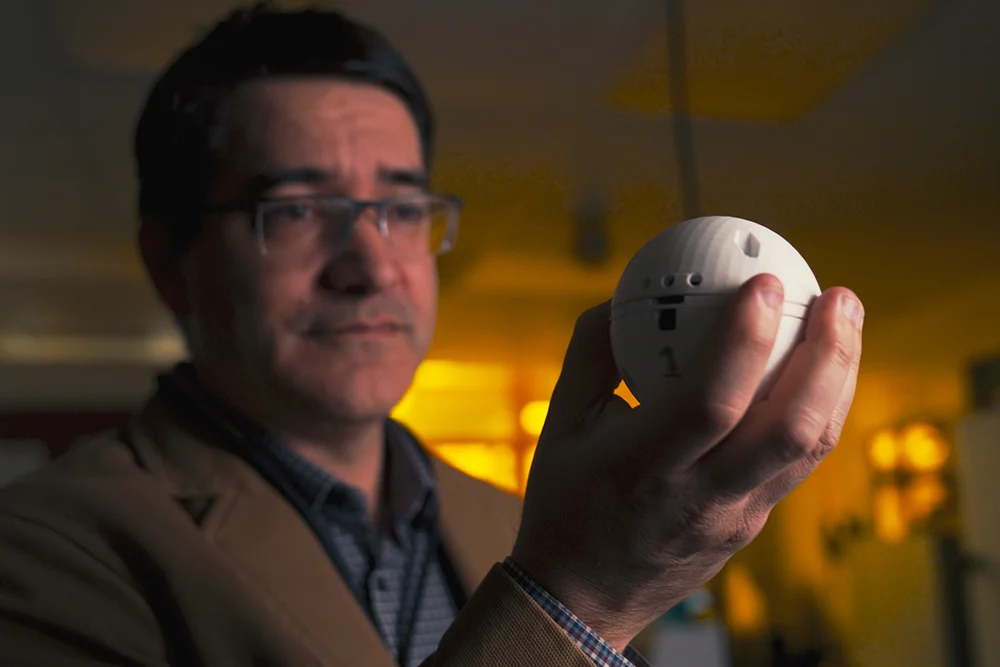
Researchers at MIT Lincoln Laboratory have unveiled a groundbreaking throwable sensor designed to provide critical early warnings of hazardous airborne substances. This innovative device, codenamed TOSSIT (Tactical Optical Spherical Sensor for Interrogating Threats), promises to significantly enhance the safety and operational capabilities of military personnel, first responders, and law enforcement agencies facing potential chemical threats.
A New Era in Chemical Threat Detection
The TOSSIT sensor, roughly the size of a baseball, represents a significant advancement in portable and deployable chemical detection technology. Its primary function is to swiftly identify the presence of dangerous vapors and aerosols, ranging from chemical warfare agents like nerve and blister agents to hazardous industrial chemicals released during accidents, and even dangerous airborne particulates such as fentanyl dust. This capability addresses a critical gap in current detection methods, offering a proactive approach to safeguarding individuals operating in potentially contaminated environments.
The operational concept behind TOSSIT is elegantly simple yet remarkably effective. The sensor can be deployed in a variety of ways, including being manually tossed into an area of concern, dropped from a drone, or even launched using specialized delivery systems. Once deployed, TOSSIT actively samples the surrounding air. Its core detection mechanism relies on an internal camera that monitors a removable dye card. This dye card is specifically engineered to undergo visible color changes when exposed to a predefined spectrum of chemical agents. The immediate visual alteration on the dye card provides a clear, albeit preliminary, indication of a potential threat.
Upon detecting a chemical signature, TOSSIT can relay this crucial information to users through a dedicated mobile application or trigger localized alarms directly on the sensor itself. This multi-faceted alert system ensures that personnel receive timely and actionable intelligence, allowing them to make informed decisions regarding their safety and operational procedures.
Addressing an Unmet Need in Threat Interrogation
The development of TOSSIT stems from a recognized deficiency in existing sensing technologies, particularly for certain types of threats. According to Principal Investigator Richard Kingsborough, "TOSSIT fills an unmet need, providing a low-cost sensing option for vapors and solid aerosol threats — think toxic dust particles — that would otherwise not be detectable by small deployed sensor systems." This highlights the device’s unique ability to identify not only gaseous threats but also finely dispersed solid particles that can pose significant health risks.
The implications of this capability are far-reaching. In military scenarios, TOSSIT could be deployed ahead of ground troops to assess the potential for chemical attacks, enabling commanders to adjust tactics and protective measures accordingly. For first responders, it offers a vital tool for evaluating the safety of sites affected by industrial accidents, chemical spills, or incidents involving the illicit production of hazardous substances. Law enforcement agencies could utilize TOSSIT to identify and mitigate risks associated with the handling of dangerous drugs like fentanyl, which can become aerosolized and pose a severe inhalation hazard.
Rigorous Testing and Transition to Operational Use
The journey of TOSSIT from concept to deployment has been marked by extensive validation. Researchers have subjected the device to rigorous field testing, simulating a wide range of operational conditions and threat scenarios. This comprehensive testing regimen has been crucial in verifying the sensor’s reliability, accuracy, and durability. The successful outcomes of these trials have paved the way for the technology’s transition into operational use, with the U.S. military actively pursuing its integration into existing defense systems.
The transfer of this technology to the military signifies a significant endorsement of TOSSIT’s effectiveness and its potential to bolster national security. This process typically involves further refinement, scaling of production, and integration into existing logistical and command structures. The speed at which this transition is occurring underscores the urgent need for such advanced detection capabilities.
Technical Underpinnings and Future Potential
While specific technical details regarding the dye card chemistry and the internal imaging system are proprietary, the fundamental principle of colorimetric detection is well-established. This method relies on chemical indicators that react with specific analytes, producing a visible color change. The sophistication of TOSSIT lies in its miniaturization, portability, and the integration of an optical system capable of reliably interpreting these color shifts. The development of a removable dye card also suggests a modular design, potentially allowing for the customization of the sensor to detect different classes of chemicals by simply swapping out the card.
The "baseball-sized" spherical design offers several advantages. Its form factor makes it aerodynamic for throwing and suitable for deployment from various platforms. The spherical shape may also contribute to omnidirectional air sampling, ensuring that it can detect threats from any direction. The low-cost aspect mentioned by Kingsborough is particularly important for widespread adoption, enabling the deployment of multiple sensors for comprehensive area coverage without prohibitive expense.
The app-based alert system further enhances its usability. This digital interface can provide users with more detailed information, such as the estimated concentration of the detected substance (depending on the sophistication of the calibration), the type of chemical identified, and recommended actions. The integration with a mobile platform also allows for data logging and potential networking of multiple sensors, creating a distributed sensing network that can map the spread and concentration of airborne hazards in real-time.
Broader Implications and Societal Impact
The TOSSIT device has the potential to revolutionize safety protocols across a multitude of sectors. Beyond its military and first responder applications, consider its impact on industrial safety. In chemical plants, oil refineries, or pharmaceutical manufacturing facilities, TOSSIT could serve as an early warning system for accidental releases, allowing for immediate evacuation and containment procedures, thereby minimizing risk to workers and surrounding communities.
In the realm of public health and emergency management, TOSSIT could be deployed during natural disasters that may involve the release of hazardous materials, such as floods inundating chemical storage sites or wildfires burning through areas with industrial contamination. Its ability to quickly assess air quality in disaster zones would be invaluable for guiding rescue efforts and ensuring the safety of both responders and displaced populations.
The ongoing opioid crisis also presents a significant application for TOSSIT. The increasing prevalence of fentanyl and its analogues, which are potent and easily aerosolized, poses a severe risk to law enforcement officers, paramedics, and public health officials involved in drug interdiction and overdose response. TOSSIT could provide a critical layer of protection, alerting personnel to the presence of airborne fentanyl particles before exposure occurs.
Future Research and Development
The success of TOSSIT is likely to spur further innovation in the field of portable chemical sensing. Future iterations of the device could incorporate:
- Enhanced Specificity: Development of dye cards or sensor elements capable of distinguishing between a wider range of specific chemicals with greater precision.
- Quantitative Analysis: Integration of sensor technology that can provide quantitative measurements of chemical concentrations, rather than just qualitative detection.
- Extended Range and Endurance: Improvements in battery technology and communication systems to enable longer deployment times and greater standoff detection distances.
- Advanced Data Fusion: Integration with other sensor platforms (e.g., radiation detectors, biological sensors) to provide a more comprehensive threat assessment.
- AI-Powered Interpretation: Utilization of artificial intelligence to analyze sensor data, predict threat patterns, and provide more sophisticated decision support.
The development of TOSSIT by MIT Lincoln Laboratory represents a significant stride forward in our ability to detect and respond to chemical threats. By providing a low-cost, deployable, and user-friendly solution, this innovative sensor promises to enhance the safety and effectiveness of those on the front lines of critical operations, ultimately contributing to a safer environment for all. The successful transition of this technology to military use marks a pivotal moment, signaling a new era of proactive threat detection and response.