The global demand for advanced energy storage solutions is accelerating at an unprecedented pace, driven by the burgeoning electric vehicle (EV) market, the rapid expansion of renewable energy infrastructure, and the increasing reliance on high-power digital technologies. While lithium-ion batteries currently dominate these sectors, their reliance on critical minerals like lithium, cobalt, nickel, and graphite — minerals considered vital for economic and national security and thus susceptible to supply chain disruptions — presents a significant vulnerability. This escalating need for energy storage systems that are not only cost-effective and abundant in resources but also capable of rapid charging and discharging has spurred innovation, with researchers at the Massachusetts Institute of Technology (MIT) making significant strides in developing complementary solutions.
A team of scientists at MIT, spearheaded by Ju Li, the Carl Richard Soderberg Professor of Power Engineering in the departments of Nuclear Science and Engineering (NSE) and Materials Science and Engineering, is at the forefront of this research. Their focus is particularly on sodium-metal batteries, a promising alternative that offers several compelling advantages. Sodium, for instance, is approximately 1,000 times more abundant than lithium and, on a pound-for-pound basis, costs roughly one-hundredth as much. However, a persistent challenge has been the high reactivity of sodium metal, which has historically made it difficult to achieve both long-term battery stability and rapid cycling capabilities.
Addressing the Electrolyte Dilemma: A Novel Approach to Sodium-Metal Batteries
A recent groundbreaking study, published in the esteemed journal Joule, details a significant advancement by 15 members of the MIT team. This research unveils a novel approach to overcoming the inherent instability of sodium-metal batteries by identifying the optimal electrolyte composition. The electrolyte, one of the three fundamental components of any battery alongside the anode (negative electrode) and cathode (positive electrode), acts as the crucial medium for ion transport. It facilitates the movement of electrically charged ions between the electrodes, enabling the battery’s electrochemical reactions.
"The electrolyte is supposed to just transmit those ions," explained Professor Li. "It’s supposed to be an ion conductor." However, a common problem encountered in battery technology is the tendency of electrolytes to engage in unwanted chemical reactions with the electrodes. These "side reactions" can severely compromise a battery’s stability and lifespan.
Weiyin Chen, a postdoctoral researcher in NSE and one of the lead authors of the Joule paper, elaborated on the detrimental effects of these side reactions. "Insoluble compounds produced during the reactions can build up on the electrodes, creating a barrier that blocks ion transport and can eventually cause the battery to fail," Chen stated. For rechargeable batteries to achieve a long cycle life, stability at both the anode and cathode is paramount. Until recently, a fully stable electrolyte for sodium-metal batteries that could withstand these reactions at both electrodes remained elusive.
A History of Innovation and the Search for Stability
The journey toward this breakthrough began in 2021 when Professor Li’s group and their collaborators identified a "sulfonamide" molecule. This molecule, composed of sulfur, oxygen, and nitrogen atoms, proved to be exceptionally stable when used as a solvent in lithium batteries. "It is magically stable at both electrodes in lithium batteries," Professor Li remarked, referring to the molecule, known as DMTMSA.
Building upon this significant discovery, Li and his colleagues turned their attention to exploring whether related molecules could enhance the performance of sodium batteries. Their objective was twofold: not only to achieve the crucial electrolyte stability but also to enable the rapid charging and discharging capabilities essential for practical applications. Slow charging times, which can extend to overnight recharging, and sluggish discharging rates, which limit power delivery when needed most, are significant drawbacks for any energy storage system.
The Analogy of the Crowded Street: Optimizing Ion Transport
To explain the complex challenge of balancing stability with speed, Chen offered an insightful analogy. Imagine trying to navigate a street packed with pedestrians, much like ions traversing between battery electrodes. "You can move more quickly through the crowd with a small backpack that is snug against your body, rather than dragging a bulky suitcase on wheels," Chen suggested.
This analogy directly applies to battery electrolytes. When sodium ions are surrounded by smaller solvent molecules, they can move more rapidly than when enveloped by larger, bulkier solvents. This enhanced ion mobility directly translates to faster charging and discharging rates. Therefore, the research team’s primary goal was to identify solvent molecules that were sufficiently small to facilitate rapid ion transport while simultaneously maintaining the critical electrolyte stability.
However, a complicating factor arises from a common trade-off in battery chemistry: increased conductivity often correlates with a higher propensity for electrolytes to react with electrodes, thus shortening battery life. Professor Li noted that "reducing the size of solvents provides a new pathway to overcome this trade-off." This insight guided their subsequent research efforts.
Harnessing AI and Molecular Design for a Superior Solvent
The critical question then became how to identify a smaller solvent molecule that possessed the necessary stability and other desirable properties. The researchers adopted a strategy of searching for molecules that were "congeneric," meaning they belonged to a similar chemical family and were structurally related. Specifically, they focused on molecules similar to DMTMSA, with the hope of discovering candidates that were smaller yet retained the exceptional stability that made DMTMSA so promising.
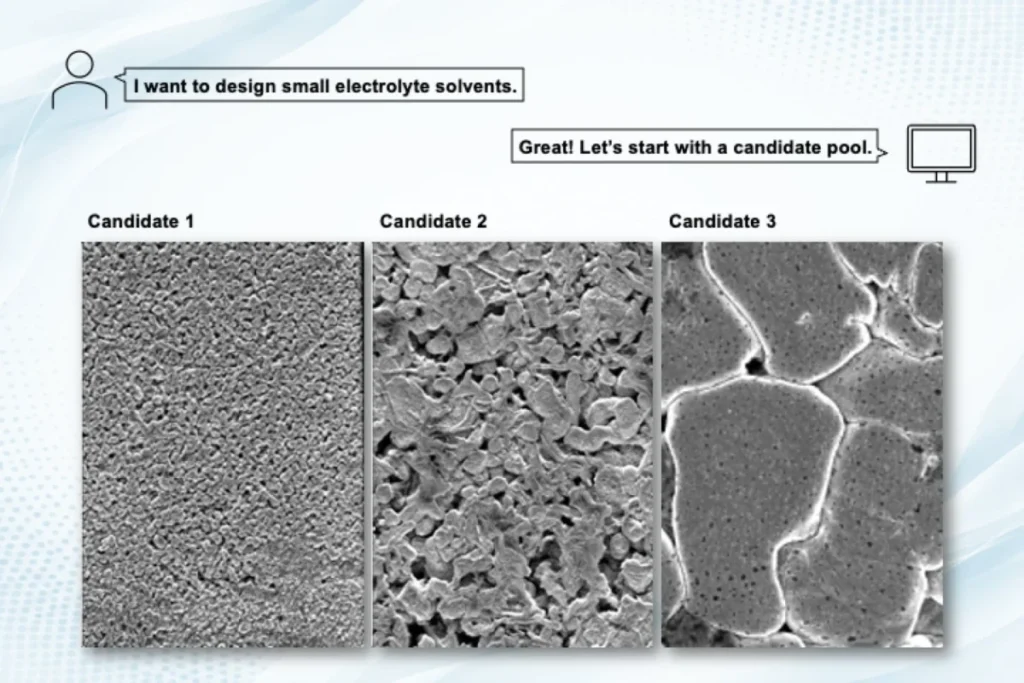
To accelerate this search, Chia-Wei Hsu, an MIT PhD student in materials science and engineering, developed an AI-guided algorithm. This innovative tool was capable of designing approximately 100,000 candidate molecules on his computer within a mere 24 hours. Hsu then meticulously narrowed down this extensive pool to 200 candidates by applying a stringent set of technical criteria, including structural similarity to DMTMSA and comparable electronic properties. From this refined list, 27 representative candidates, spanning the full spectrum of possibilities, were selected for rigorous experimental testing.
"We tested them all under the same conditions to make it a fair, head-to-head competition," Chen stated. The experimental results revealed a clear frontrunner: a solvent designated as DMFSA. This molecule emerged as the smallest and, crucially, the most effective in meeting the team’s performance benchmarks.
Broader Implications: A New Paradigm for Electrolyte Design
The significance of this research has been acknowledged by independent experts. Jinhyuk Lee, an associate professor of materials engineering at McGill University, who was not involved in the study, commented on its impact. "This work addresses one of the most persistent challenges in battery research: improving battery performance at high charging and discharging rates without sacrificing long-term stability," Lee observed. He further added, "By carefully tailoring the size of solvent molecules, the authors demonstrate a new design strategy that could enable lower-cost, higher performance batteries."
The MIT team is not resting on their laurels. A new research phase is already underway to identify even more superior solvents. This ongoing effort employs a similar methodology, but with DMFSA, rather than the larger DMTMSA molecule, serving as the new starting point. Chen expressed optimism that the novel solvents they are discovering could ultimately lead to rechargeable sodium-metal batteries that successfully combine the advantages of low-cost, abundant materials with fast charging and high-power performance, thereby unlocking a wider array of energy storage applications.
The overarching ambition of this research, as emphasized by the authors, extends beyond the advancement of sodium batteries. It aims to introduce a fundamentally new approach to electrolyte design, one that prioritizes solvent size and molecular similarity as guiding principles. By viewing sodium-metal batteries as a model system, this research establishes a more general design philosophy applicable to a broad range of future energy storage technologies.
"Because the concept is broadly applicable," Professor Li concluded, "its impact could extend well beyond sodium batteries and influence the design of a wide range of future energy storage technologies."
Funding and Infrastructure Support
This pioneering work was made possible through crucial financial support, including a grant from the National Research Foundation of Korea, funded by the government of South Korea, and a graduate research fellowship from the U.S. National Science Foundation. The advanced characterization equipment utilized in this project was partly provided by the MIT.nano Characterization Facilities, underscoring the importance of state-of-the-art research infrastructure in driving scientific discovery. The successful publication in Joule represents a significant milestone, marking a critical step forward in the quest for next-generation energy storage solutions.