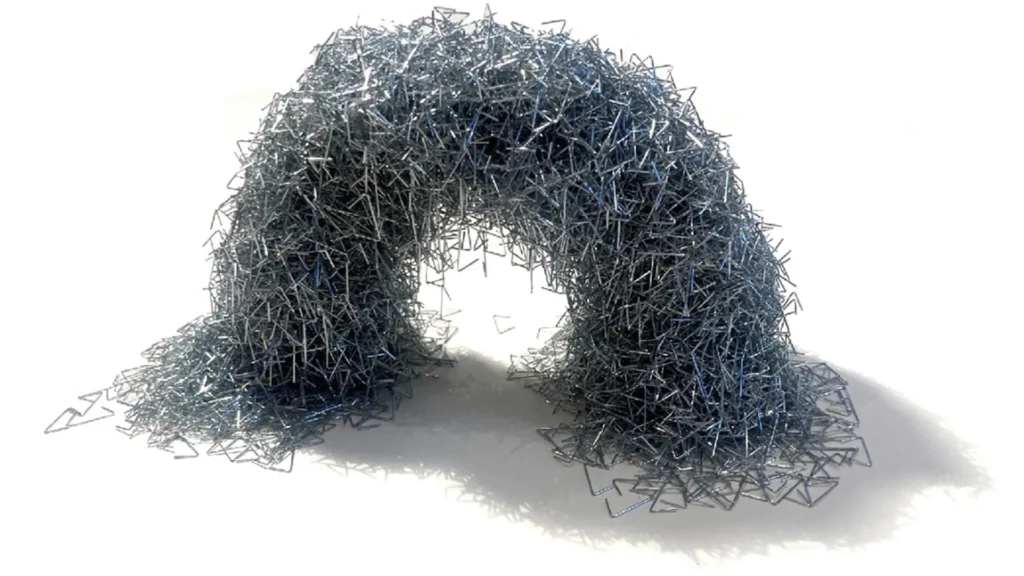
A tightly compressed bundle of office staples, seemingly mundane, can exhibit a surprising duality: immense resistance to separation, behaving almost as a single solid, yet possessing the latent ability to quickly unravel into its individual components. This fascinating paradox, observed in everyday objects, has inspired a groundbreaking research initiative at the Paul M. Rady Department of Mechanical Engineering at CU Boulder, which is now poised to revolutionize material science. Researchers there believe this unique combination of robust strength and instantaneous reversibility could be the foundational principle for a new generation of engineered materials, capable of adapting, strengthening, and even disassembling on demand. By meticulously designing particles that interlock in a manner akin to staples, the team aims to forge materials that are not only exceptionally strong and adaptable but also inherently recyclable, addressing critical sustainability challenges in various industries.
"We’ve been playing around with the idea of building blocks and geometry for many years, but we started looking at interlocking, entangled particles only recently," stated Professor Francois Barthelat, who leads the Laboratory for Advanced Materials & Bioinspiration. "We are excited about the combination of properties we can get out of these systems, and we believe this technology has the potential to go in many directions." The initial findings of this promising research were formally published in the esteemed Journal of Applied Physics, drawing attention to a novel approach in material design that leverages the pervasive yet often overlooked phenomenon of entanglement.
The Enigma of Entanglement: A Deep Dive into Granular Mechanics
At the heart of this innovation lies the principle of entanglement, a state where individual particles become intricately intertwined, forming a network of physical connections. This phenomenon is far from new; it is a fundamental aspect of strength and structure observed throughout the natural world. Consider a bird’s nest, for instance: its remarkable structural integrity, despite being composed of disparate twigs and fibers, stems from their complex, interwoven arrangement. Similarly, human bones derive their impressive strength not just from the hardness of their mineral components but equally from the intricate interaction and entanglement with softer protein matrices.
However, replicating this natural efficiency in manufactured materials has presented significant challenges. Conventional granular materials, such as sand, consist of smooth, convex-shaped grains. While they can form piles and resist compressive forces, they inherently lack the ability to interlock or entangle with one another. This absence of inter-particle connection limits their collective strength and makes them behave more like a fluid than a solid under certain stresses. The CU Boulder team recognized this critical distinction, understanding that if synthetic materials could mimic natural entanglement, their mechanical properties could be drastically enhanced.
Their research thus pivoted to understanding how similar principles could be harnessed to create novel manufactured materials. The work quickly pointed to one crucial factor as the determinant of entanglement: the precise shape of the particles themselves. "Let’s take sand as an example. Sand is smooth and convex-shaped, meaning it cannot interlock from grain to grain," explained PhD student Youhan Sohn. "However, we found that if we change the shape of a grain of sand, we can drastically affect its behavior and mechanical properties, including the particle’s ability to link with other particles." This insight became the guiding principle for their subsequent investigations, shifting the focus from the material composition to its geometric architecture.
The CU Boulder Breakthrough: From Theory to Tangible Innovation
The journey to this discovery began with a robust theoretical framework, followed by rigorous computational modeling, and finally, experimental validation. The team’s initial phase involved conceptualizing various particle geometries that could potentially facilitate entanglement. They then employed Monte Carlo simulations, a powerful computational technique widely used in physics and engineering. These simulations allowed the researchers to model and predict the interactions of millions of particles with different shapes under various conditions. By iteratively testing numerous geometric designs in a virtual environment, they could efficiently identify geometries that maximized entanglement efficiency without the need for extensive physical prototypes. This method significantly accelerated the discovery process, allowing them to pinpoint promising designs with high precision.
Chronology of Discovery:
- Early Conceptualization (Years Prior): The team, led by Professor Barthelat, had long explored the fundamental principles of building blocks and their geometric influence on material properties.
- Shift to Entanglement (Recent Focus): The specific investigation into "interlocking, entangled particles" began more recently, driven by the potential for novel properties.
- Computational Modeling (Ongoing Phase): Monte Carlo simulations were extensively used to explore a vast parameter space of particle shapes, identifying those most conducive to entanglement. This phase was crucial for down-selecting viable candidates.
- Experimental Validation (Current Phase): Promising designs identified through simulation were then fabricated and subjected to real-world tests, such as "pickup tests," to confirm their behavior.
- Future Exploration (Next Steps): The team is currently advancing to more complex particle geometries, such as multi-legged designs, to further enhance entanglement properties.
Following the identification of several promising designs through simulation, the team moved to the experimental phase, conducting "pickup tests" to directly observe how the particles behaved under tangible conditions. The results from these real-world experiments were compelling and confirmed the predictive power of their simulations.
The Revelation of the "Two-Legged" Particle: Strength Meets Reversibility
The pickup tests conclusively revealed that a specific "two-legged" particle design, remarkably similar in form to a common office staple, produced the highest degree of entanglement. This staple-like shape proved to be exceptionally effective at intertwining with its counterparts, forming a robust and cohesive mass. What truly set this design apart, however, were the unexpected benefits it offered, particularly its ability to simultaneously achieve both high tensile strength and toughness.
In conventional materials science, these two properties are often in opposition, representing a classic engineering trade-off. Tensile strength refers to a material’s ability to withstand forces that pull it apart without breaking. Toughness, on the other hand, describes a material’s capacity to absorb energy and deform plastically without fracturing. A material designed for high strength might be brittle, while a tough material might lack the stiffness or resistance to deformation. The staple-like particles defied this conventional wisdom. "Our entangled granular material using the staple-like particle demonstrates both high strength and toughness at the same time," noted PhD student Saeed Pezeshki, highlighting a significant leap in material design capabilities. This synergistic combination implies a material that can not only resist significant pulling forces but also absorb impact energy and deform without catastrophic failure, making it ideal for a wide range of demanding applications.
Beyond this impressive mechanical performance, the staple-like particles displayed another extraordinary characteristic: rapid reversibility. They could quickly coalesce into a strong, entangled structure and then, just as swiftly, separate again into a loose collection of individual pieces. This dynamic control over the material’s state is achieved through the application of specific vibration patterns. Gentle vibrations encourage the particles to interlock, strengthening the material by increasing the degree of entanglement. Conversely, stronger, higher-frequency vibrations cause the intertwined network to unravel, allowing the particles to separate and the material to become fluid-like.
"It’s a strange material because it’s obviously not a liquid. However, it’s also not quite solid. This opens new and intriguing engineering possibilities," Professor Barthelat remarked, emphasizing the unique nature of these "quasi-solid, quasi-liquid" materials. He added, "Handling a bundle of these entangled particles feels very remote and exotic," underscoring the novelty of interacting with a material that can fundamentally alter its mechanical state with such ease and speed. This capability places these staple-like particles at the forefront of active materials research, a field dedicated to designing materials that can respond to external stimuli by changing their properties.
Broader Horizons: Implications for a Sustainable Future
The potential applications of this reconfigurable material technology span multiple sectors, with profound implications for sustainability, manufacturing, and advanced robotics.
-
Revolutionizing Construction and Infrastructure:
The construction industry is a major contributor to global waste, with demolition debris accounting for a significant portion of landfill content. For instance, in the United States alone, construction and demolition (C&D) waste generated nearly 600 million tons in 2018, more than twice the amount of municipal solid waste. Traditional construction materials like concrete and steel, while durable, are often energy-intensive to produce and challenging to recycle effectively at the end of their service life.The CU Boulder research offers a visionary alternative. Imagine bridges, buildings, and other large structures constructed using entangled materials that can be easily "unbuilt" rather than demolished. At the end of a structure’s functional lifespan, instead of incurring massive costs and environmental damage through demolition, the entangled components could simply be disentangled using specific vibrations. These separated particles could then be fully reused in new construction projects or recycled into fresh materials, aligning perfectly with the principles of a circular economy. This paradigm shift could dramatically reduce construction waste, lower the environmental footprint of infrastructure development, and conserve valuable resources. The ability to disassemble and reconfigure structures would introduce unprecedented flexibility into urban planning and material management.
-
Advancements in Robotics and Adaptive Systems:
The concept of dynamically reconfigurable materials also holds immense promise for the field of robotics, particularly in areas like swarm robotics and soft robotics. "I was talking with other students who believe this technology can be used in swarm robotics – where small robots can entangle, do a task and then disentangle when they are done," Pezeshki explained. This envisions scenarios where numerous small, modular robots could link together to form larger, stronger structures for specific tasks, such as lifting heavy objects or traversing complex terrain, and then separate to perform individual functions or navigate confined spaces.Professor Barthelat drew a vivid analogy to popular science fiction, stating, "Yes, kind of like that liquid metal T-1000 in Terminator 2 who can change shape to slide under a door and then transform back to a human’s size on the other side." While acknowledging the significant challenges of scaling such technology and the current costs involved, he affirmed that "it’s expensive and scaling up is a challenge, but it’s something that’s on everybody’s mind." Beyond swarm robotics, these materials could enable the creation of highly adaptive tools, reconfigurable manufacturing jigs, or even components for soft robots that can change their stiffness and shape to interact safely with delicate objects or navigate unpredictable environments. The ability to transition between rigid and compliant states on command opens up a plethora of possibilities for robots with enhanced dexterity and versatility.
-
Other Potential Applications:
The implications extend further to adaptive protective gear, dynamically adjustable acoustic dampening materials, or even smart packaging that can conform to different product shapes. The underlying principle of controlled entanglement could also inspire innovations in energy absorption systems, where materials can stiffen upon impact and then relax, offering novel approaches to shock protection.
The Road Ahead: Evolving Particle Designs and Future Research
The CU Boulder team is not resting on its laurels; they are already progressing into the next phase of their ambitious research agenda. Their latest experiments are focused on developing even more advanced particle designs, specifically those that incorporate additional protruding "legs." These multi-legged particles are conceptually compared by the researchers to the spiky burrs found in nature – those tenacious seed pods that cling stubbornly to clothing and animal fur. The hypothesis is that these added features will create even stronger entanglement effects, further enhancing the material’s mechanical properties and unlocking new possibilities for future materials.
However, several challenges lie ahead. Scaling up the production of these intricately shaped particles from laboratory prototypes to industrial quantities will require innovative manufacturing techniques, potentially involving advanced additive manufacturing or micro-fabrication processes. Cost-effectiveness will also be a critical factor in determining widespread adoption. Furthermore, comprehensive research into the long-term durability, fatigue resistance, and performance of these materials under various environmental conditions (temperature, humidity, chemical exposure) will be essential before commercialization. The scientific community and industrial partners will keenly watch as CU Boulder continues to push the boundaries of what materials can do, cementing its position at the forefront of this emerging and transformative field.
Conclusion
The work emanating from the Paul M. Rady Department of Mechanical Engineering at CU Boulder represents a significant stride in materials science, offering a compelling vision for a future where materials are not static but dynamic, reconfigurable, and inherently sustainable. By drawing inspiration from the deceptively simple behavior of office staples and leveraging the fundamental principles of entanglement, Professor Barthelat and his team have unveiled a material system that combines unprecedented strength with remarkable reversibility. This breakthrough has the potential to fundamentally redefine how we design, construct, operate, and ultimately recycle materials in the 21st century, paving the way for more efficient, adaptable, and environmentally responsible solutions across numerous industries. The "exotic" feel of handling a bundle of these entangled particles hints at a future where our built environment and robotic companions are as flexible and resilient as nature itself.