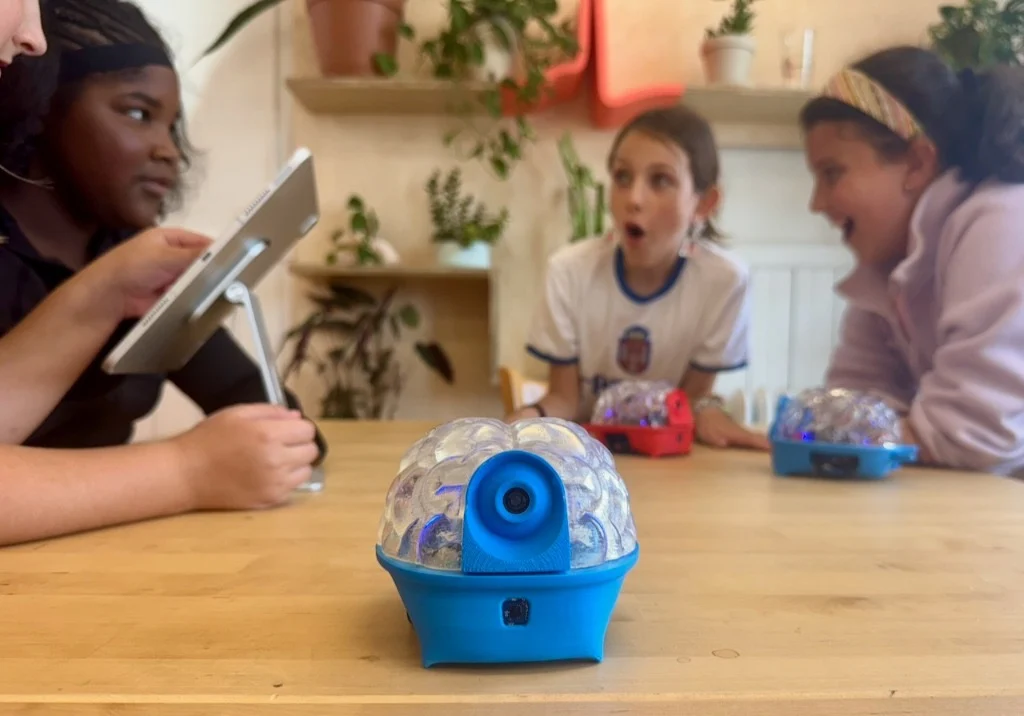
Backyard Brains, a pioneer in accessible neuroscience education, has unveiled SpikerBot, an innovative educational robot designed to demystify the complexities of brain function and robotics through an intuitive, neuron-based programming interface. Launched via a successful Kickstarter campaign set to conclude on June 14, 2026, SpikerBot offers a novel approach to learning engineering and neuroscience, allowing users to program "life-like behaviors" without traditional code. This initiative aims to bridge a critical gap in neuroscience education, enabling students of all ages to grasp how networks of neurons generate intelligence and behavior.
A New Paradigm in Robotics and Neuroscience Education
Traditional robotics often introduces learners to abstract concepts of computer logic, such as if-then statements and sequential programming, which can be a significant barrier to entry for beginners. SpikerBot, developed by Backyard Brains Co-Founder & CEO Greg Gage and Designer Alex Hatch, fundamentally redefines this learning curve. Instead of lines of code, users interact with a visual application that allows them to construct "sketches" entirely out of virtual neurons, synapses, and sensory inputs. This innovative interface emphasizes the emergent properties of neural circuits, mirroring biological intelligence. As the creators articulate, "there’s no code, no LLMs, just neurons, synapses, and behavior emerging from a circuit a kid designed." This philosophy resonates deeply with the principles outlined in Valentino Braitenberg’s influential 1984 book, Vehicles: Experiments in Synthetic Psychology, which demonstrates how surprisingly complex and seemingly "intelligent" behaviors can arise from simple, direct connections between sensors and motors. SpikerBot embodies this concept, allowing the robot to respond directly to its environment, with intricate behaviors emerging from the most basic neural configurations.
Bridging the Neuroscience Literacy Gap

A significant motivation behind SpikerBot is addressing a pervasive issue in science education: the fragmented learning of neuroscience. While elementary school curricula often introduce the basic function of a single neuron, the continuity of this learning thread is frequently lost until advanced collegiate studies, where students might explore the intricate workings of millions of interconnected neurons. This creates a vast educational chasm, akin to understanding a single transistor but lacking any knowledge of electronics before attempting to program in Python. Backyard Brains seeks to eliminate this "neuroscience illiteracy" by providing a tangible, interactive platform for understanding intermediate neurological concepts. By engaging with SpikerBot, students can organically progress from grasping individual neural components to comprehending how small networks generate observable behaviors, fostering a deeper, more continuous understanding of the brain. This hands-on approach is crucial, as studies consistently show that experiential learning significantly enhances retention and comprehension in STEM fields.
The Innovative Neuron-Based Programming Language
The core of SpikerBot’s innovation lies in its unique programming environment. Users program the robot by dragging and connecting virtual neurons and axons on a screen, much like patching cables on a modular synthesizer. This visual, holistic approach allows users to view the entire neural circuit at once, promoting a more intuitive understanding of how different components interact. Unlike traditional text-based coding, where changes often require compilation and uploading, SpikerBot boasts instantaneous feedback. Modifying a neuron from excitatory to inhibitory, for instance, yields immediate, observable changes in the robot’s behavior, fostering a rapid cycle of experimentation and discovery. This immediacy keeps learners engaged and encourages iterative design, crucial for scientific exploration.
This unconventional programming method creates an interesting inversion of difficulty. Behaviors that are notoriously complex for beginner robotics — such as a robot following a person – become remarkably straightforward to implement with just a few neurons. Conversely, tasks that are trivial in traditional computer logic, like counting in binary, transform into intricate webs of neural connections within SpikerBot’s paradigm. This contrast highlights the fundamental differences between biological and digital computation, offering profound insights into the nature of intelligence itself. The focus on natural, emergent behaviors and intuitive interaction is designed to sustain engagement longer than conventional robotics kits, allowing users to incrementally build complex "personalities" for their bots, starting from simple reactive movements.
Grounded in Science and Expert Feedback

The development of SpikerBot’s app and hardware was a collaborative effort, incorporating feedback from both child educators and professional neuroscientists. This ensures that while the learning experience is accessible and fun, it remains scientifically accurate and pedagogically sound. SpikerBot comes with a library of sample brain models, allowing users to deconstruct, modify, and learn from pre-built circuits. Through this process, users can discover fundamental neurological patterns such as recurrent pairs (essential for memory and sustained activity) and lateral inhibition (key for sensory processing and distinguishing stimuli), gaining practical insight into how working memory and other cognitive functions operate.
Beyond its core functionality, SpikerBot supports peripherals, including Backyard Brains’ existing Spiker:bit board. This expandability allows users to integrate bio-signal inputs, such as muscle signals from their own arm, to control their robot, creating a direct, embodied connection to neuroscience principles. Such integrations further blur the lines between human biology and artificial systems, offering unparalleled opportunities for interdisciplinary learning.
The SpikerBot Hardware: A Brain on Wheels
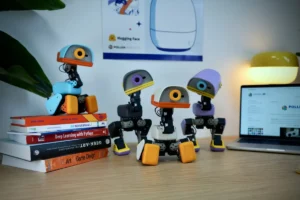
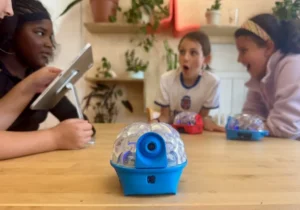
The physical embodiment of SpikerBot’s intelligence is a brain-shaped robot, deliberately modeled after Backyard Brains’ distinctive logo. This chassis is equipped with a comprehensive array of sensors, including a camera, a microphone, and a distance sensor, enabling it to perceive and react to its real-world environment. Beyond its sensory capabilities, SpikerBot features carefully crafted lights and sounds designed to emulate natural, biological responses. The lights glow and fade like bioluminescent cells, and the sound effects are described as charming and quirky, contributing to the robot’s endearing, life-like personality.
The hardware also incorporates practical design elements, such as connection points for 3D-printed attachments. This feature encourages personalization and creativity, allowing owners to customize their bot’s appearance and functionality to match its emerging "personality," whether it’s a dragon-like creature or a feline companion. The provided images showcase examples like a "SpikerBot cat" reacting to a real cat and tracking a ball of yarn, or a "SpikerBot dragon" formed through customized neural circuits and physical attachments.

Backyard Brains: A Legacy of Democratizing Neuroscience
Backyard Brains, co-founded by Greg Gage and Tim Marzullo, has a strong track record of making advanced neuroscience concepts accessible to students and enthusiasts outside traditional research labs. Their previous innovations, such as the original SpikerBox, which allows users to record action potentials from insect neurons using a smartphone, have garnered widespread acclaim for democratizing neuroscience education. Their mission has consistently been to create affordable, open-source tools that empower individuals to conduct real neuroscientific experiments. This history instills confidence in their ability to deliver on the promises of SpikerBot, even within the inherent risks of crowdfunding. The company’s commitment to educational outreach has been recognized by numerous scientific and educational organizations, solidifying their reputation as leaders in STEM innovation.
Accessibility, Sustainability, and Broader Implications
SpikerBot’s design philosophy extends to long-term usability and accessibility. The accompanying app is free and does not require cloud-based authentication, ensuring that the learning experience remains accessible regardless of internet connectivity or subscription models. The robot itself is powered by easily-swappable AA batteries, a deliberate choice over non-replaceable lithium cells, addressing concerns about product longevity and environmental impact. Backyard Brains further supports this by offering custom, high-performance NiMh AA batteries for recharging, promoting sustainable usage. This commitment to open access and repairability stands in stark contrast to many contemporary tech products, reinforcing Backyard Brains’ dedication to enduring educational value.
The implications of SpikerBot extend beyond pure STEM education. With statistics indicating that approximately one in five people experience a neurological condition, fostering a shared language and understanding of fundamental brain patterns is paramount. By allowing users to explore concepts like recurrent pairs and lateral inhibition, SpikerBot helps demystify the mechanisms behind various neurological conditions, potentially fostering empathy and reducing stigma. This foundational understanding can empower individuals to better comprehend and discuss neurological health, contributing to a more informed public discourse.

Market Reception and Future Potential
The Kickstarter campaign, offering the SpikerBot for an early bird price of $219 before its eventual retail price of $299, demonstrates a strategic approach to market entry, leveraging community support to bring this innovative product to life. The enthusiasm surrounding the campaign underscores a significant demand for accessible, engaging STEM tools that move beyond conventional programming paradigms.
Looking ahead, Backyard Brains envisions even greater features and capabilities for SpikerBot, although much of its ultimate potential is expected to emerge from the user community itself. As Alex Hatch aptly puts it, "a lot we haven’t seen because you guys haven’t built anything yet." This open-ended invitation to create and explore highlights the profound potential of SpikerBot not just as an educational tool, but as a platform for emergent discovery, where the collective ingenuity of its users will continually push the boundaries of what a "brain on wheels" can achieve. SpikerBot stands poised to revolutionize how we understand and interact with the fundamental principles of intelligence, offering a tangible, inspiring gateway into the marvels of neuroscience and robotics.