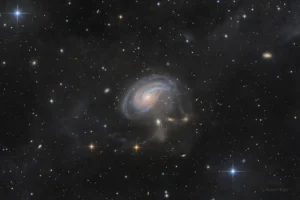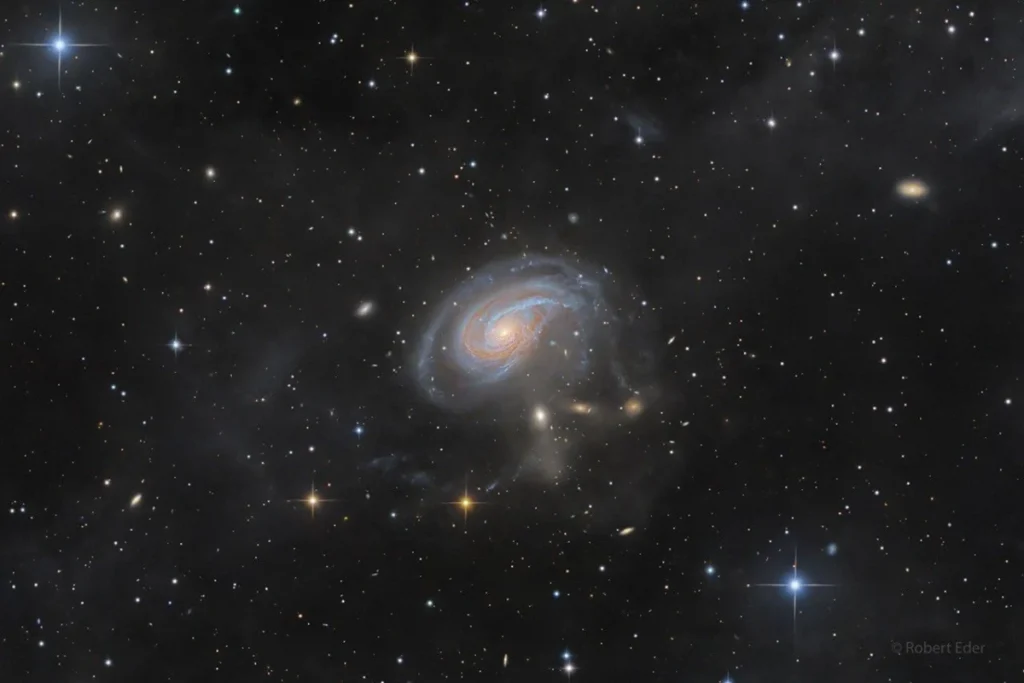
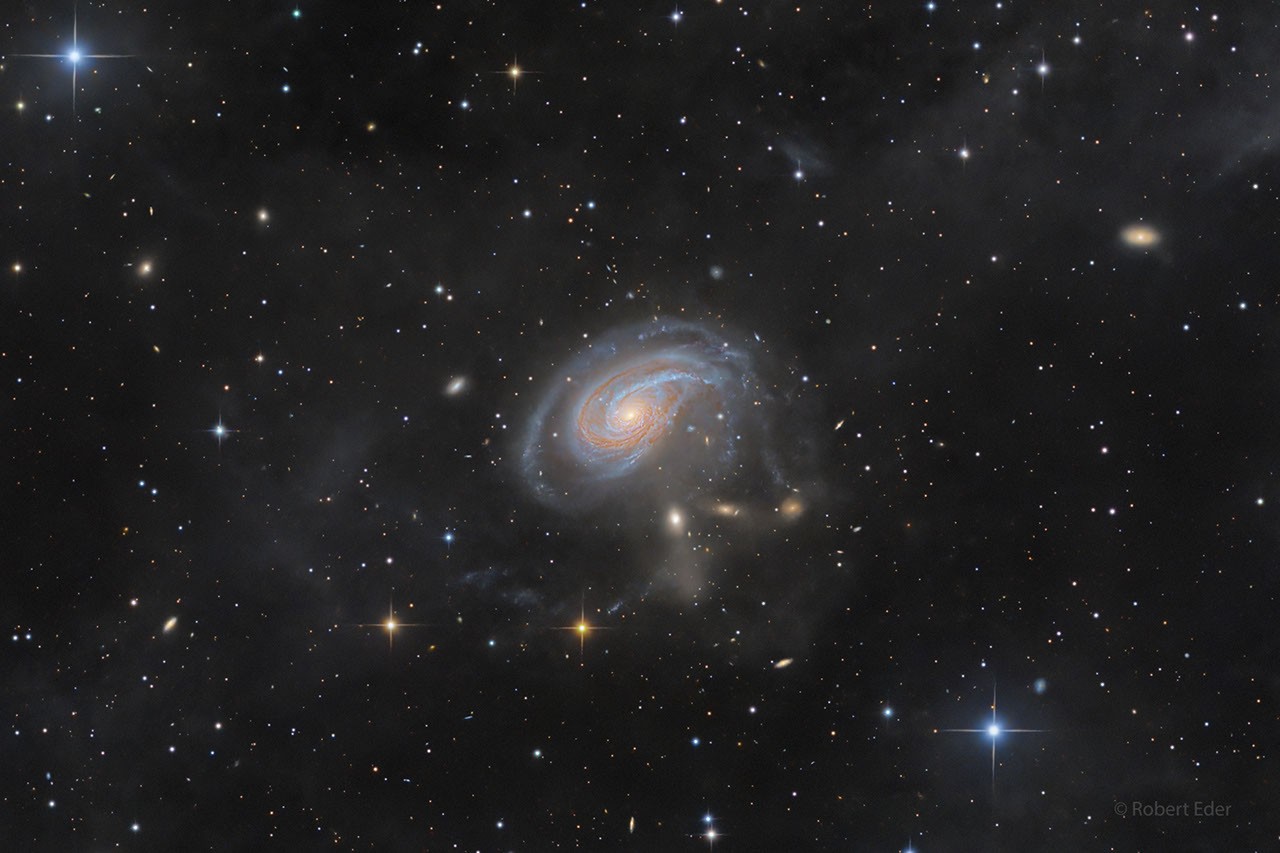
A breathtaking new image from NASA’s Astronomy Picture of the Day (APOD) program, featuring the peculiar spiral galaxy Arp 78, offers a dramatic glimpse into the powerful forces shaping our universe. This celestial marvel, also cataloged as NGC 772, is located approximately 100 million light-years away, a vast distance that places it well beyond the familiar stars and nebulae of our own Milky Way galaxy. The featured photograph, captured by Robert Eder, highlights a particularly striking characteristic of Arp 78: an exceptionally prominent and extended spiral arm, a testament to significant gravitational interactions with its cosmic neighbor.
A Galaxy of Immense Scale and Striking Features
Arp 78 is an island universe of colossal proportions, spanning an estimated 200,000 light-years across. This makes it significantly larger than the Milky Way, which is thought to be around 100,000 to 180,000 light-years in diameter. The galaxy resides within the constellation Aries, a region of the night sky traditionally associated with the ram. While its overall structure is that of a grand spiral, it is the exaggerated outward sweep of one particular spiral arm that captivates astronomers and enthusiasts alike.
The image meticulously details the intricate structure of this prominent arm. Sweeping dust lanes, the cosmic highways of star formation, are clearly visible, tracing the galaxy’s rotation. Within these lanes, and extending outward, are clusters of young, intensely blue stars, the energetic byproducts of recent star birth. These stellar nurseries paint vibrant streaks across the galaxy’s expanse, drawing the eye and hinting at the dynamic processes at play.
The Gravitational Dance: Unraveling Arp 78’s Peculiarity
The extraordinary development of this single spiral arm is not a random occurrence but a direct consequence of powerful gravitational forces. Astronomers attribute this "pumped-up" appearance to galactic-scale tidal interactions. The primary instigator of this cosmic dance is Arp 78’s brightest companion galaxy, NGC 770. This smaller, more compact, and elliptically shaped galaxy is positioned directly below Arp 78 in the featured image.
The gravitational pull exerted by NGC 770, even though it is smaller, has significantly influenced the distribution of gas, dust, and stars in Arp 78. Over millions of years, these gravitational tugs have warped the galactic disk, stretching and elongating the spiral arm closest to NGC 770. This phenomenon is a common occurrence in the universe, demonstrating that galaxies are not isolated entities but are constantly interacting and evolving through gravitational encounters.
Contextualizing Galactic Interactions: A Universe in Motion
The study of interacting galaxies provides crucial insights into galaxy evolution. These encounters can trigger intense bursts of star formation, fuel supermassive black holes at galactic centers, and even lead to the eventual merging of galaxies. The Hubble Space Telescope, in particular, has provided numerous stunning examples of galactic collisions and close passes, revealing the dramatic transformations that can occur. For instance, the Antennae Galaxies, a pair of interacting galaxies, showcase a spectacular display of gas and dust being ejected, leading to widespread star formation. Similarly, the Andromeda Galaxy, our closest large galactic neighbor, is on a collision course with the Milky Way, a merger that will dramatically reshape our local group of galaxies over billions of years.
The peculiar nature of Arp 78, as cataloged by astronomer Halton Arp in his influential Atlas of Peculiar Galaxies, highlights the diversity of galactic morphologies and the complex evolutionary pathways galaxies can follow. Arp’s atlas, published in 1966, aimed to document galaxies that deviated from the standard Hubble classification scheme, suggesting that interactions and other unusual phenomena played a significant role in their formation and appearance. Arp 78’s classification as "peculiar" underscores its deviation from the archetypal spiral galaxy.
Technical Details of the Image and Observation
The image presented by APOD is a high-resolution photograph, allowing for the observation of fine details within Arp 78. The technical specifications indicate a resolution of 1772 pixels wide by 1182 pixels high, optimized for various viewing devices through responsive image scaling. The source link points to a NASA asset, suggesting it was either captured by a NASA telescope or processed by NASA scientists. The use of srcset attributes further indicates advanced web development practices, ensuring optimal image quality across different screen sizes and resolutions.
While the specific telescope used to capture this particular image is not explicitly stated in the provided snippet, the level of detail and clarity suggests it was likely obtained using a powerful ground-based telescope or potentially from space-based observatories like the Hubble Space Telescope or the James Webb Space Telescope, which are renowned for their deep-sky imaging capabilities. The photographer, Robert Eder, is credited, implying that this image may be a composite of multiple exposures or a particularly well-executed single shot from an amateur or professional astronomer utilizing advanced astrophotography techniques.
The Astronomy Picture of the Day (APOD) Program: A Window to the Cosmos
The Astronomy Picture of the Day (APOD) program, a long-standing initiative by NASA, serves as a vital educational tool, bringing the wonders of the universe to a global audience. Each day, APOD features a different image or photograph of space, accompanied by a concise yet informative explanation penned by a professional astronomer. This program allows individuals to "Discover the cosmos!" and learn about celestial objects, phenomena, and the ongoing research in astronomy. The archive of APOD images offers a rich historical record of astronomical discoveries and stunning visual representations of the universe.
The APOD program also plays a crucial role in fostering public interest in science and space exploration. By providing visually appealing and scientifically accurate content, it inspires curiosity and encourages further learning. The program’s commitment to including explanations from professional astronomers ensures that the information presented is credible and up-to-date, making it a valuable resource for students, educators, and the general public alike.
Broader Implications and the Future of Galactic Study
The study of galaxies like Arp 78 has profound implications for our understanding of the universe’s evolution and the processes that lead to the formation of structures like our own Milky Way. By observing and analyzing these interactions, scientists can refine cosmological models and gain a deeper appreciation for the dynamic nature of the cosmos. The ongoing advancements in telescope technology, both ground-based and space-based, promise even more detailed and insightful observations in the future.
The discovery and cataloging of peculiar galaxies continue to be an active area of research. Citizen science projects, where the public assists professional astronomers in analyzing vast datasets, are also playing an increasingly important role. For instance, projects like Galaxy Zoo have allowed millions of volunteers to classify galaxies, contributing significantly to our understanding of galactic diversity and evolution.
A Note on Submissions and Future APOD Features
The APOD program also serves as a platform for astronomers and astrophotographers to share their work. The provided snippet includes an important update regarding changes to APOD’s email for image submissions, directing users to a specific page for detailed guidelines. This underscores the program’s ongoing efforts to engage with the astronomical community and to continuously showcase the latest and most compelling celestial imagery.
Looking ahead, the APOD program promises to continue unveiling the universe’s marvels. The mention of "Tomorrow’s picture: a harvest" hints at an upcoming feature with a potential theme related to celestial events or objects that evoke the idea of a harvest, perhaps a stellar nursery ripe with new stars or a celestial alignment that appears bountiful. This subtle teaser adds to the anticipation and ongoing engagement with the APOD platform. The continuous flow of new images and explanations ensures that the public’s fascination with space remains perpetually nourished.