As artificial intelligence (AI) systems increasingly permeate the daily lives of children and adolescents—ranging from the predictive algorithms of streaming platforms like Netflix and YouTube to the conversational interfaces of smart speakers—the necessity for a robust pedagogical framework has never been more urgent. While traditional digital literacy focused on operational competence, the emergence of complex, often opaque, AI models demands a shift toward what scholars are now defining as Critical Computational Literacy (CCL). This evolution was the focal point of a recent research seminar hosted by the Raspberry Pi Foundation, featuring Professor Dr. Dan Verständig from Goethe University Frankfurt’s Center for Critical Computational Studies. Professor Verständig’s presentation delved into the nuances of Social Explainable AI (Social XAI), arguing that the explanations provided by AI systems are not merely technical data points but are social constructs that require active interpretation and critical interrogation by the user.
The Shift from Technical Outputs to Social Constructs
The seminar opened with a fundamental inquiry into the nature of explanations. In the context of AI, an explanation is typically viewed as the "why" behind a specific output—for instance, why a medical algorithm flagged a specific X-ray or why a financial model denied a loan application. However, Professor Verständig posited that explanations serve a much broader social function: they provide orientation in an increasingly complex digital landscape, reducing uncertainty and making the shared social world liveable.
Historically, the delivery of information has evolved from Socratic dialogue and printed manuscripts to modern digital interfaces. Professor Verständig emphasized that explanations have never been neutral. To illustrate this, he presented an aerial photograph of Montara State Beach in California. While a casual observer might notice the sand and the tide, a climate researcher might see evidence of coastal erosion, a surfer might analyze the break of the waves, and an artist might focus on the interplay of light and shadow. This demonstration underscored a pivotal thesis: an explanation is always situated within a specific context, designed for a specific audience, and serves a specific purpose. Consequently, AI explanations cannot be viewed as purely technical; they are deeply intertwined with the perspectives of those who design them and those who consume them.

Defining Social Explainable AI (Social XAI)
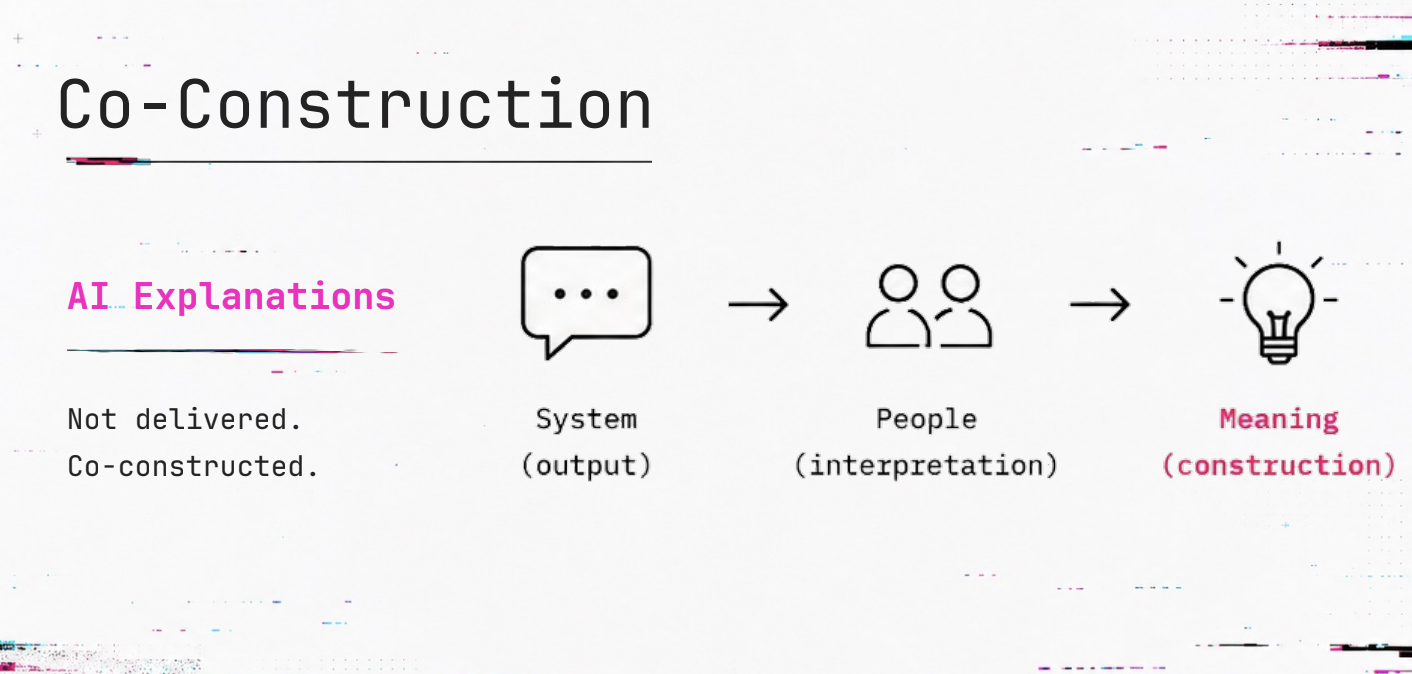
Building upon the 2026 research of Rohlfing and Lim, Professor Verständig introduced the concept of Social XAI. This framework moves away from the "one-size-fits-all" model of explainability, where a system generates a static piece of text or a visualization. Instead, Social XAI places interaction at the heart of the process. In this model, an AI explanation begins as a system output, passes through the filter of an individual’s personal interpretation, and only then achieves meaning through a process of co-construction.
This approach challenges the industry standard where "transparency" is often equated with showing the internal weights of a neural network or providing a list of data features. For a layperson, such technical disclosures are often meaningless. Social XAI suggests that for an explanation to be effective, it must be "co-constructed" between the system (or its developers) and the user. This necessitates a move toward "dialogic" AI, where users can ask follow-up questions, challenge assumptions, and receive explanations that align with their specific level of expertise and their social needs.
The Four Dimensions of Critical Computational Literacy
To empower individuals to engage with these systems, Professor Verständig outlined the four interlocking dimensions of Critical Computational Literacy (CCL). This framework is designed to move beyond a narrow, technical understanding of AI toward a more holistic, biographical, and value-laden form of literacy.
1. The Analytical Dimension
The analytical dimension involves the ability to deconstruct how an AI system functions. This is not limited to understanding code but includes analyzing the logic of data processing. Users must be able to ask: What data was used to train this model? What are the mathematical proxies being used to represent real-world phenomena? By understanding the underlying mechanics, individuals can identify where a system might be prone to error or bias.

2. The Reflective Dimension
Reflective literacy encourages users to consider their own relationship with the technology. It asks individuals to evaluate how their reliance on AI affects their decision-making processes and their autonomy. This dimension pushes back against "automation bias"—the human tendency to trust automated systems over manual ones—and fosters a healthy skepticism toward algorithmic "truth."
3. The Biographical Dimension
One of the most unique aspects of Professor Verständig’s framework is the biographical dimension. This recognizes that every individual brings their own history, culture, and personal values to an encounter with a computational system. Literacy, in this sense, is not a static skill set but a personal journey. An individual’s past experiences with technology will inevitably shape how they interpret and trust an AI’s explanation.
4. The Socio-Technical Dimension
The final dimension looks at the broader impact of AI on society. It involves understanding the power structures behind the technology: Who owns the data? Who benefits financially from the algorithm’s recommendations? This dimension treats AI as a political and social tool, requiring users to evaluate the ethical implications of deployment, such as privacy concerns, environmental costs of data centers, and the potential for systemic discrimination.
Implementation in K-12 Education
The implications of Social XAI and CCL are particularly profound for the K-12 classroom. As children interact with AI-driven devices daily, educators have a unique opportunity to transition students from passive consumers to critical evaluators. Professor Verständig suggested that even young students can be taught to interrogate AI outputs. For example, if a smart speaker suggests a specific recipe, students can be encouraged to ask: Why this recipe? Is the speaker prioritizing a sponsored result? What ingredients or cultural styles are being excluded?

The Raspberry Pi Foundation has already begun integrating these concepts into its "Experience AI" resources. One practical application is the use of "model cards." Similar to nutrition labels on food packaging, model cards document the origin of a model, the training data used, the accuracy of its predictions, and its known limitations. In a classroom setting, students are tasked with creating their own model cards for AI systems they build. Social XAI suggests an extension to this: students should not only write the cards but also consider who will read them and how different audiences—such as a parent, a teacher, or a fellow student—might interpret the information provided.
Chronology of AI Literacy Development
The seminar is part of a broader timeline of educational reform aimed at addressing the "black box" nature of modern technology.
- 2010–2018: The focus of digital education was largely on "coding" and computational thinking, teaching students how to give instructions to machines.
- 2019–2022: With the rise of large-scale data harvesting, the focus shifted toward data literacy and privacy.
- 2023–Present: The explosion of Generative AI (like ChatGPT) has necessitated a move toward "AI Literacy," with a specific emphasis on ethics, bias, and explainability.
- 2025 and Beyond: The introduction of Social XAI frameworks, as discussed by Professor Verständig, marks the next phase where literacy is defined by the ability to co-construct meaning and interrogate the social power of algorithms.
Supporting Data and Global Context
The urgency for Critical Computational Literacy is supported by recent global data. According to a 2024 UNESCO report on AI in education, while 70% of countries have some form of digital literacy in their curriculum, fewer than 15% have specific guidelines for AI literacy. Furthermore, a study by the OECD highlighted that while young "digital natives" are proficient at using interfaces, they often lack the critical thinking skills necessary to identify algorithmic bias or misinformation generated by AI.
In the corporate sector, the demand for "Explainable AI" is also growing. A report by Gartner suggests that by 2026, 30% of government contracts for AI systems will require documented "Social Explainability" to ensure public trust. This aligns with Professor Verständig’s research, suggesting that the skills taught in classrooms today will be essential for the workforce of tomorrow.
Broader Impact and Future Implications
The shift toward Social XAI and Critical Computational Literacy represents a fundamental change in how society views the relationship between humans and machines. By treating AI explanations as co-constructed narratives rather than technical truths, we move closer to a "glass box" model of technology. This transparency is essential for democratic participation in a world where algorithms influence everything from criminal sentencing to healthcare access.
The Raspberry Pi Foundation’s seminar series continues to explore these themes, with upcoming sessions scheduled to cover the integration of AI into engineering and robotics curricula. As Professor Verständig concluded, genuine literacy is not about knowing how a model works in isolation; it is about the ability to interrogate the system, understand who benefits from its explanations, and maintain human agency in an automated world.
The next seminar, scheduled for October 6, will feature Eleni Petraki and Damith Herath from the University of Canberra. They will discuss how to equip future engineers with the diverse skills required by a rapidly evolving global workforce, further bridging the gap between technical training and critical social awareness. Through these ongoing dialogues, the educational community is laying the groundwork for a future where technology serves the public good through transparency, accountability, and mutual understanding.