The fundamental understanding of the proton, the building block of every atom in the known universe, is undergoing a profound transformation. New data emerging from the Solenoidal Tracker at RHIC (STAR) detector at the Relativistic Heavy Ion Collider (RHIC) have provided compelling evidence that a long-held assumption in nuclear physics may be incomplete, if not entirely incorrect. For decades, the scientific consensus held that a proton’s "baryon number"—the quantum property that makes it a proton rather than a different type of particle—was carried collectively by its three constituent valence quarks. However, the latest findings, published in the prestigious journal Science, suggest that this essential property may instead reside within a complex "junction" of gluons, the force-carrying particles that act as the subatomic "glue" holding matter together.
This discovery, the result of decades of theoretical speculation and years of high-energy particle collisions, challenges the textbook description of atomic nuclei. If confirmed by further experimentation, it would represent one of the most significant shifts in our understanding of the strong nuclear force since the development of Quantum Chromodynamics (QCD) in the mid-20th century.
The Evolution of Nuclear Theory: From the 1970s to the Present
To understand the magnitude of this discovery, one must look back at the history of particle physics. In the 1960s and 70s, physicists developed the quark model, which posits that protons and neutrons (collectively known as baryons) are each composed of three valence quarks. In this "naive" model, each quark carries exactly one-third of the baryon number. Because the total baryon number must be conserved in any physical process, the stability of the universe—the fact that protons do not simply decay into lighter particles—was attributed to these three quarks being bound together.
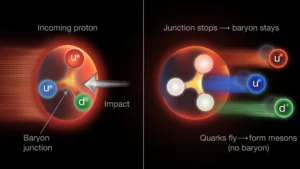
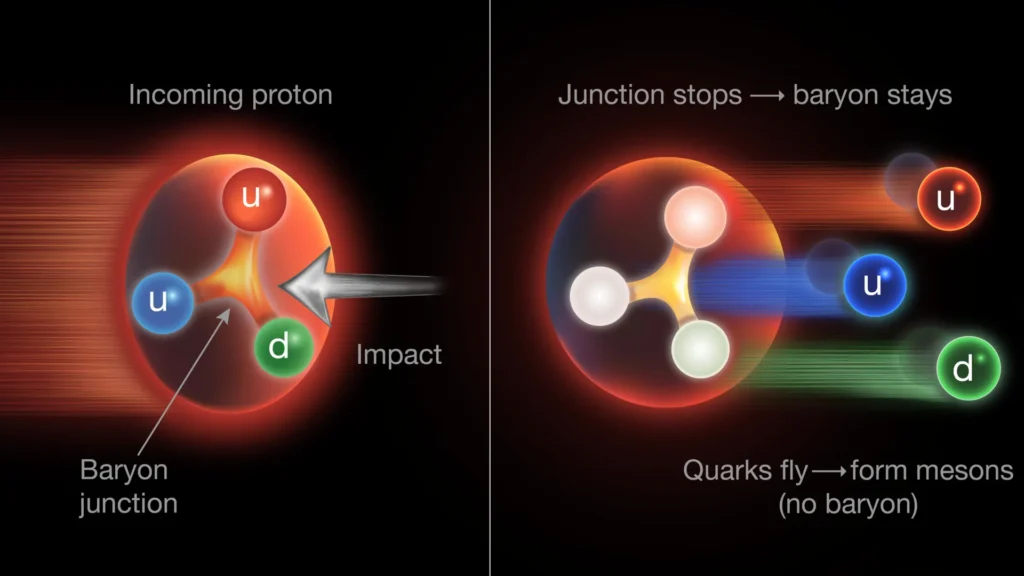
However, theoretical physicists in the 1970s began to suspect that the internal architecture of the proton was more complex than a simple trio of particles. They proposed the existence of a "gluon junction," a Y-shaped configuration where the gluon fields emanating from the three quarks meet. In 1996, Dmitri Kharzeev, a theoretical physicist at Stony Brook University and Brookhaven National Laboratory, took this idea a step further. He proposed that it was not the quarks themselves that carried the baryon number, but rather this topological junction of gluons.
For nearly thirty years, Kharzeev’s hypothesis remained a mathematical possibility without experimental verification. The technology required to "see" inside a proton during a high-speed collision and differentiate between the behavior of quarks and gluons did not yet exist. That changed with the maturation of the STAR detector at RHIC, a Department of Energy Office of Science user facility located at Brookhaven National Laboratory.
The RHIC Experiment: Smashing Atoms to Reveal Subatomic Secrets
The Relativistic Heavy Ion Collider is a 2.4-mile-long underground ring designed to accelerate nuclei to nearly the speed of light. When these nuclei collide, they create a "quark-gluon plasma," a state of matter so hot and dense that it mimics the conditions of the universe microseconds after the Big Bang. In this primordial soup, quarks and gluons are momentarily liberated from their hadronic confines, allowing scientists to study the forces that govern them.
The STAR collaboration, an international team of hundreds of scientists, spent years analyzing data from these collisions. Their primary focus was on "net-baryon" production—the difference between the number of baryons (matter) and antibaryons (antimatter) produced in a collision. Because the colliding beams consist of gold nuclei (which are made of protons and neutrons), the system starts with a positive baryon number. According to the laws of physics, that baryon number must be conserved, appearing in the debris of the collision.
The mystery arose when researchers looked at the "midrapidity" region—the area perpendicular to the direction of the colliding beams. They found a surprising excess of baryons in this region. If the baryon number were tied strictly to the valence quarks, those quarks would have to be stopped almost entirely in their tracks during the collision to appear at midrapidity. However, the high-energy nature of these collisions usually causes valence quarks to retain most of their forward momentum, continuing down the beampipe.
The Anomaly: Where Electric Charge and Baryon Number Diverge
To solve the puzzle of the "stopped" baryons, the STAR team devised a clever test involving electric charge. Quarks carry both baryon number and electric charge. In a gold nucleus (which contains 79 protons), the ratio of electric charge to baryon number is well-defined. If the quarks were responsible for carrying the baryon number into the midrapidity region, then the electric charge should follow them in a predictable ratio.
"Measuring the electric charge coming out perpendicular to the collision gives you a definitive way of measuring how many quarks are stopped and transformed into new particles," explained Zebo Tang, a professor at the University of Science and Technology of China.
The results were startling. The researchers observed that the baryon number was being transported to the midrapidity region much more efficiently than the electric charge. In fact, there were roughly twice as many baryons as would be expected if quarks were the sole carriers. This "charge-baryon mismatch" provided the first concrete experimental evidence that something other than quarks—something that carries baryon number but no electric charge—was being stopped in the center of the detector.
The only candidate that fits this description is the gluon junction. Gluons are electrically neutral, but in the Y-shaped junction configuration, they possess the topological properties required to carry and transport baryon number.
The Role of the Gluon Junction in Particle Formation
The mechanism proposed by the STAR team explains the discrepancy through the lens of momentum. As protons are accelerated to higher energies, the number of gluons inside them multiplies rapidly. This is a known phenomenon in QCD; the "gluon density" increases as energy increases. Consequently, the total momentum of the proton is shared among an increasingly large number of gluons.
The gluon junction, being a collective structure, carries a relatively small fraction of the proton’s total momentum compared to the valence quarks. When two nuclei collide, this slower-moving junction is much easier to "snag" and stop in the center of the interaction zone. While the high-momentum valence quarks continue to fly forward, the stopped gluon junction remains at midrapidity.
Once the collision ends, the stopped junction cannot exist in isolation due to the laws of color confinement. It acts like a topological "sink," pulling quarks out of the vacuum—energy converted into matter—to form a new baryon. This explains why scientists see more protons and neutrons at midrapidity than can be accounted for by the original quarks in the gold nuclei.
Implications for the Early Universe and Matter-Antimatter Asymmetry
The discovery that gluons carry baryon number has implications that extend far beyond the laboratory. One of the greatest mysteries in cosmology is the "Baryon Asymmetry"—the question of why the universe is made almost entirely of matter when the Big Bang should have produced equal amounts of matter and antimatter.
"Since the Big Bang, the number of protons and neutrons all together never changes as a function of time," said Nicole Lewis, a STAR physicist at Rice University. "The reasons for this conservation are not well understood. It’s one of the mysteries of the universe, related to why we have more matter than antimatter."
By identifying the gluon junction as the true carrier of baryon number, physicists may have found a new avenue for exploring how this conservation law operates at the most fundamental level. If the "identity" of matter is tied to the topology of gluon fields rather than just the presence of quarks, it may change our models of how matter condensed out of the early universe’s energy.
Furthermore, this finding reinforces the extraordinary stability of the proton. If the baryon number were merely the sum of three parts, it might be easier for a proton to decay. However, if the baryon number is a topological property of a junction, the proton becomes a much more "robust" object, explaining why its lifetime is estimated to be longer than the age of the universe itself.
Expert Reactions and the Road Ahead
The publication of these findings has sent ripples through the physics community. Zhangbu Xu, a professor at Kent State University and a longtime leader within the STAR collaboration, emphasized that this research "reshapes how we think about the structure of matter."
Tommy Tsang, a researcher at Argonne National Laboratory, noted that the complexity revealed by these collisions proves that the "naive quark model" is no longer sufficient for modern physics. "It’s actually a really complex object," Tsang said, referring to the proton. "There are not only three quarks but also a lot of gluons interacting… and there are also quarks and antiquarks that pop up from the vacuum."
The STAR collaboration’s work is not yet finished. While the evidence for the gluon junction is strong, physicists are already looking toward the next generation of experiments. The upcoming Electron-Ion Collider (EIC), also to be built at Brookhaven National Laboratory, will act as a high-resolution "microscope" for the interior of the proton. By smashing electrons into protons, the EIC will be able to map the distribution of gluons and quarks with unprecedented precision, potentially providing a direct "image" of the Y-shaped junction.
Conclusion: A New Chapter in Subatomic Physics
The discovery at RHIC marks a turning point in our quest to understand the building blocks of reality. By demonstrating that gluons—once thought of as mere "messengers" for the strong force—play a central role in carrying the very identity of matter, the STAR collaboration has opened a new chapter in nuclear physics.
This research underscores the importance of large-scale scientific facilities like RHIC, which allow humans to probe the limits of the known. As we move closer to the end of RHIC’s operational life and toward the era of the EIC, the "gluon junction" stands as a testament to the fact that even the most familiar particles, like the humble proton, still hold secrets capable of redefining our place in the cosmos. The universe, it seems, is held together by more than just quarks; it is bound by a complex, invisible web of gluons that defines the very essence of matter.