The traditional narrative of black hole formation, a cornerstone of astrophysics for decades, posits that these celestial enigmas are the direct remnants of dying stars. When a massive star exhausts its nuclear fuel, it undergoes a cataclysmic supernova explosion, leaving behind a dense core that collapses under its own gravity to form a black hole. While this "first-generation" origin story remains accurate for many objects, a groundbreaking new study from the Massachusetts Institute of Technology (MIT) suggests that the universe’s black hole population is far more complex and recursive than previously understood.
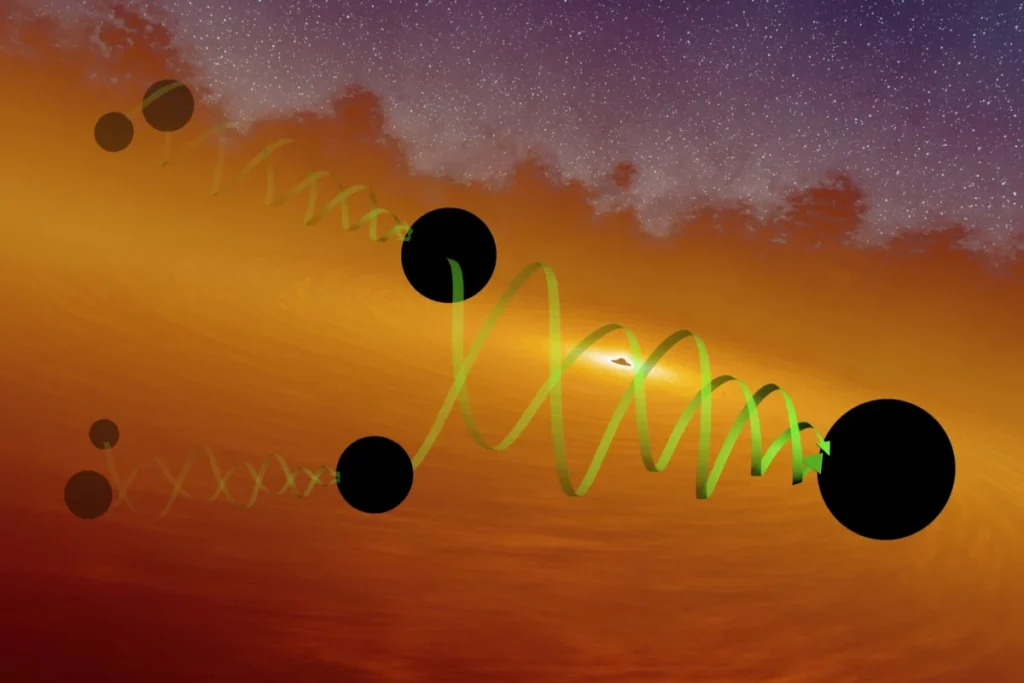
By conducting a comprehensive analysis of recent gravitational-wave data, researchers have determined that approximately 14 percent of merging black holes are likely "second-generation" entities. These objects were not born directly from stars but were instead forged through the prior collision and merger of two smaller black holes. This process, known as hierarchical merging, represents a significant and perhaps overlooked pathway in the evolution of the cosmos, providing an explanation for massive black holes that defy the standard limits of stellar evolution.
The Shift from Stellar Evolution to Hierarchical Growth
For nearly a century, the life cycle of a star has been the primary framework for understanding the birth of black holes. Massive stars—those at least eight to ten times the mass of our sun—end their lives in a violent transition. As the outward pressure of nuclear fusion ceases, gravity takes over, crushing the stellar core into a singularity. However, this process has inherent physical limits. Stellar evolution theory predicts a "mass gap," suggesting that supernovae from extremely massive stars are so energetic that they blow the entire star apart, leaving nothing behind. This leaves a mysterious void in the expected mass distribution of black holes, particularly in the range of 50 to 130 solar masses.
The emergence of gravitational-wave astronomy has allowed scientists to peer into this void. Since the first detection of gravitational waves in 2015 by the Laser Interferometer Gravitational-Wave Observatory (LIGO), researchers have observed hundreds of black hole mergers. To their surprise, many of these detected black holes fall into mass ranges that stellar evolution cannot easily explain.
The new MIT study, published this week in Physical Review Letters, provides the most robust evidence to date that these "impossible" black holes are the result of hierarchical merging. Cailin Plunkett, a graduate student in MIT’s Department of Physics and the study’s lead author, notes that for many of these cosmic giants, the observed merger is "not their first rodeo." The research suggests a universe where black holes are constantly interacting, capturing one another, and growing through successive generations of collisions.
Spin and Mass: The Fingerprints of a Black Hole’s Origin
To distinguish between a black hole born from a star and one born from a previous merger, the MIT team looked at two primary characteristics: mass and spin.
When a single star collapses, it tends to lose a significant portion of its angular momentum during the supernova process. Consequently, first-generation black holes are expected to have relatively low spin. In contrast, when two black holes merge, the orbital angular momentum of the pair is converted into the spin of the resulting daughter black hole. According to Salvatore Vitale, associate professor of physics at MIT and co-author of the study, these second-generation black holes should be "spinning very fast, at about 70 percent of their maximum possible spin."
Furthermore, the mass of the black holes provides a clear signal. The MIT analysis of 155 pairs of binary black holes from the LIGO-Virgo-KAGRA (LVK) collaboration revealed a distinct pattern. While "run-of-the-mill" black holes typically clustered around 10 and 30 solar masses, a second population emerged at approximately 20 and 40 solar masses—exactly what one would expect if the smaller black holes were merging to form larger ones.
The discovery of black holes exceeding 40 solar masses is particularly telling. "Stellar evolution theory predicts you shouldn’t be able to form black holes in that mass range at all from just a supernova," Plunkett explains. "We think supernovae from really massive stars end up being so violent that they leave no black holes at all above roughly 45 solar masses. Yet we have seen black holes that are that massive."
The Mechanics of Orbital Precession
To identify these hierarchical mergers within the massive LVK dataset, the researchers developed a sophisticated model to detect "orbital precession." This phenomenon occurs when the spins of the merging black holes are not aligned with their orbital plane, causing the entire system to wobble like a dying top as the objects spiral toward each other.
In a standard binary system where two stars evolved together and eventually became black holes, the spins are usually aligned. However, in a hierarchical merger, a second-generation black hole (already spinning rapidly from its previous merger) is captured by another black hole in a crowded environment. The resulting pair is likely to have misaligned spins, leading to significant precession.
By searching for this characteristic "wobble" in the gravitational-wave signals, the MIT team could statistically determine which mergers involved at least one second-generation component. Their analysis of the GWTC-4.0 catalog—the most recent and comprehensive collection of gravitational-wave detections—pointed toward the 14 percent figure, suggesting that hierarchical merging is not a rare anomaly but a consistent feature of the universe.
Cosmic Hubs: Where Black Holes Meet and Merge
The study also sheds light on the environments required for such repeated mergers to occur. For two black holes to find each other and merge, they must be in a "dense stellar environment." These are regions of space where stars and black holes are packed so tightly that gravitational interactions are frequent.
Typical candidates for these cosmic "meeting rooms" include:
- Globular Clusters: Ancient, spherical collections of hundreds of thousands of stars.
- Active Galactic Nuclei (AGN): The centers of galaxies where a supermassive black hole is surrounded by a dense disk of gas, dust, and smaller black holes.
- Nuclear Star Clusters: Extremely dense regions at the very heart of galaxies.
In these environments, black holes "whizz around" and can be gravitationally captured by one another. Once they merge, the new, larger black hole remains in the cluster, where it can eventually capture another partner, repeating the process ad infinitum.
Chronology of Discovery and Data Analysis
The MIT study is the culmination of years of data collection by the global network of gravitational-wave observatories. The timeline of this research reflects the rapid acceleration of the field:
- 2015: LIGO makes the first-ever detection of gravitational waves (GW150914), proving that black hole mergers exist.
- 2019-2020: The third observing run (O3) of LIGO and Virgo significantly increases the number of known mergers, revealing "high-mass" black holes that challenge existing models.
- Early 2024: The LVK observatories detect two specific signals, GW241011 and GW241110. Detailed analysis of these events shows "lopsided" pairs where one black hole is significantly more massive and faster-spinning than its partner—a "smoking gun" for hierarchical merging.
- Late 2024: Plunkett and Vitale expand this analysis to the entire GWTC-4.0 catalog, applying their precession model to 155 binary pairs to reach the 14 percent conclusion.
Implications for the Future of Astrophysics
The realization that a significant portion of the black hole population is "recycled" has profound implications for our understanding of the early universe and the growth of supermassive black holes. If black holes can grow through successive mergers, it provides a potential bridge between the small stellar-mass black holes and the "intermediate-mass" black holes that have been notoriously difficult to find.
Furthermore, this research validates the importance of gravitational-wave detectors as tools for "cosmic archaeology." By analyzing the spin and mass of these objects, scientists can reconstruct the history of a black hole, determining how many "ancestors" it had and what kind of environment it grew up in.
As gravitational-wave technology continues to evolve, the precision of these measurements will only improve. Future observatories, such as the space-based LISA (Laser Interferometer Space Antenna) and the ground-based Einstein Telescope or Cosmic Explorer, are expected to detect thousands of mergers per year. Salvatore Vitale anticipates that within the next decade, scientists will be able to see gravitational waves "irrespective of where they happen in the universe," potentially allowing us to track the hierarchical growth of black holes back to the dawn of time.
Conclusion
The MIT study marks a pivotal shift in the study of compact objects. By moving beyond the "one star, one black hole" model, researchers are uncovering a more dynamic and interconnected universe. The finding that 14 percent of merging black holes are second-generation products suggests that the "textbook" origin story is only the first chapter in a much longer and more violent cosmic biography. As we continue to listen to the ripples in spacetime, the story of how the universe builds its most massive and mysterious objects is finally becoming clear.