The development of modern consumer electronics, from the high-resolution displays in smartphones to the high-efficiency panels in solar farms, is fundamentally rooted in the field of precision optics. For decades, the process of testing new materials for these technologies has relied on meticulously constructed experiments where lasers and light sources are used to probe optical properties. However, these experiments are notoriously difficult to set up, often requiring months of manual labor as scientists struggle to align delicate mirrors, lenses, and cameras with micron-scale accuracy. In a major technological leap, researchers at the Massachusetts Institute of Technology (MIT) have developed a reconfigurable, robotic optics laboratory designed to automate this entire process, potentially reducing months of physical labor to mere minutes of autonomous operation.
This robotic system, developed by a multidisciplinary team at MIT’s Research Laboratory of Electronics (RLE), represents a significant shift in how experimental physics is conducted. By integrating advanced robotics, computer vision, and specialized hardware, the system can autonomously assemble standard optical components, tune them to precise specifications, and even dismantle the setup to prepare for the next experiment. The implications for the speed of scientific discovery are profound, offering a future where the physical constraints of laboratory work no longer bottleneck theoretical progress.
The Physical Tedium of Optical Science
To understand the impact of the MIT robotic lab, one must first consider the traditional workflow of an optics researcher. A tabletop optics experiment often resembles a densely packed, miniature city. It is populated by an array of mirrors, beam splitters, lenses, and lasers, all mounted on a heavy vibration-dampening table. For an experiment to yield valid data, these components must be aligned so precisely that even a deviation the width of a human hair can render the results useless.
Historically, this alignment has been performed by hand. Scientists spend hours, sometimes days, turning tiny knobs to tilt mirrors by fractions of a degree or sliding lenses along tracks to find the perfect focal point. "Sometimes this manual setup takes days or months depending on the complexity of the experiment," explains Marin Soljacic, the Cecil and Ida Green Professor of Physics at MIT. "It’s meticulous work that has to be done again and again for each experiment."
While some modern labs use motorized stages—components that can be moved via computer command—no system until now has been able to handle the end-to-end process of picking up a raw component, placing it in the correct spot, and performing the final, high-precision alignment without human intervention.
Technical Architecture: The Mechanics of an Autonomous Lab
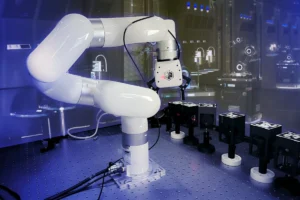
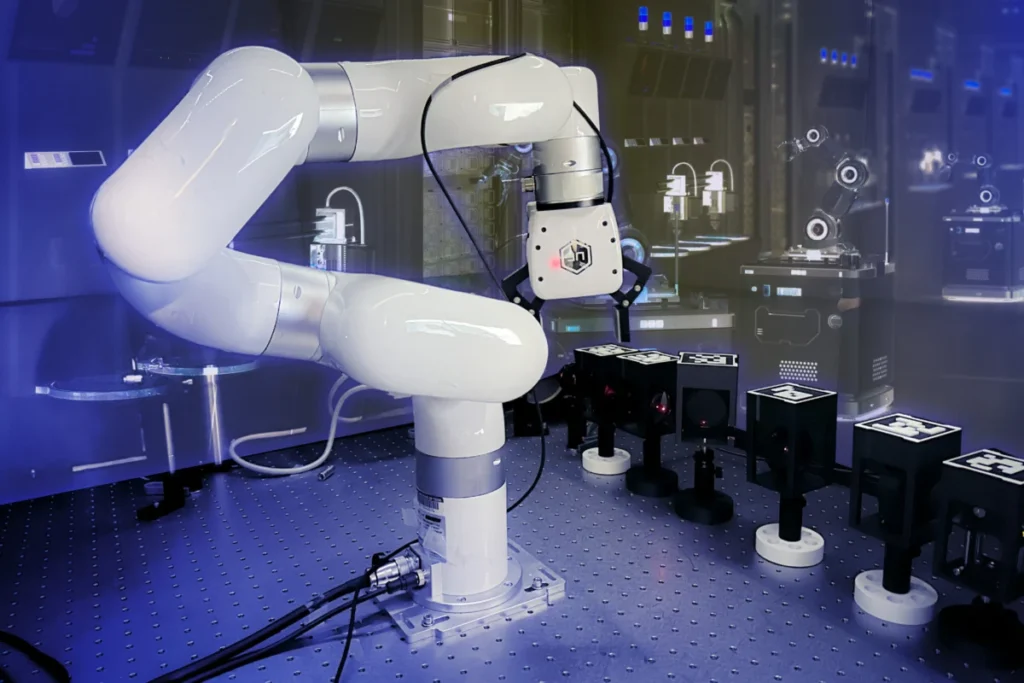
The MIT team’s solution is a sophisticated marriage of hardware and software. At the heart of the system is a robotic arm with seven degrees of freedom (moveable joints), mounted to a metallic tabletop. This arm acts as the "hands" of the experimenter, but with a level of consistency and patience that no human could match.
To allow the robot to interact with delicate glass components, the researchers developed custom 3D-printed plastic housings for every lens and mirror. These housings serve several purposes:
- Grip and Safety: They provide a standardized surface for the robotic arm to grab, ensuring that the robot never touches the sensitive optical surfaces directly.
- Identification: Each housing is etched with a unique QR code. When the robot’s overhead cameras scan the table, the software identifies exactly what the component is (e.g., a 50mm focal length lens versus a flat mirror) and its exact dimensions.
- Stability: The base of each housing contains magnets that secure the component to the metallic tabletop, providing stability while still allowing the robot to reposition it as needed.
Beyond the robotic arm, the researchers designed a "fine-adjustment tool." This is a Wi-Fi-enabled, motorized device that clips onto the mounts of standard optical components. Once the robot has placed a mirror in roughly the right spot, this tool takes over to turn the adjustment knobs with sub-micron precision. This mimics the "feel" and intuition of a human experimentalist but with a digital accuracy that is far more repeatable.
The Software Stack: The Brain Behind the Beam
The hardware is managed by a complex software stack that handles the high-level logic of the experiment. This includes computer vision algorithms that process feeds from a pair of overhead cameras to maintain a "birds-eye" view of the workspace.
The software is responsible for path planning—ensuring the robotic arm does not collide with existing components while moving new ones—and for the "auto-tuning" phase. During auto-tuning, the system monitors the light output of the experiment (using sensors or cameras) and uses feedback loops to adjust the components until the desired optical property is achieved.
To make the system accessible, the team created a virtual user interface. This allows a scientist to design an experiment in a digital environment, dragging and dropping virtual mirrors and lenses. Once the design is finalized, the robot translates that digital map into physical reality, fetching the necessary parts and aligning them on the table.
Chronology of a Breakthrough: The Laser Cavity Demonstration
To prove the system’s capabilities, the MIT researchers tasked the robot with building a laser cavity—a fundamental but challenging component of many optics experiments. A laser cavity requires two mirrors to be placed perfectly parallel to one another on opposite sides of a gain medium (such as a crystal). Light must bounce back and forth between these mirrors perfectly to be amplified into a laser beam.
The demonstration followed a precise chronology:
- Component Recognition: The robot scanned the available parts on the table, identifying the mirrors and the crystal via their QR codes.
- Autonomous Assembly: The robot executed a series of 50 distinct maneuvers to pick up, place, and orient the components.
- Precision Alignment: Using the Wi-Fi-enabled adjustment tool, the system tuned the mirrors until a stable laser beam was formed.
- Completion: The entire process was completed in just 30 minutes.
For a human trainee, setting up such a cavity for the first time could take an entire afternoon or longer to achieve the same level of precision. Furthermore, the researchers tested the system’s resilience by intentionally disturbing the components—moving a mirror slightly out of place. The robot detected the drop in laser intensity and automatically readjusted the components to restore the beam, a process known as automatic stabilization.
Broader Implications and Industrial Impact
The potential applications for an autonomous optics lab extend far beyond the walls of MIT. In the industrial sector, the speed of prototyping is a major competitive factor. Companies developing next-generation augmented reality (AR) and virtual reality (VR) goggles, for instance, must test hundreds of different lens configurations to minimize distortion and maximize field of view.
"A system like this could help industry test prototypes faster, for everything from cameras and displays to solar cells and AR/VR goggles," says Sachin Vaidya, a postdoc in MIT’s Research Laboratory of Electronics and a lead author on the project.
In the realm of environmental science, the MIT team is already applying the robot to carbon-capture research. They are using the system to test new materials that can absorb carbon dioxide from the atmosphere. By using the robot to rapidly set up spectroscopy experiments, they can analyze how different light frequencies interact with these materials, identifying the most efficient candidates for carbon sequestration much faster than previously possible.
Analysis of the "Self-Driving Lab" Trend
The MIT robotic optics lab is part of a broader movement in science toward "self-driving laboratories." In chemistry and materials science, researchers are increasingly using AI and robotics to conduct "high-throughput screening"—running thousands of tiny experiments in parallel to find new drugs or battery electrolytes.
However, optics has remained a holdout for manual labor because of the extreme physical sensitivity of the setups. The MIT project proves that even the most "delicate" sciences can be automated. This shift suggests a future where:
- Scientific Productivity Increases: As Professor Soljacic noted, a robot does not get bored and can work 24/7. This allows human scientists to focus on high-level theory and experimental design rather than the mechanics of alignment.
- Remote Science Becomes Standard: The researchers are developing a cloud-based application to allow scientists to submit experimental protocols from anywhere in the world. This could democratize access to high-end experimental facilities, allowing a researcher at a small college to run an experiment on a world-class robotic table at a major hub.
- Reliability and Data Integrity Improve: Because the robot can continuously monitor and "self-heal" its alignment, the risk of losing data due to temperature fluctuations or minor building vibrations is significantly reduced.
Conclusion and Future Work
The MIT team will officially present the full details of their robotic lab at the Intelligent Robots and Systems (IROS) conference later this month. The project team includes Sachin Vaidya, Seou Choi, Caio Silva, Shrish Choudhury, Shiekh Uddin, and Sajib Shuvo.
While the current system is a "first step," the researchers are already planning expansions. Future versions of the lab may include a secondary robot to act as a "librarian," fetching components from a storage shelf and delivering them to the main assembly robot. They also aim to improve the system’s spatial sensing to allow for even more crowded and complex experimental layouts.
As experimental optics serves as the backbone for fields ranging from quantum computing to medical imaging, the automation of the laboratory environment may well be the catalyst for the next generation of technological breakthroughs. By removing the "tedium" from the equation, MIT has opened a door to a faster, more reliable, and more inclusive era of scientific inquiry.
Acknowledgements:
This research was supported by various institutions, including the Korea Foundation for Advanced Studies, the U.S. National Science Foundation, the U.S. Army Research Office, the MIT Generative AI Impact Consortium, and Shell International Exploration and Production Inc.