Does gravity affect every type of particle in exactly the same way, or does the fundamental architecture of the universe hide subtle discrepancies between different generations of matter? This question lies at the heart of a pioneering experiment currently being prepared by researchers at ETH Zurich and the Paul Scherrer Institute (PSI) in Villigen, Switzerland. By focusing on the muon—one of the more enigmatic and short-lived particles in the subatomic catalog—scientists hope to probe the universality of free fall with a level of precision and specificity never before achieved.
For centuries, the concept that all objects fall at the same rate regardless of their mass or composition has been a cornerstone of physical science. From Galileo Galilei’s legendary experiments at the Leaning Tower of Pisa to Isaac Newton’s mathematical formalization of universal gravitation, the principle has held firm. Albert Einstein later elevated this observation to the "Equivalence Principle," a central tenet of General Relativity that posits the equivalence of gravitational and inertial mass. However, as modern physics pushes into the realm of the Standard Model, researchers are increasingly questioning whether this principle holds true for "exotic" matter—specifically those particles belonging to the second and third generations of the particle family tree.
The Architecture of Matter: Generations and Mysteries
The tangible world is built from the first generation of matter, which includes the up and down quarks that form protons and neutrons, and the electrons that orbit them. Yet, the Standard Model of particle physics reveals that nature has replicated this blueprint twice more, creating heavier, short-lived versions of these particles. The muon is the second-generation relative of the electron; it possesses the same negative charge and spin but is approximately 200 times more massive.
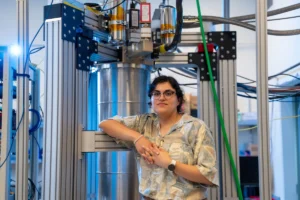
"We physicists do not yet understand why these additional generations exist at all in the first place," notes Anna Soter, a professor of physics at ETH Zurich and a lead researcher on the project. "And why are there three in total?" This fundamental mystery suggests that there may be properties or interactions unique to these heavier generations that have yet to be discovered. If the gravitational interaction of a muon differs even slightly from that of an electron or a proton, it would signal a breakdown of the Equivalence Principle and necessitate a radical revision of our understanding of the cosmos.
The Challenge of Measuring Gravity at the Subatomic Scale
Testing gravity on individual particles is an immense technical challenge. Gravity is the weakest of the four fundamental forces—the others being electromagnetism, the strong nuclear force, and the weak nuclear force. For a single particle, the electromagnetic pull from a stray electron or a nearby magnetic field can be trillions of times stronger than the pull of Earth’s gravity. To measure the gravitational "drop" of a particle, researchers must ensure the particle is electrically neutral to avoid these overwhelming interferences.
This is where the "muonium" atom becomes essential. Muonium is an exotic, hydrogen-like atom consisting of a positively charged antimuon (the muon’s antimatter counterpart) and a negatively charged electron. Because it contains one positive and one negative charge, the resulting atom is electrically neutral. "The exotic muonium is very well suited to this because it is a neutral atom," Soter explains. "After all, to make something fall, you need something neutral."
However, muonium presents its own set of obstacles. The primary hurdle is its incredibly short lifespan. A muon survives for only about 2.2 microseconds (millionths of a second) before decaying into other particles. Within this blink of an eye, the researchers must create the atom, propel it into a controlled beam, and measure its gravitational deflection. Previous methods of creating muonium produced atoms that moved at random speeds and in various directions, making them impossible to use for precise measurements.
A Breakthrough in Superfluid Helium
The team at PSI has recently overcome this "speed and direction" problem by developing a novel method to produce a "cold" muonium beam. The results of this development, published in the journal Nature Physics, describe a process that uses the unique properties of quantum fluids to tame the chaotic behavior of these particles.
The researchers utilized superfluid helium, cooled to a temperature near absolute zero (minus 273 degrees Celsius). At these extreme temperatures, helium becomes a quantum fluid with zero viscosity, meaning it flows without friction and behaves as a single coherent entity that expels impurities. Jesse Zhang, the lead author of the study, describes the process as using the chemical potential of the liquid as an "atomic cannon."
When antimuons from PSI’s High Intensity Proton Accelerator (HIPA) are injected into a thin layer of superfluid helium, they slow down and pick up free electrons to form muonium atoms. Because of the quantum mechanical properties of the superfluid, the muonium atoms experience a positive chemical potential that pushes them toward the surface. As they exit the liquid, this potential is converted into kinetic energy, launching the atoms vertically upward in a narrow, predictable beam where all atoms travel at nearly the same speed.
"We have managed to produce the muonium atoms in a ‘cold’ state, which is what makes the gravity experiment possible in the first place," Soter says. The uniformity of this beam allows for the precision necessary to observe the minuscule effects of gravity before the muons decay.
The Interferometer: Measuring the Invisible
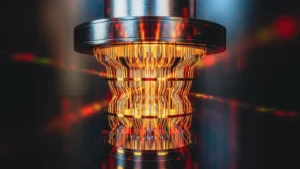
To detect the influence of Earth’s gravity on this fleeting beam, the researchers are constructing a specialized instrument known as an interferometer. Rather than trying to "see" the atoms fall in the traditional sense, the device exploits the wave-particle duality of matter. In quantum mechanics, particles like muonium also behave as waves.
As the muonium beam passes through a series of gratings in the interferometer, the waves will interfere with one another, creating a distinct pattern of "fringes." If Earth’s gravity is acting on the muonium as predicted by Einstein, it should cause the entire interference pattern to shift downward by a tiny, measurable amount. By quantifying this displacement, the team can determine the gravitational mass of the muon with high accuracy.
The timeline for the project is ambitious. The team hopes to test the interferometry method with the newly developed atomic beam within the current year. If these preliminary tests are successful, the full-scale gravity measurement is slated to take place in two to three years.
Broader Implications: A Fifth Force?
While the primary goal of the ETH Zurich and PSI team is to confirm the Equivalence Principle for second-generation particles, the possibility of an unexpected result is what truly excites the scientific community. If the experiment reveals that muonium falls at a different rate than ordinary matter, it could provide the first evidence for a "fifth force" of nature.
Currently, physics recognizes four fundamental interactions. However, many theories attempting to bridge the gap between General Relativity and Quantum Mechanics—such as string theory or various models of dark energy—predict the existence of additional forces that might only interact with specific types of particles or over specific distances.
"That would indeed be surprising, and, in addition to other theories, it could point to the existence of a fifth force," Soter outlines. Even a null result—finding that the muon behaves exactly like an electron—would be a significant achievement, as it would tighten the constraints on theoretical models and confirm that Einstein’s vision of gravity remains robust even at the second generation of matter.
Precision Physics and the Muoniverse
Beyond gravity, the development of the cold muonium beam opens doors for other high-precision measurements. For instance, laser spectroscopy of muonium can provide more accurate values for the muon’s mass and other fundamental constants. These measurements are vital for resolving ongoing discrepancies in particle physics, such as the "muon g-2" anomaly, where the observed magnetic moment of the muon differs from the Standard Model’s predictions.
The research is supported by the National Centre of Competence in Research (NCCR) "Muoniverse," a collaborative effort aimed at using muons as a window into the deep laws of physics. The Paul Scherrer Institute is uniquely positioned for this work, as it houses the world’s most intense continuous muon source, providing the high flux of particles necessary to gather statistically significant data within the muons’ short lifetimes.
As the experiment moves from the development phase to active measurement, the scientific world watches closely. Whether the result confirms Einstein’s 100-year-old theory or reveals a crack in the foundation of modern physics, the muonium gravity experiment represents a landmark effort to understand the fundamental forces that govern our universe. For Soter, the motivation remains purely scientific: "I simply want to measure, for the first time, whether the equivalence between gravitational and inertial mass also applies to the second generation of particles—this alone is quite an inspiring piece of work."