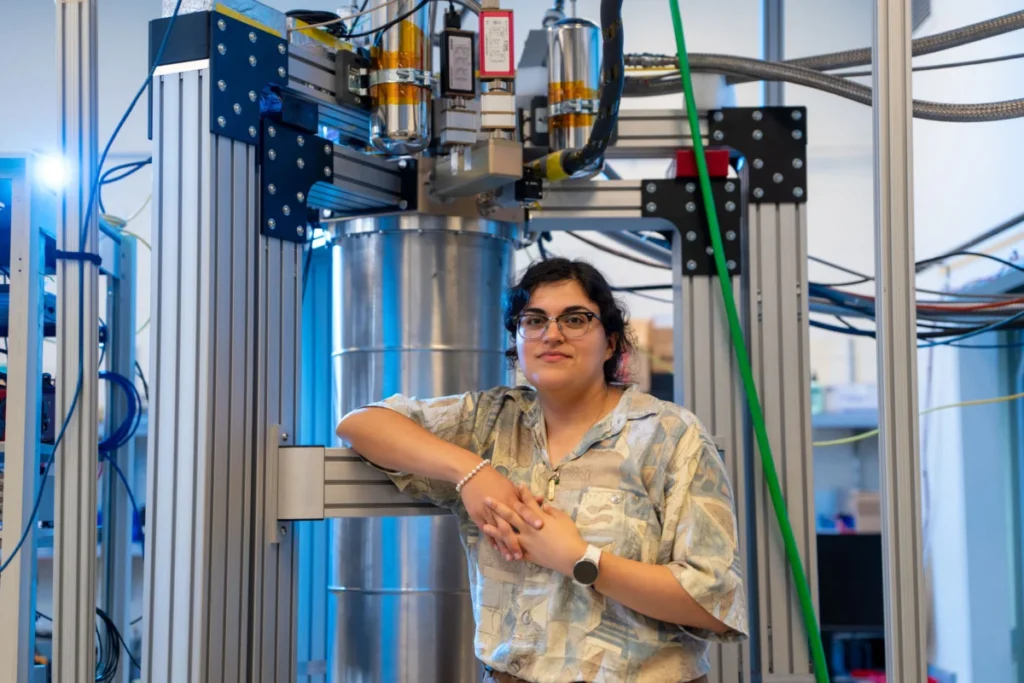
Deep within the specialized laboratories of the Massachusetts Institute of Technology and the high-flux nuclear reactor facilities of Grenoble, France, the fundamental building blocks of the universe are being scrutinized with unprecedented precision. At the center of this scientific frontier is Reyes, a sixth-year PhD student in the Formaggio Group within MIT’s Laboratory for Nuclear Science (LNS). As an experimental particle physicist, Reyes has dedicated her doctoral tenure to the study of neutrinos—subatomic particles so elusive they are often referred to as "ghost particles." These elementary particles possess a mass so infinitesimal it was once thought to be zero, and they interact so weakly with matter that billions pass through a human thumbnail every second without a trace.
The research conducted by Reyes and her colleagues is not merely an exercise in academic curiosity; it is a vital component of the global effort to address the deficiencies of the Standard Model. While the Standard Model has served as the bedrock of particle physics for decades, providing a remarkably accurate framework for the particles and forces we observe, it remains an incomplete "map" of the cosmos. It fails to account for gravity, dark matter, or the specific reasons why neutrinos have mass at all. By investigating these particles, Reyes is helping to chart the territory that lies beyond our current scientific boundaries.
The Enigma of the Ghost Particle
Neutrinos are produced in some of the most violent and energetic processes in the universe, from the nuclear fusion powering the sun to the cataclysmic explosions of supernovae. On Earth, they are generated in abundance within nuclear reactors during the process of radioactive decay. Despite their ubiquity, detecting them requires extraordinary engineering and patience. Because they lack an electric charge and have vanishingly little mass, they are unaffected by the electromagnetic forces that govern most of the physical world.
"The Standard Model is extremely accurate and describes most of everything that we see," Reyes explains. "But it’s not complete." This incompleteness is the primary driver for the next generation of high-energy physics experiments. If scientists can find a discrepancy between the predicted behavior of neutrinos and their actual behavior in a laboratory setting, it could provide the first concrete evidence of "New Physics"—forces or particles that have yet to be categorized.
The Ricochet Experiment: A Global Pursuit of CEvNS
Reyes is a key member of the Ricochet neutrino experiment, an international collaboration that operates at the Institut Laue-Langevin (ILL) in Grenoble. The ILL is home to one of the world’s most intensive sources of neutrons and neutrinos: a high-flux research reactor. The proximity of the Ricochet detectors to this reactor allows scientists to study a high density of neutrinos in a controlled environment.
The primary objective of Ricochet is to observe and measure Coherent Elastic Neutrino-Nucleus Scattering (CEvNS). Predicted by theorists in 1974 but not experimentally observed until 2017, CEvNS occurs when a neutrino interacts with an entire atomic nucleus rather than just a single proton or neutron. This interaction causes the nucleus to recoil slightly. Because the recoil energy is incredibly low, detecting it requires technology capable of sensing minute thermal changes, often at temperatures just a fraction of a degree above absolute zero.
Through Ricochet, Reyes and her team aim to determine if neutrinos behave exactly as the Standard Model predicts during these low-energy interactions. Any deviation could suggest the existence of "sterile neutrinos" or other non-standard interactions that could reshape our understanding of the early universe’s evolution.
A Career Defined by Adaptability and Technical Innovation
The trajectory of a PhD candidate is rarely a straight line, and Reyes’ experience reflects the inherent unpredictability of experimental physics. When she initially joined the Ricochet collaboration, her work was intended to focus on a specific project located on-site at MIT. However, as is common in large-scale experimental science, timelines shifted. A few years into her residency, it became clear that the MIT-based project would not be operational in time for her to complete her dissertation research.
Faced with a potential stall in her progress, Reyes pivoted. She shifted her focus to the ongoing work in France, immersing herself in the technical complexities of the experiment’s detectors. This transition required a move from theoretical planning to the "hands-on" reality of experimental hardware.
During her first three-month stint in Grenoble, the Ricochet experiment was in its nascent stages, utilizing only two detectors. Reyes’ role involved the painstaking, routine work of characterization—understanding how the detectors responded to various stimuli and identifying the "noise" that could obscure a real neutrino signal. However, as the experiment scaled up to nine and eventually 18 detectors, the complexity of managing the data grew exponentially.
Recognizing that manual monitoring was becoming unsustainable, Reyes and a colleague took the initiative to innovate. They developed a comprehensive software framework designed to automate low-level analysis and detector health monitoring. This system essentially took the repetitive tasks Reyes had been performing manually and delegated them to an algorithm.
"It’s sort of like you’re building your own stuff to replace yourself," Reyes notes. "Which is nice in a way because you can save yourself a lot of time." This automation not only increased the efficiency of the Ricochet experiment but also cemented Reyes’ reputation as a physicist who could bridge the gap between hardware and high-level data science.
The Chateaubriand Fellowship and International Collaboration
The collaborative nature of particle physics often requires scientists to bridge geographical and cultural gaps. Reyes’ work was supported in part by the prestigious Chateaubriand Fellowship, a grant offered by the Embassy of France in the United States. This fellowship allowed her to spend nine months living and working in France, following two previous shorter visits.
Living in Grenoble provided more than just proximity to the reactor; it offered an immersive look into a different scientific culture. By working in the same physical office as her international collaborators, Reyes was able to bypass the logistical hurdles of time-zone differences and remote communication. This period was instrumental in her development, allowing her to transition from a student learning the ropes to a leader guiding the work of others.
The experience also provided a shift in perspective regarding work-life balance. Reyes found herself drawn to the French approach to research, which emphasizes deep focus during work hours while maintaining a healthy separation from personal life. "I fell in love with France and the people," she says. "And also, the work culture."
Leadership and the Evolution of Scientific Confidence
One of the most significant transformations during a doctoral program is the shift from being a consumer of knowledge to a generator of it. For Reyes, this transition was marked by a growing confidence in her own scientific judgment.
In the early stages of her career, Reyes admits she was more comfortable following established protocols and instructions from senior researchers. However, the responsibility of managing the detector systems for an international collaboration forced her to trust her instincts. Leading projects and coordinating diverse groups of scientists required her to advocate for her ideas and defend her technical choices.
"I think I was sometimes not really standing up for myself," she reflects. "But now I feel more confident in my position and my prowess as a physicist." This personal growth is as critical to a successful career in science as technical expertise, as high-level research often involves navigating complex interpersonal dynamics and "wrangling" various stakeholders toward a common goal.
The Satisfaction of Tangible Creation
The world of particle physics is one of extreme abstraction. Physicists like Reyes spend their days thinking about particles that cannot be seen, using mathematical models to describe forces that defy intuition. To balance the cerebral demands of her research, Reyes has turned to hobbies that offer a different form of satisfaction.
Outside the lab, she is an avid video game player and has taken up crocheting—a skill she honed during her time in France. Crocheting provides a rhythmic, tactile contrast to the world of subatomic decay. While her professional life is dedicated to detecting the invisible, her hobby allows her to create something tangible, stitch by stitch.
"For a physicist whose work involves investigating some of the universe’s smallest and most elusive particles, the hobby offers a different kind of satisfaction: creating something tangible," the report notes. This balance is a common trait among high-level researchers, providing a necessary mental "reset" that allows for continued creativity in the lab.
Broader Implications for the Scientific Community
As Reyes prepares to complete her doctorate and looks toward a postdoctoral position, the impact of her work on the Ricochet experiment continues to resonate. The automation tools she developed are now integral to the experiment’s operations, and the data being collected in Grenoble will contribute to the global understanding of CEvNS for years to come.
The success of researchers like Reyes highlights the importance of institutional support for international fellowships and the necessity of adaptability in scientific training. As the search for "New Physics" intensifies, the ability to collaborate across borders and automate complex systems will be the hallmark of the next generation of scientific leaders.
Reyes’ journey from a student at MIT to a key contributor in a major French laboratory underscores a fundamental truth about modern science: it is a human endeavor. Behind the cold data and the massive nuclear reactors are individuals learning to lead, innovating to solve practical problems, and seeking to understand the fundamental nature of the world we inhabit. Whether she is "wrangling" physicists or crocheting a new project, Reyes remains driven by the same quest for understanding that first drew her to the field of physics.