The search for extraterrestrial life has historically been guided by a "follow the water" mantra, focusing almost exclusively on terrestrial-like environments where liquid water serves as the universal solvent. However, a groundbreaking study led by researchers at the Massachusetts Institute of Technology (MIT) has fundamentally challenged this biological paradigm. Published in the Proceedings of the National Academy of Sciences (PNAS), the research demonstrates that short chains of amino acids, known as peptides, can remain stable and—more importantly—adopt complex, functional three-dimensional shapes within highly concentrated sulfuric acid. These conditions mirror the extreme environment found in the cloud layers of Venus, a planet long dismissed as a viable candidate for life due to its corrosive atmosphere.
For decades, the scientific consensus held that the concentrated sulfuric acid droplets comprising the Venusian clouds would instantly dehydrate and destroy any complex organic molecules. Yet, the MIT team, led by senior authors Sara Seager and Mei Hong, has provided empirical evidence that the building blocks of life are far more resilient than previously understood. By utilizing advanced nuclear magnetic resonance (NMR) spectroscopy, the team observed that peptides not only survived exposure to 98 percent sulfuric acid for weeks but also folded into specific geometries, such as the "omega loop," which are critical for biological signaling and molecular recognition in Earth-based proteins.
The Venusian Paradox: A Harsh Environment with Temperate Pockets
Venus is often described as Earth’s "evil twin." While similar in size and composition, its surface is a hellish landscape with temperatures exceeding 460 degrees Celsius (860 degrees Fahrenheit) and atmospheric pressures 92 times that of Earth. However, approximately 48 to 60 kilometers (30 to 40 miles) above the scorched surface, the environment shifts. In this middle and upper cloud layer, temperatures range from 0 to 60 degrees Celsius, and pressures are comparable to those at Earth’s sea level.
Despite these hospitable temperatures, the atmosphere is dominated by droplets of sulfuric acid with concentrations ranging from 85 to 98 percent. On Earth, sulfuric acid is a powerful desiccant and oxidizing agent capable of dissolving metals and charring organic tissue by stripping away water molecules. This chemical hostility led most astrobiologists to conclude that any organic chemistry in the Venusian atmosphere would be limited to the simplest molecules, incapable of forming the complex structures required for life.
The MIT study re-evaluates this assumption by looking at the chemistry of the "building blocks" themselves. Meteorites frequently deliver amino acids and peptides to planetary atmospheres. If these molecules can survive the initial descent into the Venusian clouds, the MIT research suggests they could persist and potentially participate in a form of "acid-solvent" biochemistry.
Chronology of Discovery: From Phosphine to Peptides
The current investigation is part of a broader, multi-year research program initiated by Sara Seager, the Class of 1941 Professor of Planetary Sciences at MIT. The catalyst for this line of inquiry was the controversial 2020 detection of phosphine gas in the Venusian atmosphere—a chemical that, on Earth, is primarily associated with anaerobic biological activity. While the phosphine detection remains a subject of intense debate, it sparked a renewed interest in the possibility of an aerial biosphere on Venus.
Following the phosphine discovery, Seager’s lab began a systematic evaluation of how life’s essential components behave in sulfuric acid.
- 2020–2022: The team first tested nucleic acid bases (the components of DNA and RNA). To their surprise, they found that these molecules remained stable in concentrated sulfuric acid.
- 2023: Research shifted to lipids and amino acids. The team discovered that many of these molecules could withstand the acid, though they did not yet know if they could link together into more complex structures.
- 2024: The latest study focused on peptides—strings of amino acids. This was the most critical test, as the bonds holding amino acids together (peptide bonds) are notoriously susceptible to acid-catalyzed hydrolysis in the presence of water.
Technical Methodology: Probing the Atomic Scale
The breakthrough was made possible through a collaboration between Seager and Mei Hong, an MIT professor of chemistry and an expert in NMR spectroscopy. The researchers used an 800-megahertz solution NMR spectrometer, a highly sensitive instrument capable of mapping the magnetic properties of atomic nuclei to determine the precise 3D structure of molecules.
The team analyzed three specific peptides:
- HHQ: A synthetic peptide consisting of seven amino acids (histidine-histidine-glutamine).
- HHQ13: A longer variation of the HHQ sequence.
- K7: A peptide composed of seven lysine residues.
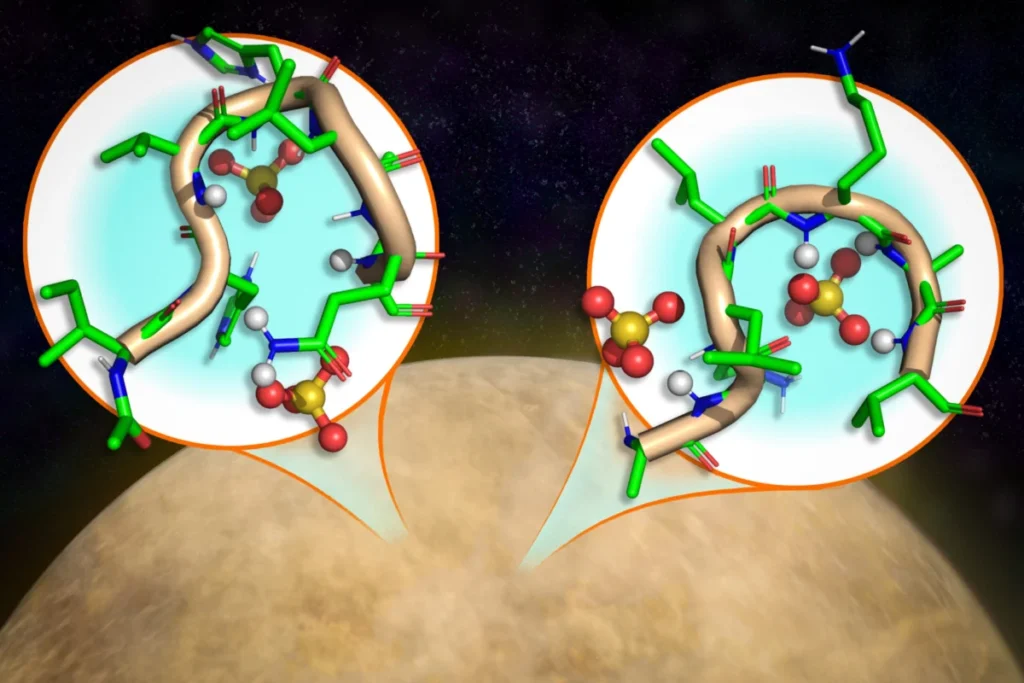
In an aqueous (water-based) environment, these peptides typically form flat structures known as beta sheets, which eventually aggregate into long, fibrous chains. However, when submerged in 98 percent sulfuric acid, the molecules behaved differently. Instead of degrading, they folded into "omega loops"—a structural motif characterized by a loop where the ends of the peptide chain come close together without overlapping, resembling the Greek letter $Omega$.
The Chemistry of Survival: Why Acid Isn’t Always Destructive
The primary reason sulfuric acid is so destructive to life on Earth is its interaction with water. In a typical acidic solution on Earth, water molecules act as a medium that allows the acid to break chemical bonds through hydrolysis. However, the Venusian clouds are composed of 98 percent sulfuric acid and only 2 percent water.
"Without water, an acid that you would consider a harsh solvent suddenly is not as menacing as one might think," explains Mei Hong. In the absence of sufficient water molecules to drive hydrolysis, the peptide bonds remain intact. Furthermore, the researchers discovered that the sulfuric acid molecules themselves appear to act as a "chemical scaffold." The acid molecules slide into the center of the peptide loops, providing structural support that maintains the molecule’s specific 3D shape.
This discovery is significant because "structure dictates function" in biology. For a molecule to perform a task—such as acting as an enzyme or a signaling receptor—it must have a stable, predictable shape. The fact that peptides can maintain a defined conformation in sulfuric acid suggests they could theoretically perform biological work in that environment.
Broader Implications for Astrobiology and Exoplanet Research
The implications of this study extend far beyond our solar system. As astronomers discover thousands of exoplanets, the criteria for "habitability" are being constantly refined. Current models heavily favor "Earth twins"—planets with liquid water oceans. However, Sara Seager argues that this focus may be too narrow.
"We really don’t know the full extent of what planet archetypes are out there," Seager noted. "We’re seeking exoplanets that might be a true Earth twin, but what if they’re all Venuses? Our findings definitely open up a whole range of possibilities." If life can exist in concentrated sulfuric acid, then the "habitable zone" of star systems—the region where life is possible—could be significantly broader than previously estimated, encompassing planets with vastly different atmospheric chemistries.
The study also suggests that the search for life should include "alternative" biochemistries. One area of future interest for the MIT team is Peptide Nucleic Acid (PNA). PNA is a synthetic molecule that mimics the information-carrying capacity of DNA but uses a peptide-like backbone instead of a sugar-phosphate backbone. Preliminary tests indicate that PNA is also stable in sulfuric acid, raising the possibility of a genetic system that could function in the clouds of Venus.
Reaction from the Scientific Community
The findings have been met with significant interest from the international scientific community. Adriaan Bax, chief of the Section on Biophysical NMR at the National Institutes of Health (NIH), who was not involved in the study, characterized the results as both "important and unexpected." Bax noted that the observation of conformational order in such a harsh solvent "raises the prospect that folded oligopeptide/protein structures can exist in such environments," potentially supporting life in atmospheric conditions radically different from those on Earth.
Janusz Petkowski, a research assistant professor at Wroclaw University of Science and Technology and a co-author of the paper, emphasized that this research moves the conversation from speculation to laboratory-verified data. The stability of these molecules for "many weeks on end" provides a timeframe consistent with biological processes.
Future Research and Exploration
The MIT team is already planning the next phases of their research. Key objectives include:
- Testing Longer Peptides: Determining if larger, more complex proteins can also maintain stability and fold correctly in sulfuric acid.
- Double-Stranded PNA: Investigating whether PNA can form the double-helix structure necessary for stable genetic replication in acidic conditions.
- Metabolic Simulation: Exploring whether these folded peptides can facilitate chemical reactions, acting as primitive "acid-enzymes."
Parallel to the laboratory work, the "Morning Star Missions to Venus"—a series of privately funded missions led by Seager—are being developed to explore the Venusian clouds directly. The first of these missions, the Venus Life Finder, is designed to send a probe into the cloud layer to detect organic fluorescent signatures and potentially provide the first in-situ evidence of complex chemistry.
The research was supported by the Alfred P. Sloan Foundation, the NOMIS Foundation, and the National Institutes of Health. As Seager prepares to join the faculty at the University of Toronto in September, the study stands as a testament to the shifting boundaries of astrobiology. By proving that the most fundamental components of life can withstand the most "un-Earthly" of conditions, the MIT researchers have fundamentally expanded the horizon of where, and how, we might find life in the cosmos.