In a landmark achievement for the field of high-energy physics, an international team of researchers, including a prominent contingent from the University of Oxford, has successfully demonstrated that quantum entanglement—one of the most mysterious and fundamental aspects of quantum mechanics—persists even among some of the heaviest and most short-lived particles known to science. The study, conducted using the ATLAS detector at CERN’s Large Hadron Collider (LHC), confirms that entanglement occurs between pairs of Z bosons produced through the decay of Higgs bosons. This discovery, published in the prestigious journal Physical Review Letters, marks a significant leap in our understanding of the subatomic world, proving that quantum correlations remain robust even under the violent, high-energy conditions of a particle collider.
Quantum entanglement is a phenomenon where two or more particles become linked in such a way that the quantum state of each particle cannot be described independently of the others. Even when separated by vast distances, a measurement performed on one particle instantaneously influences or reveals the state of its partner. This "spooky action at a distance," as Albert Einstein famously described it, has been the subject of intense study for nearly a century. While entanglement has been observed in lower-energy systems such as photons, electrons, and trapped ions, the recent ATLAS experiment provides one of the highest-energy confirmations of the phenomenon ever recorded, pushing the boundaries of the Standard Model of particle physics.
The Nature of the Z Boson and the Higgs Connection
The experiment focused on the Z boson, a massive elementary particle that acts as a carrier of the weak nuclear force, one of the four fundamental forces of nature. Unlike photons, which are massless and stable, Z bosons are incredibly heavy—roughly 97 times the mass of a proton—and possess an extremely short lifespan. A Z boson exists for only about 3 x 10^-25 seconds before decaying into other particles. Because of this fleeting existence, observing quantum properties like entanglement requires sophisticated detection technology and complex statistical reconstruction.
The source of these Z bosons was the Higgs boson, the particle responsible for giving other elementary particles their mass. Discovered at the LHC in 2012, the Higgs boson is a central pillar of modern physics. In the high-energy environment of the LHC, where protons are accelerated to 99.99% the speed of light and collided at energies of 13 trillion electron volts (TeV), Higgs bosons are occasionally produced. These Higgs bosons can then decay into a pair of Z bosons.
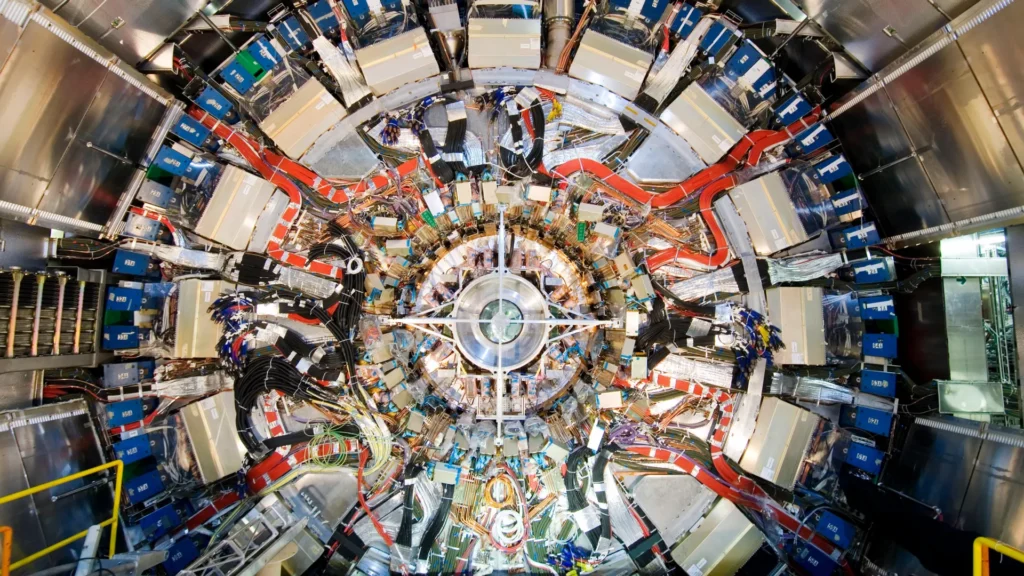
The ATLAS collaboration’s breakthrough involved analyzing the decay products of these Z boson pairs. When a Z boson decays, it typically produces a pair of leptons, such as electrons or muons. By using the ATLAS detector—a massive instrument the size of a five-story building—researchers were able to precisely measure the trajectories and angles of these leptons. By working backward from the decay products, the team reconstructed the spin states of the original Z bosons to determine if they were entangled.
A Chronology of Quantum Milestones
The observation of entanglement in Z bosons is the latest chapter in a long history of quantum research that dates back to the early 20th century. To understand the significance of the Oxford-CERN achievement, one must look at the timeline of how physicists have grappled with the nature of reality:
- 1935 – The EPR Paradox: Albert Einstein, Boris Podolsky, and Nathan Rosen published a paper questioning the completeness of quantum mechanics, arguing that "hidden variables" must exist because "spooky action at a distance" seemed to violate the principle of locality.
- 1964 – Bell’s Theorem: Physicist John Stewart Bell proposed a mathematical way to test whether the universe truly follows quantum mechanics or if Einstein’s hidden variables were correct. His "Bell inequalities" became the benchmark for testing entanglement.
- 1980s – First Experimental Proofs: Experiments by Alain Aspect and others using low-energy photons provided the first clear evidence that Bell’s inequalities were violated, confirming that entanglement was a real feature of the universe.
- 2012 – Discovery of the Higgs Boson: Scientists at CERN confirmed the existence of the Higgs boson, completing the Standard Model and providing a new "laboratory" for studying fundamental forces.
- 2023 – Top Quark Entanglement: The ATLAS and CMS collaborations at CERN reported the first observation of entanglement between top quarks, the heaviest known elementary particles. This proved that entanglement could exist in the quark sector at high energies.
- 2024 – Z Boson Entanglement: The current study confirms entanglement in the boson sector at high energies, specifically using the Higgs-to-Z-Z decay chain, offering a new level of precision and theoretical insight.
Technical Methodology and Supporting Data
The challenge of detecting entanglement in Z bosons lies in the "noise" of high-energy collisions. The LHC produces billions of collisions per second, and researchers must filter through this data to find the rare instances of Higgs boson production and subsequent decay.
For this study, the ATLAS collaboration utilized data collected during the LHC’s "Run 2," which took place between 2015 and 2018. The researchers focused on the "four-lepton" decay channel, where the two Z bosons decay into either four electrons, four muons, or two of each. This channel is known as the "gold channel" because it is exceptionally clean and allows for the most precise measurement of the Z bosons’ properties.
The researchers measured a specific observable known as the "spin correlation," which quantifies how the spins of the two Z bosons relate to one another. According to the laws of quantum mechanics, if the Z bosons are entangled, their spins will show a degree of correlation that exceeds what is possible in classical physics. The statistical significance of the results was high, providing "strong evidence" that the Z boson pairs were indeed entangled from the moment of their creation in the Higgs decay.
Oxford’s Leading Role and Interdisciplinary Impact
The University of Oxford has been a cornerstone of this research. Professor Alan Barr, a co-author of the study and a member of Oxford’s Department of Physics, was a pioneer in proposing that the LHC could be used as a tool for quantum information science. Having been involved in the construction of the LHC, Barr recognized that the collider’s utility extended far beyond the traditional search for new particles or dark matter.
"We’re used to thinking of entanglement as something delicate, seen in laboratory experiments with single photons," Professor Barr remarked. "Finding it alive and well among particles as heavy and short-lived as Z bosons, created in some of the most violent collisions we can produce on Earth, shows just how fundamental and robust this quantum effect really is."
The research is not limited to the realm of physics; it also touches upon deep philosophical questions regarding the nature of the universe. Professor Chris Timpson, from Oxford’s Faculty of Philosophy, co-leads an interdisciplinary project with Professor Barr that examines the foundational implications of these experiments.
"Entanglement is both the most promising and the most puzzling aspect of quantum reality," Professor Timpson stated. "These collider experiments detecting entanglement present a new frontier in investigations of the foundations of quantum mechanics."
Broader Implications for Quantum Computing and Future Physics
The confirmation that entanglement is a robust feature of high-energy environments has significant implications for both theoretical physics and emerging technologies. In the world of quantum computing, entanglement is the "engine" that allows qubits to process information in ways that classical bits cannot. By proving that entanglement can survive the "violence" of the LHC, scientists are gaining a better understanding of the limits—or lack thereof—of quantum coherence.
Furthermore, this research opens a new window into the search for "New Physics." The Standard Model, while incredibly successful, does not explain everything in the universe, such as gravity or dark matter. By applying quantum information techniques to LHC data, physicists can look for subtle deviations in entanglement patterns. If the measured entanglement were to differ from the predictions of the Standard Model, it could provide the first evidence of new, undiscovered particles or forces.
Professor Daniela Bortoletto, the UK coordinator for the ATLAS detector’s pixel system upgrade at Oxford, highlighted the scientific power of the collaboration. "Oxford researchers have played a leading role in developing these new approaches to studying quantum phenomena at the highest energies," she said. "We are proud to contribute to an international effort that is opening new ways to explore the fundamental laws of nature."
Looking Ahead: The High-Luminosity LHC
As CERN prepares for the future, the study of quantum entanglement at high energies is expected to accelerate. The Large Hadron Collider is currently undergoing an upgrade to become the High-Luminosity LHC (HL-LHC). This upgrade will significantly increase the number of collisions, providing researchers with a data set ten times larger than what is currently available.
With this vast influx of data, the ATLAS collaboration will be able to perform even more sophisticated tests of quantum mechanics. Scientists hope to conduct "Bell-like" tests on Z bosons and top quarks with unprecedented precision. The upgraded detector systems, which Oxford scientists are currently helping to build, will allow for more accurate tracking of particles, further reducing the uncertainties in these delicate quantum measurements.
The success of the Z boson entanglement study proves that the LHC is not just a tool for smashing atoms, but a sophisticated laboratory for testing the very fabric of reality. As particle physics and quantum information science continue to converge, the discoveries made at the heart of the LHC will likely reshape our understanding of the universe for generations to come.